An atlas of different universes

Science & Philosophy

Where our knowledge ends, where a model of our own choosing begins, and where imagination takes over.

How we label claims

Established science
Published results, with a source. They describe our cosmos or proven mathematics.
Our calculation
Numbers from the author’s computer models, compared with published work.
Speculative model
Rules we choose ourselves, and small calculations that hold for small examples.
Imagined beings
Inhabitants, their senses and cultures. They belong to imagination and remain a hypothesis.
Author’s reflection
Personal thoughts and parallels with our own world.

What we know today

Established science

The laws of nature contain constants whose values we measure. Theory does not yet derive them from a deeper principle. Physicists have long noted that a world with noticeably different values would be a very different place, a feature known as fine-tuning. The Stanford Encyclopedia of Philosophy sets out both the physical findings and the disputes over their interpretation [Friederich].

How sharp is the tuning? In 2019 Fred Adams gathered two decades of calculations and concluded that stars, chemistry and long-lived structures survive across fairly wide ranges of many parameters, often spanning several orders of magnitude [Adams 2019]. Our cosmos is hospitable to life, and the space of hospitable possibilities is wider than the popular picture suggests.

Do other universes exist? Some estimates in string theory mention around 10500 possible vacuum states [Douglas 2003]. That is a count of solutions to one theory. No observation so far confirms any other universe, so the question stays open.

What remains open

Established science

Two words on this site call for particular care.

  • Life. Science has no generally accepted definition of life. Working definitions lean on the only example we know, the biochemistry of Earth [Benner 2010].
  • Consciousness. Several theories of consciousness are under serious study, and there is no consensus among them [Seth and Bayne 2022].

In our worlds, life and inner experience therefore remain assumptions. When we describe a pattern that sustains itself, remembers and responds to its surroundings, we have described an organization. Whether experience accompanies such an organization is something none of our models can show.

How we build a world

Speculative model

Each world starts from a single rule of our own choosing. The rule comes with a small calculation, simple enough for a reader to check with a pencil. The numbers in those calculations were chosen for clarity and hold for small examples. A complete, validated model of an entire universe lies far beyond this essay.

Then we ask what could endure in such a world. Three conditions from the introduction apply: finite sources, real channels for messages, and memory that stays readable. Every inhabitant of our worlds pays those three costs.

There is also a more modest path, which keeps familiar physics and changes only the values of the constants. Such worlds can be tested by patient calculation, as in the work Adams reviewed. The third circle of the atlas, “The same laws, different numbers”, takes that path. Sections marked “Our calculation” give numbers from the author’s computer models, together with the places where a model is crude.

The philosophical question

Author’s reflection

Why spend time on worlds we will probably never see? We think the value lies in changing the question. When we first look at what a reality permits, we notice more easily what we take for granted in our own: that a message arrives, that the other person endures, that a memory stays readable.

In the essay The Universe That Fits Us, the author of this project also sets out a wider, metaphysical view: cosmos and observer are complementary aspects of one process. That view belongs to philosophy and personal conviction. The essay itself stresses that it offers no numerical explanation of the constants and leaves the existence of other worlds unproven.

Scientific footing, world by world

Added by the site’s editors. The sources below support the starting idea, while life in this world remains a thought experiment.

Different laws

The Scaleless World

Speculative model

The same relation between parts and whole repeats at every fourfold magnification, across a finite series of levels.

Established science

Discrete scale invariance is a studied symmetry. A system that has it looks the same only under magnification by a specific factor, and its signature is log-periodic oscillation. It has been described in hierarchical lattices, fractal growth and rupture processes. Observations of our cosmos show no such construction across all scales.

Tetrion

Speculative model

A body’s position takes four spatial coordinates, while time runs separately, as it does for us.

Established science

Four-dimensional geometry is rigorous mathematics, and the regular simplex with five vertices and ten edges is one of its familiar objects. The physics is stricter. If gravity and electrostatics followed the same law in four spatial dimensions as they do here, force would fall with the cube of distance, leaving planetary orbits and atoms unstable. Tetrion therefore receives binding rules of its own, with a minimum separation and a limited range.

Foam

Speculative model

A single field has four stable phases. Each cell of the foam is a region of one phase, and the boundaries between them carry excitations bound to the surface.

Established science

Walls between regions of different field phases are familiar in field theory, and in 1983 Rubakov and Shaposhnikov showed that particles can remain bound to such a wall. The slow rearrangement of cells has been measured in ordinary soap foam. A lasting cosmic network of membranes with life on them belongs to imagination, and the chapter’s question about dark matter remains the author’s speculation. The figure of about 95% refers to dark matter and dark energy in the standard cosmological model.

Counterflow

Speculative model

There is a single history of the world, satisfying conditions set at both of its temporal ends. Two oppositely directed streams run within it.

Established science

The basic laws of motion are almost symmetric in time, and physicists most often link the arrow of time to the ordered initial state of the cosmos. In 1999 Schulman showed in models that regions with opposite thermodynamic arrows can coexist while their interaction is weak. Observations have found no such region. The rule of the cheapest history and the strain account are our own choices.

Transmutation

Speculative model

Every region carries a local state x and a regime register r. A fixed meta-law specifies when regimes change and requires boundaries to advance at a limited speed.

Established science

Whether constants vary across space and time is a question tested by measurement. A 2011 analysis of light from distant quasars pointed to a slight spatial variation in the fine-structure constant; later measurements have not confirmed it, and laboratory and astronomical limits remain very tight. A world where entire regimes of law succeed one another under a meta-law is our construction.

Other universes

The Braid

Speculative model

Nearness is determined by the links between nodes. Changing the links changes the available path.

Established science

Models in which space and nearness emerge from a network of relations are studied in quantum gravity; one example is the “quantum graphity” of Konopka, Markopoulou and Severini. They are theoretical proposals without experimental confirmation. Living weaves and their economy of ports belong to our construction.

Cordia

Speculative model

Matter consists of elastic strands that can intertwine and tie into knots.

Established science

Stable knotted solutions exist in particular field models; Jäykkä and Palmu found them in a modified Ginzburg–Landau model. From such a solution to matter made of strands, and to a body that remembers, leads a series of assumptions that we introduce ourselves.

The Deep

Speculative model

All places belong to a branching, tree-like hierarchy.

Established science

A distance given by the length of a shared address prefix is an ultrametric, a rigorously defined mathematical structure. In physics it appears in the description of spin glasses and hierarchical systems. Observations give no sign that our space has such a geometry.

The Sliding Dimension

Speculative model

The number of directions in which movement stays available changes with the local state of the medium.

Established science

In some approaches to quantum gravity the spectral dimension depends on scale: in the calculations of Ambjørn, Jurkiewicz and Loll it falls at very small distances. That is a property of theoretical models at microscopic scales. Macroscopic regions with a different number of available directions are something we add as a law of the fiction.

Vortex

Speculative model

A body is a maintained arrangement of vortices in a two-dimensional fluid.

Established science

In two-dimensional flows energy moves towards larger scales, so vortices merge into long-lived structures; this has been measured in experiments and simulations. Small disturbances in a compressible fluid are carried at the speed of sound. A vortex that remembers and leaves offspring remains our hypothesis.

Chord

Speculative model

The foundation consists of excitations and the mutual relations of oscillations.

Established science

Coupled oscillators spontaneously align their rhythms; the Kuramoto model and its variants describe this in chemical, biological and engineered systems. Synchronization is an established phenomenon. A world in which oscillations are the basic fabric, with no space in the background, is our choice.

Morphia

Speculative model

The fabric of the world consists of local reactions and the exchange of ingredients.

Established science

In 1994 Lee and colleagues observed spots that grow and divide in a laboratory reaction–diffusion system. That shows simple chemistry can build and multiply patterns unaided. Heritable memory in such patterns was not shown in the experiment; we introduce it as a constructional hypothesis.

Two Times

Speculative model

An event has two time coordinates. A local alignment steers the permitted development.

Established science

Tegmark showed that in worlds with more than one time dimension the equations of physics lose predictability, so an observer there cannot reliably compute the future. Bars develops two-time physics with additional symmetries that remove the problem. Our wedge of permitted steps and the alignment field are chosen rules of the story.

The Ring

Speculative model

After a set period the complete state of the world returns, with every record.

Established science

In 1973 Bennett showed that any computation can be carried out in reversible steps, with careful handling of intermediate results. That is a well-founded result of the theory of computation. A cosmos that returns exactly to its initial state is an additional global postulate, and we leave open how the returning half of the cycle would be experienced.

Manyfold

Speculative model

The complete physical fabric is a distribution among different possible configurations.

Established science

Everett's 1957 interpretation of quantum mechanics takes all branches of the wavefunction to exist. It is one of several interpretations of the same experimentally confirmed theory, and the choice among them remains open. Manyfold borrows only the picture of possibilities represented at once; its integer weights and transfer rules are our model.

The Archive

Speculative model

There are realized records and free places. A new event links to earlier records and spends a unique right to a particular continuation.

Established science

The idea that the world is at root a partially ordered set of events exists in physics: in 1987 Bombelli, Lee, Meyer and Sorkin proposed space-time as a causal set. It is a research programme in quantum gravity without experimental confirmation. The finite fund of free places and the unique right to a continuation are our rules.

The Interior

Speculative model

Elementary experience enters the initial postulate. One subject belongs to each largest whole of the active network in which a path leads from every unit to every other.

Established science

This is the only world of the atlas in which experience is an explicit postulate. The view that experience is a basic feature of reality is called panpsychism; it is a matter of philosophical debate and has no experimental confirmation. The strongly connected components of a directed network are a rigorously defined mathematical notion. Equating them with a single subject is a law of the fiction.

The same laws, different numbers

The Compact Cosmos

Speculative model

The dimensionless number that measures the strength of gravity is ten times larger. Atoms, chemistry and light stay the same.

Established science

In 2008 Adams showed that stable stars exist across a wide range of the strength of gravity and of the other constants. Laughlin, Bodenheimer and Adams calculated that the smallest stars of our cosmos last for trillions of years. The numbers for Ember and Pebble come from the author's models and depend on how they are tuned.

The Grip

Speculative model

The fine-structure constant is ten per cent larger. Particle masses and the strong nuclear force stay the same.

Established science

The position of the Hoyle resonance depends on the strength of the electromagnetic force, as Oberhummer and colleagues calculated. The stellar simulations of Schlattl and colleagues and of Huang, Adams and Grohs give different estimates of how much carbon then remains, so its amount in the Grip is uncertain. The scaling of atoms and bonds follows from quantum mechanics for light atoms.

The Beryllium Cosmos

Speculative model

Beryllium-8 is a bound nucleus, as a consequence of a small change in the strong force. We follow only that one consequence.

Established science

In 2017 Adams and Grohs showed that with stable beryllium-8 carbon would form without a triple collision and without the Hoyle resonance, and stars would shine stably. Carbon planets were considered by Kuchner and Seager. A scarcity of oxygen and water across such a cosmos is an assumption that nobody has yet calculated.

Cosmic Islands

Speculative model

The density of vacuum energy is thirty times greater. The early cosmos is the same as ours.

Established science

Barnes and colleagues showed with the EAGLE simulations that galaxies and stars form even with a considerably greater vacuum energy, because stars are born early. In 2007 Krauss and Scherrer described how observers in the far future of our own cosmos lose the evidence of expansion. The number of galaxies still visible in the story depends on the assumed density of galaxies.

The Quiet Cosmos

Speculative model

The weak nuclear force is switched off, with coordinated changes to the initial ratio of neutrons to protons and to the number of particles per photon.

Established science

In 2006 Harnik, Kribs and Perez described a cosmos without the weak force that stays similar to ours, given coordinated changes to two more parameters. In 2018 Grohs, Howe and Adams calculated its nucleosynthesis and its stars with stable neutrons. Weak radioactivity and short geological activity are the author's estimates, with no claim that radioactivity is entirely absent.

The essay’s introduction · Author’s text, Nebo D. Lukovich

How different could reality be

When we look at the night sky, we usually imagine places far away. We wonder what planets orbit other stars, and whether someone on one of them is looking at their own sky right now. That thought is strange enough. Yet we can go further. We can ask what a world might look like if nature itself followed different rules.

Physicists often point out how remarkably well the constants of our cosmos suit stars, planets and life. With slightly different values, much of what we know would struggle to arise. I wrote about this fine-tuning and what it might mean in The Universe That Fits Us. If other universes exist, there are probably a great many of them. Some estimates in string theory suggest around 10500 possible vacuum states. Whether any of them is physically realized anywhere remains an open question. Our intuition seems to suggest something similar: such worlds would be numerous and profoundly different from one another. Most might be sterile. Even the handful left over, however, would be enough to stir our curiosity.

Can we imagine them at all? Our minds know only one world, and that world has shaped them. So we will give our imagination free rein, while asking it to meet some strict conditions.

In this essay I propose five thought experiments. We will give each world one clear physical rule, then follow its consequences far enough to meet one inhabitant and spend a day in their life. Along the way, we will keep track of the price each universe charges for existence. Every source has a finite reserve. Every message travels through a real channel and takes time. Every memory must be recorded somewhere, and its record must remain readable.

Let us make one qualification now, and only once. We choose the rules of these worlds ourselves, and the small calculations that accompany them apply to small examples. Everything we say about the inhabitants’ lives, senses and inner experience comes from our imagination and remains hypothetical. The names we give them let us stay with one being long enough for its difficulties to become tangible. From here on, we can tell our stories freely.

One question will follow us throughout. However hard we try to imagine something completely different, we will recognize a few patterns from our own world in every world we visit. Is that a limit of our minds, or do some patterns belong to every possible reality? We will return to this question at the end.

Five worlds lie ahead. First comes the Scaleless World, where every being carries entire communities within it. Then comes Tetrion, whose space has one more direction than ours. In Foam, life unfolds on the walls between voids. Counterflow is a world where two peoples remember the same history in opposite directions. Finally, we reach Transmutation, where the very laws of nature change.

The essay’s conclusion · Author’s text, Nebo D. Lukovich

What we take away from five worlds

Author’s reflection

Let us return to an ordinary encounter. Someone speaks to us; we listen and answer. That brief exchange depends on many conditions we rarely notice. First, there must be a channel reliable enough to carry the message. Second, both of us must last long enough to finish the conversation. And third, we must have some way of retaining a trace of what was said.

The five worlds took those conditions apart. Sela showed us that understanding requires knowing another being’s rhythm. Ilan discovered how difficult it is to know that a home is truly enclosed when space has a direction we cannot see. Savaj reminded us that a memory lives on a surface that can change. Ner paid the price of excessive precision with someone who remembers time in reverse order. Oru, moreover, had to translate himself, spending his last reserve on his own past.

After each of them, the same question remains: under what condition do we call a continuation the same life?

A Layerling is a community and, at the same time, part of a larger community.

A Tetran is a whole that nobody outside can see all at once.

A Foldling moves its own past from place to place.

A Conditionite is a sequence that one intense encounter can rearrange.

A Translator, finally, is a relationship that persists through a change in the very fabric of its body.

I think these examples help us see more clearly how much we assume when we say “I.”1

Can we imagine something truly different?

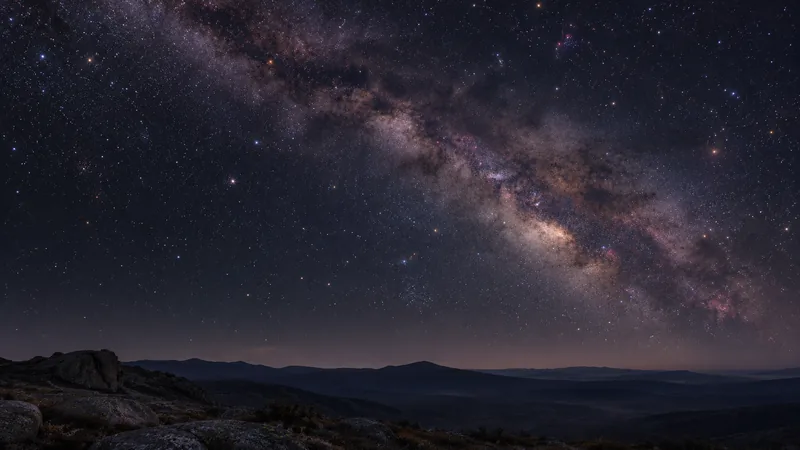
A view of the night sky returns us to the limits of imagination. The familiar cosmos remains the starting point for this comparison.

In each of these worlds, although we tried to make it completely different from our own, we spontaneously found some shared trait. The Scaleless World reminded us of fractals and the hierarchies of our society. Foam led us to think about dark matter and higher layers of reality. In Counterflow we recognized old questions about living wisely. Transmutation brought us back to the changes that force us to grow. It seems we can find parallels everywhere.

Is this simply because our minds are too limited to conceive of something truly different? If we did conceive of something wholly unlike anything we know, could we imagine it at all, or, worse still, describe it?

Just think of the diversity in our own cosmos: so many different galaxies, stars and planets, to say nothing of the countless, utterly different beings that probably exist throughout it. All of this rests on physical laws that are the same here and ten billion light-years away. How much greater a diversity of structures, civilizations, individual beings and inner experiences might we expect on an imagined journey through entirely different universes?

It seems to me that the similarities we keep finding tell us something about both possibilities. Our minds certainly have their limits. Yet some patterns probably belong to every reality in which something endures, remembers and encounters another: finite sources, routes for messages, the cost of memory.

Indeed, the value of these thought experiments lies in changing the question itself. We can begin by looking at what a particular reality permits, then ask who might be able to endure there. That lets us move beyond our habit of looking for something human wherever we go.

Let us look at the night sky again. We have tried to broaden our idea of who might be looking at it and, in some cases, what looking itself might mean. Perhaps afterward we will listen even to a familiar companion with much more patience. We can ask what their response depends on, and what something that seems easy to us costs them.

Napomene · Notes

  1. The question of where experience belongs, to the whole or to its parts, is familiar to our own psychology as well. I have written about personality as a system of parts that cooperate or come into conflict on the page Parts of Personality. ↩

This chapter is part of the essay “Five Different Universes”, published on 15 November 2026. The full essay on the Reintegration System blog.

Author’s text, Nebo D. Lukovich

The essay “Five Universes That Could Have Existed”

Introduction: The same laws, different numbers

In the essay Five Different Universes we gave imagination free rein. We pictured worlds with four spatial dimensions, with time flowing in two directions, and with laws that change from region to region. This time we take a more modest path. We keep the physics we know: the same quantum theory, the same gravity, the same particles. We change only a few numbers.

The laws of nature contain constants whose values nobody knows how to derive. We measure them and enter them in tables. How strong is gravity compared with the other forces? How strongly do an electron and a proton attract each other? How much energy does empty space carry? To these questions theory answers with silence, and experiment with a number.

Physicists have long noted that a world with slightly different numbers would be a very different place. I wrote about that fine-tuning in the essay The Universe That Fits Us. The claim that “even the smallest change would destroy everything”, however, can now be tested by patient calculation. Fred Adams and his colleagues have been doing exactly that for two decades, and their conclusion is more moderate than the popular one. Stars, for example, survive across a very wide range of constants. Some other processes are sensitive indeed.

So this time we went a step further. For each of the five worlds we wrote a computer model and actually ran it. We compared the results with published scientific papers, and where our model is crude, we will say so. All the programs, data and checks are in the research appendix, so anyone can repeat the calculation.

I would ask the reader to keep three kinds of claim apart while reading. The first are numbers we calculated or took from the technical literature. The second are estimates: what those numbers probably mean for rock, water and air. The third is the story. We invented the inhabitants, their names and their worries, under one constraint: no scene may contradict the calculation. The existence of stable stars and atoms is only a necessary beginning. From there to life the road is long, and we do not fully understand it even in our own world.

One more remark. A change makes sense only if we alter a number without units. If we said that “the speed of light is twice as great”, we would in fact have said nothing, because the metre and the second would change with it. In each chapter we therefore change a ratio: the strength of one force relative to another, or one density relative to another.

It also matters how many numbers we change at once. In three worlds we change one number and hold everything else fixed. The Beryllium Cosmos is a special case, because stable beryllium is a consequence of a small change in the strong force, and we follow only that one consequence. The Quiet Cosmos, finally, requires a coordinated change of several quantities. In each chapter we therefore state separately what has been changed and what has been kept.

Five worlds lie ahead. In the Compact Cosmos gravity is ten times stronger. In the Grip the electromagnetic force is ten per cent stronger. The Beryllium Cosmos has one more stable atomic nucleus. In the Cosmic Islands empty space carries thirty times more energy. The Quiet Cosmos, finally, exists without the weak nuclear force.

Comparison and conclusion: Five worlds, side by side

Our calculation Author’s reflection

Let us now look at what we changed and what we obtained. The table contains only findings that follow from the calculations or from the cited literature.

UniverseWhat was changedMain calculated findingWeakest link
The Compact Cosmosgravity 10 times strongerstars 32 times lighter; the Sun's twin shines for about 1 billion years, small convective stars for hundreds of billionssmall worlds quickly lose internal heat and hydrogen
The Gripα larger by 10 per centatoms 9 per cent smaller, bonds 21 per cent stronger; water liquid from 57 to 163 °C; Hoyle resonance higher by about 325 to 400 keV (estimate)amount of carbon uncertain, probably less than ours
The Beryllium Cosmosberyllium-8 stable (a consequence of a small change in the strong force)carbon forms in two ordinary steps; 98.5 to 99.9 per cent carbon in the stellar corethe amount of oxygen and water in the cosmos has not been calculated
Cosmic Islandsvacuum energy 30 times greatergalaxies form; growth of structure stops at 45 per cent; in the 30th billion years a few large and about a hundred dwarf galaxies are visibleloss of evidence about the cosmos
The Quiet Cosmosno weak force, with accompanying changesthe stars' fuel is deuterium; composition agrees with the literature to better than one part in a thousandlittle oxygen and nitrogen; radioactivity probably weak; short geological activity

A few things stand out. All five worlds passed the first test. In each there are stable atoms and stars that shine for billions of years. That is indeed in line with Adams’s extensive reviews: stars are resilient to changes in the constants.

Every world pays some price, however, and it almost always appears in an unexpected place. Stronger gravity hits the lifetime of bright stars hardest. A stronger electromagnetic force barely touches atoms, and calls carbon into question. Stable beryllium eases the path to carbon and may endanger oxygen. The small, dense worlds of the Compact Cosmos die out quickly from within. It seems to me that this is the real content of the phrase “fine-tuning”. Hardly any constant acts on one thing alone. Each pulls on a whole web of consequences, and it is hard to guess in advance which thread will give way first.

The caveat needs repeating too. We have shown that the necessary physical conditions exist in these worlds, and in several cases that they are seriously impaired or uncertain. About the probability of life arising, our models say nothing.

Is our world special

Let us return to the question from the beginning. How far can the numbers of our cosmos change while it still contains someone to ask questions?

Five examples give no final answer, but they give a feeling. The range is wider than is often claimed. Gravity can be ten times stronger. The energy of empty space can be thirty times greater. An entire force can be absent, if two more things are adjusted. On the other hand, a change of only ten per cent in the electromagnetic force brings carbon close to the edge, and the exact position of that edge is still a subject of research. Our world therefore lies on a broad plateau with a few steep edges. The image of a needle on whose point everything stands seems too narrow to me.

It is also interesting that our cosmos probably does not offer the best possible conditions. In the Beryllium Cosmos carbon forms more easily than here. The inhabitants of each of these worlds could, from their own standpoint, write their own article about fine-tuning. The Groundlings would marvel at the fortunate size of their planet. The Waterkeepers would celebrate what little oxygen there is. The Lumans would not even know they had something to marvel at.

Everyone finds their own numbers natural

Here we come to a deeper question. Every observer finds the constants of their world as a given. For Isel water boils at a hundred of his degrees, because his thermometers, his body and the water he measures are made by the same, stronger force. The chemistry of the Grip, expressed in its own measures, is identical to ours. The change we see from outside is invisible from within. It shows only in the stars, where one force is weighed against another. It seems to me that an important lesson lies there. What we call natural is often what we ourselves are tuned to.

Conditions shape perception itself. The Groundlings see two and a half kilometres and think in nearnesses. The Lumans see one island of light and conclude that it is the whole cosmos. The Quietfolk remember only what they have counted themselves. All three pictures of the world come from the same laws, and each is framed by a different sky and a different ground. I think the same holds for us. Our picture of reality arises through senses, instruments and the epoch we live in, so it too is one window among possible windows.

On the pages of the Reintegration System we have written about the idea that the world we perceive is a projection of a deeper order, in the text The Holographic Nature of Reality. Our calculations neither prove nor refute that idea. Still, they show something related. The same basic laws, with different numbers, give worlds that their inhabitants would experience as complete and as the only ones possible. The difference between reality and the experience of it thus becomes a question worth asking from each of the five worlds. The answer stays open, and it seems honest to me to leave it so.

Do those other worlds exist somewhere? We do not know. Our calculations show what physics would permit. On whether nature has made use of that permission anywhere they say nothing, and no estimate of the probability of a multiverse follows from them. I think it is honest to leave it at that.

There remain a few questions that arose of their own accord during the work.

  • How many constants can be changed at once, and do their harms then add up or cancel out?

  • Is there a chemistry of life that uses carbon or water far more sparingly than ours?

  • What would the inhabitants of some more fortunate cosmos regard as the greatest shortcoming of ours?

  • How much about our own world do we still take as necessary, when it is in fact only one of the outcomes?

Five imagined inhabitants also left us something more personal. Garun lowered the beam and widened the foundation. Isel saved what was scarcest. Tavi broke the seal and wrote her name. Meda left accurate measurements. Nohu drew a line where his knowledge ends. Each of them lives with a limitation they did not choose, and each found within it a way to do the right thing.

Perhaps that is what conscious beings have in common in every possible world. The numbers of the cosmos set the stage. What we do on it remains up to us.
This chapter is part of the essay “Five Universes That Could Have Existed” (2026). The charts and diagrams come from the author’s calculations. The English translation was prepared by the site’s editors.

Sources

Cited in the essay “Five Different Universes”

Cited in the unpublished manuscript “Fifteen Other Universes”

Cited in the essay “Five Universes That Could Have Existed” (a selection)

Further reading (selected by the site’s editors)