
World 4 of 22 · Different laws
Counterflow
Two peoples remember the same history in opposite directions.
- Time
- Communication and delay
- Memory
- Identity
Text: Nebo D. Lukovich ·
Imagined beings
Ner entered the channel and immediately felt a dull, steady pressure, like the sensation of diving deeper than we intended. That is roughly how his body feels the proximity of the opposite flow. His partner waited at the other end. The partner’s identifying signal arrived first. In it, Ner read something that baffled him every time. His partner already carried a trace of the end of their encounter. For him, their parting was a memory, while their greeting was still to come.
Ner sent him a question, together with the range of answers he could receive. The first pattern to return was narrow and precise. The pressure rose sharply. Ner realized too late how difficult so much strain would be for his memory system to bear. One of his records shifted. He knew it contained two events. Yet he could no longer tell which had come first.
He broke off the exchange and waited for the pressure to subside. Then he proposed a different, broader agreement. It allowed more outcomes that fitted both accounts, so it required less force. The question went through. The answer arrived gently, with almost no resistance. Ner stored it together with a note about the route it had taken. They said their goodbyes, each in his own way.
On his way out, he settled the account. Of the six units of work he had set aside for the encounter, two remained. He took the shifted record with him just as it was.
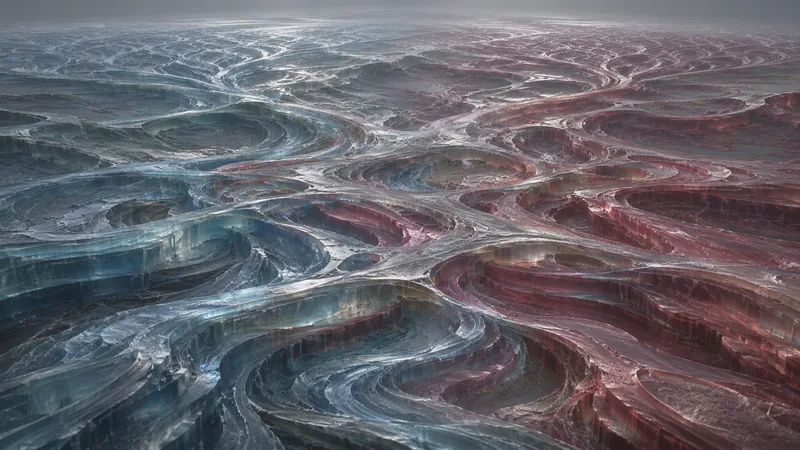
One history, two memories
Speculative model
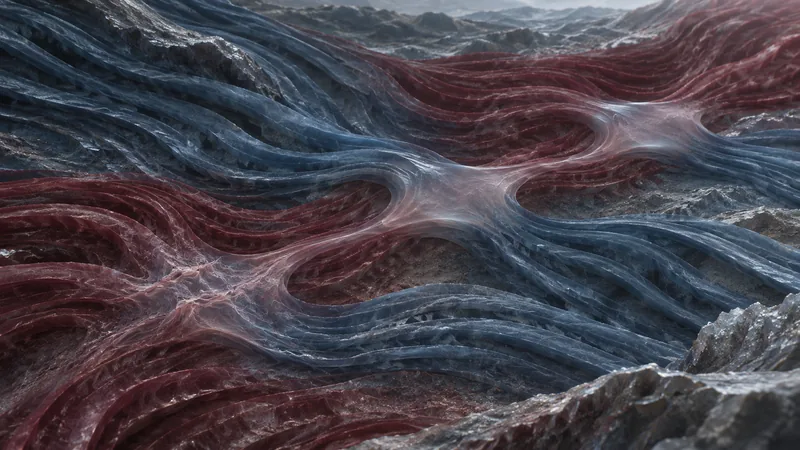
Let us consider what happened here. In the universe we have called Counterflow, there is a single history of the world. It must satisfy conditions specified at both of its temporal ends. Within it run two oppositely directed flows. Each inhabitant remembers in their own direction, so what one calls the past still lies ahead for the other.
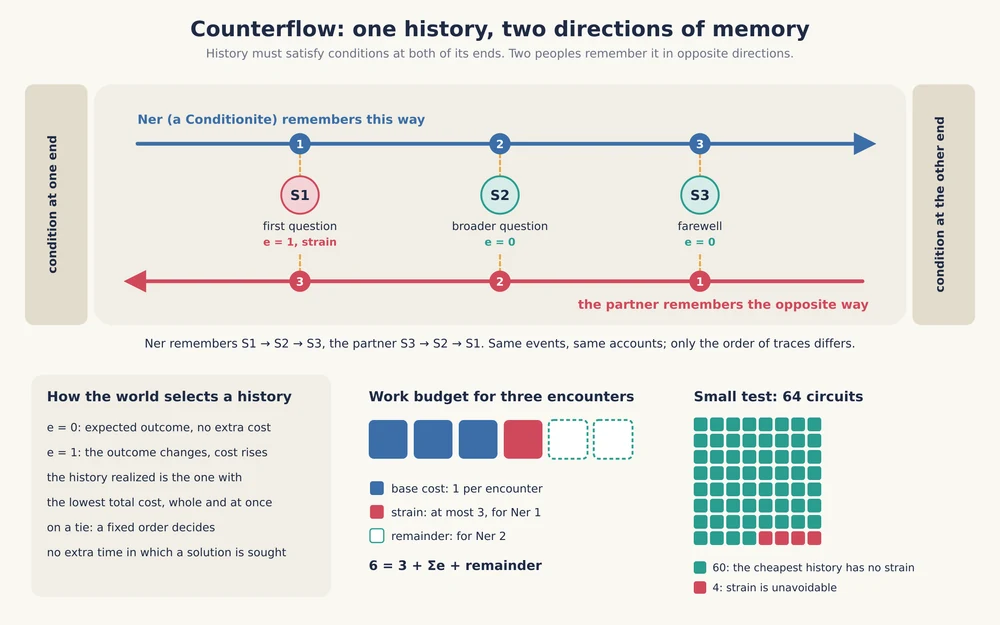
As long as the two flows remain apart, each lives peacefully in its own temporal sequence of events. The difficulty often arises when they meet. An exchange between two beings must fit the memories of both parties at once. In our small model, we represent the cost of disagreement as physical strain, the very pressure Ner felt.
The model works like this. Each encounter has an expected outcome and a strain indicator, which we call e. When an encounter goes smoothly, e is zero. When extra adjustment is needed, e is one, the outcome changes and the “bill” rises. The law of this world then selects, from all possible histories, the one with the lowest total “cost.” If two are equally “expensive,” a predetermined ordering decides between them. There is no additional time in which history tries out solutions. Only the cheapest history is realized, whole and all at once.
These creatures set aside the work in advance. For three encounters, for example, they prepare six units: the base expenditure is three, and strain can consume at most another three. Ner’s account now becomes clear. He had three exchanges: the first question, the repeated question and the parting. He paid three units for the exchanges themselves and one for the strain of the first.
Every case in one small family of these circuits has been counted. Of sixty-four, sixty have a cheapest history with no strain at all. In the remaining four, strain is unavoidable. An encounter between opposite flows can therefore usually pass peacefully. Sometimes, though, the world simply has no painless outcome to offer.
It is interesting to imagine the same encounter from the other side. The partner experienced the parting first. Then he received a gentle, open question and answered it. Only afterward came the moment of sharp pressure, and finally Ner’s arrival. Both descriptions concern the same events, and both accounts balance. Only the order of the traces in the two memories differs.
Junction and its inhabitants
Imagined beings Author’s reflection
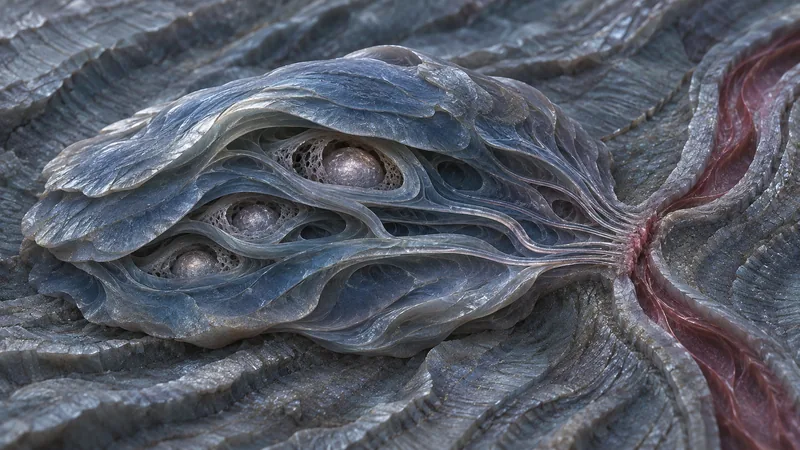
We call the largest whole the Double Delta. Let us say it is a distant counterpart of a galaxy. Many channels run through it, and individual channels belong to different directions of time. We call the sources of work Conditioners. Their order is specified at the boundaries of history, at both ends.
Ner lives in a region called Junction. Local life there is reliable, and contact with the opposite flow is confined to special zones. We call the people of this region Conditionites. Each Conditionite belongs to one flow and cares above all about preserving its sequence, because that sequence is its autobiography. Any stronger disturbance can scatter it. The being then ceases to live, even though its fabric remains. Its offspring therefore receives a separate working process and reserves aligned with its own direction. Much of the technology these beings have developed serves one purpose: keeping strain away from the systems that remember.
I think such a world would develop a very unusual form of trust. Let us put ourselves in one of these creatures’ places. A partner from the opposite flow possesses a trace whose origin lies in our future. To trust it, we must know the route by which it arrived. Every important claim would therefore be accompanied by the grounds for its reliability. Contracts would contain the same wisdom Ner learned the hard way: an overly precise plan demands great strain at the slightest change in circumstances, while a good agreement leaves room for several compatible outcomes.
Again, we can ask how much this strange world resembles ours. Time travel? Precognition? At least at their root, its existential questions sound familiar. How do we live and survive? How do we build the best relationships? How do we become wise? The natural laws in this universe are clearly very different from ours, yet some parallels with our existence remain.
Established science
Scientific footing
The basic laws of motion are almost symmetric in time, and physicists most often link the arrow of time to the ordered initial state of the cosmos. In 1999 Schulman showed in models that regions with opposite thermodynamic arrows can coexist while their interaction is weak. Observations have found no such region. The rule of the cheapest history and the strain account are our own choices.
Sources for this world
- L. S. Schulman (1999). Opposite Thermodynamic Arrows of Time. Physical Review Letters 83, 5419.
Added by the site’s editors. The sources below support the starting idea, while life in this world remains a thought experiment.
Gallery of this world
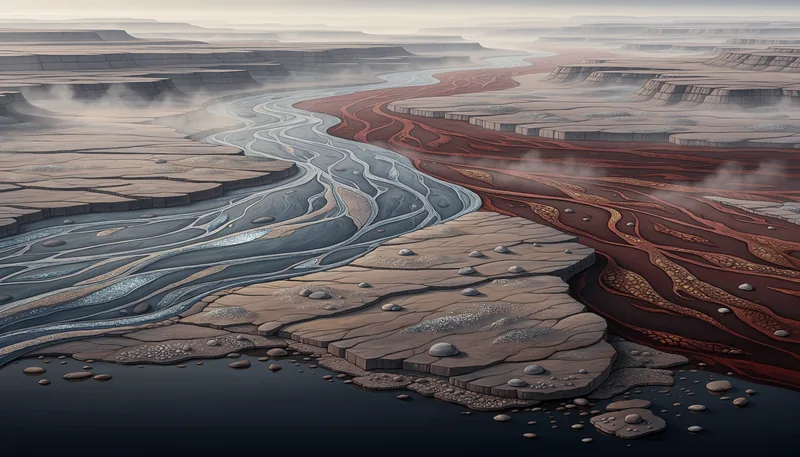
Illustrations are AI-assisted and serve as visual analogies. The rule diagrams are the author’s own. This chapter is part of the essay “Five Different Universes”, published on 15 November 2026. The full essay on the Reintegration System blog.