Planned
Genesis Lab
A laboratory where we will set the rules of a world, run the simulation and measure what emerges.
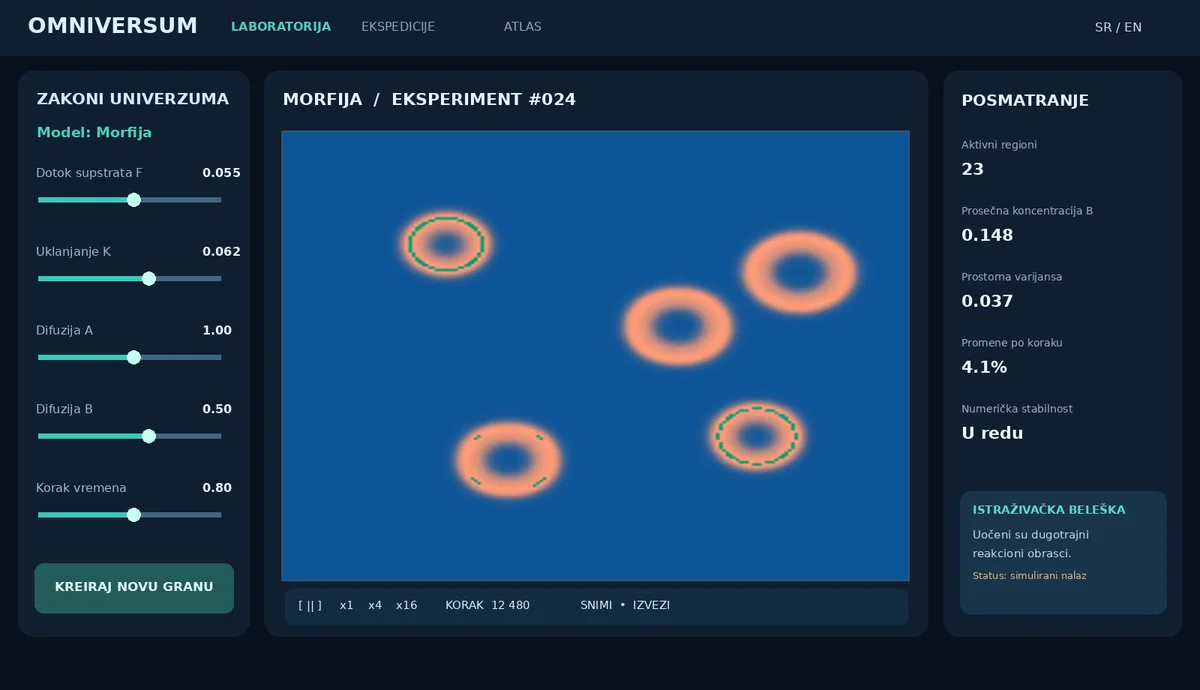
Where things stand
Genesis Lab exists as a functional specification. No program code has been written yet, and no release date has been set. This page describes the idea so that readers know where the atlas is heading.
One basic idea
The user sets a rule, sees its consequences and explores the limits of a world of their own. Sometimes simple rules will produce unexpectedly complex patterns. Sometimes structures will vanish or settle into a stable state. Every outcome is a useful experimental result.
The specification rests on five principles:
- Physics comes before story. Behaviour arises from the given equations and rules.
- Surprise is welcome. Discoveries come from the simulation and from analysing its results.
- Play gives purpose. Missions guide experimentation with clear goals.
- Truth is checkable. A simulated result, a derived metric and a speculative interpretation carry different labels.
- Every model has limits. Its assumptions and numerical constraints are open to the user.
The first two models
The first release envisages two models with real numerical dynamics.
- Celurion is a world of cellular automata. It shows the patterns that simple local rules allow on a grid.
- Morphia is a world of reaction and diffusion. It shows the spots, stripes and waves that form when two substances spread and react with each other.
Morphia is already in the atlas, among the worlds of the second circle. Celurion comes from the earlier manuscript on ten universes and has not yet been added to the atlas. The other worlds call for different simulations, so including them remains a question for later versions.
Three ways of working
- Laboratory is the free mode. We choose a world, adjust parameters and run the simulation. Changing a fundamental parameter opens a new branch, so two histories from the same moment can be compared.
- Expeditions are tasks with a checkable goal. A discovery counts only when an algorithm can compute the required property.
- Atlas stores experiments together with their initial seed and parameters, so that every result can be reproduced.
The limit of its claims
The laboratory will recognize measurable structures and events. Consciousness, the independent development of a civilization and subjective experience remain open questions. If they ever appear in later versions, they will carry a clear label as speculative depictions.