World 3 of 22 · Different laws
Foam
The cells are almost empty. All of life unfolds on the walls between them.
- Body as process
- Space and geometry
- Memory
- A changing ground
- Identity
Text: Nebo D. Lukovich ·
Speculative model
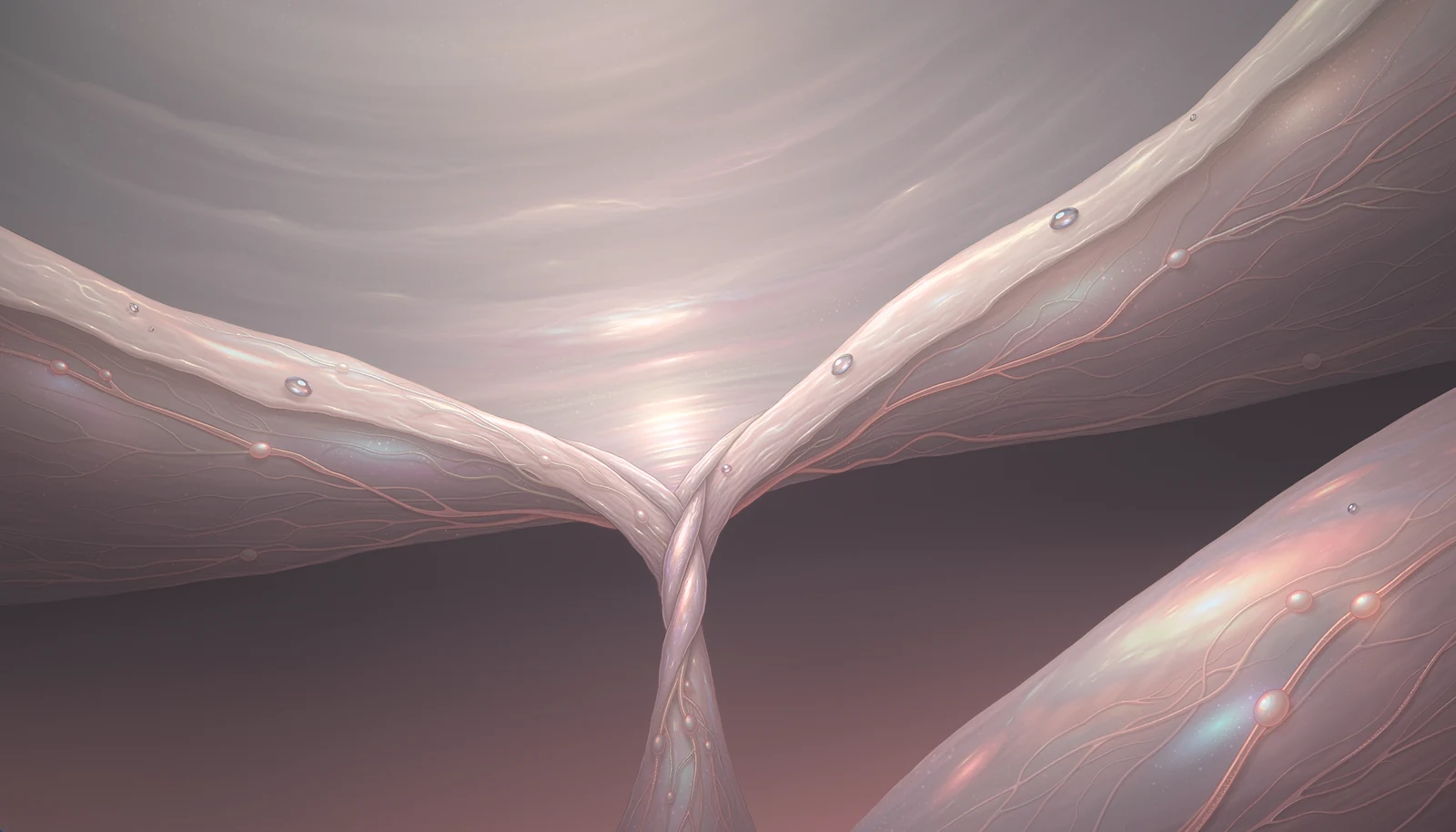
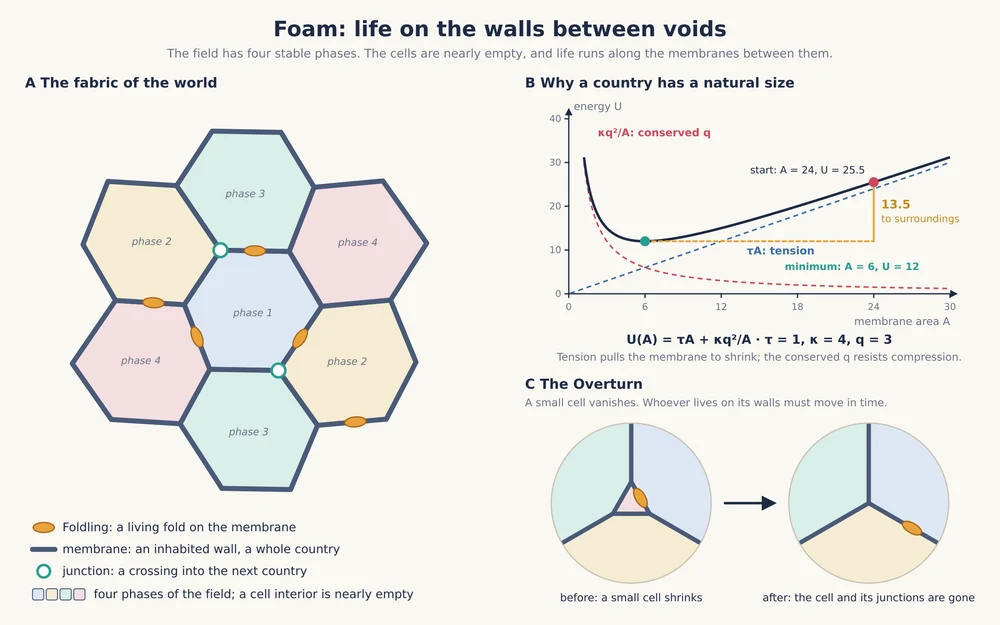
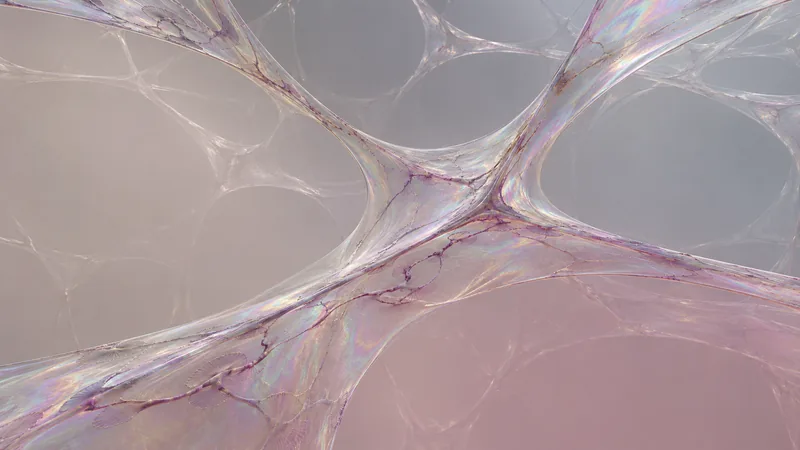
Imagine an immense foam, larger than anything we know. To its inhabitants, the cells are almost empty. All life unfolds on the walls between them. What we would see as a thin partition is, for them, an entire country, with roads and neighbors of its own. The way to the next country lies across a junction, where membranes meet.
Why does this universe have a foam-like structure? Let us imagine its physical basis this way. The field filling this world can occupy four different stable states, which we call phases. Each cell of the foam is a region of one phase. The boundary between two regions has energy of its own and can carry excitations bound to its surface. Real physics includes models in which particles remain bound to such a lower-dimensional wall. To this idea we add a long-lived network of membranes and processes that endure on them.
On the largest scale, then, home is one great cell with its walls. A whole connected region of membranes plays the role of a galaxy. A traveler cares only about surface routes and places where crossing a junction is allowed. The void on either side of a wall is, for that traveler, what the depths beneath Earth’s crust are for us.
What determines a membrane’s size
Speculative model
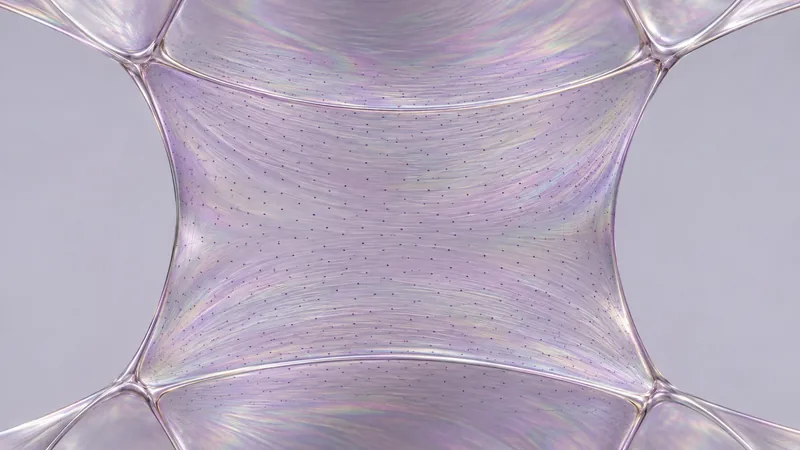
A membrane has tension, so it tends to contract, like a stretched skin. If that were all there was to it, every country would gradually disappear. We therefore distribute a conserved quantity over the membrane and denote it by q. It stays the same whatever happens, and compressing it into a small area comes at a high cost.
We write the energy of an isolated piece of membrane with area A as U(A) = τA + κq2/A. The first term increases with area. The second increases as the area shrinks. Somewhere between the two, there is a size at which these demands balance.
Let us look at the numbers. For τ = 1, κ = 4 and q = 3, the most favorable area is A = 6. A membrane starting with an area of 24 has an energy of 25.5. As it relaxes to an area of 6, its energy falls to 12, and the difference of 13.5 passes into the surroundings. The country has acquired a natural size. Yet that calculation applies to one quiet piece of membrane. The entire foam shifts slowly, and that is where its inhabitants’ troubles begin.
Foldlings
Imagined beings
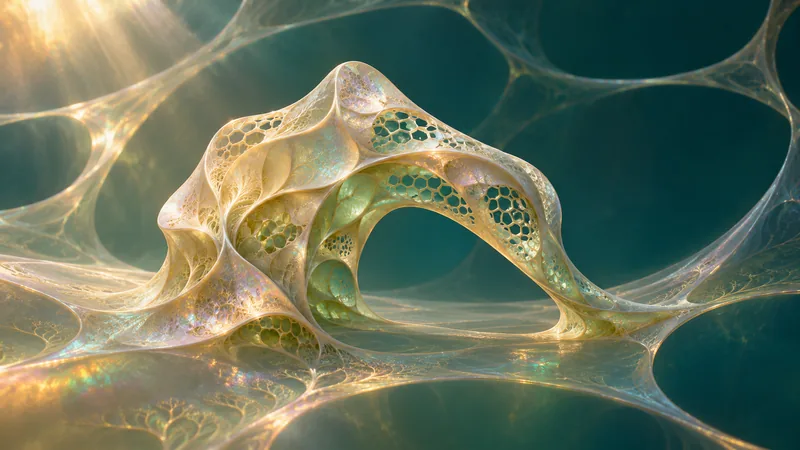
We call an inhabitant of Foam a Foldling. It is a living fold in a membrane, a self-maintaining pattern of surface excitations. When we speak of its relationship to the surface supporting it, we also call it a Membraner. Naturally, many different species of these creatures exist. Here we will describe only what the great majority have in common.
Every Foldling senses the world along its entire length. It feels a wave arriving across the membrane as a tremor, and a change in tension as a tightening or slackening of the ground beneath it.
It stores memories in lasting patterns on the surface. To recall something, it sends a weak probe toward a pattern and waits for the response to return to the active part of its body. A memory therefore has both an address and a route. A longer route naturally means a later recollection.
The inhabitants of Foam obtain the energy for life from focal sources, the counterparts of our stars. In this universe, these are strained folds and junctions that gradually release reserves stored long ago. When a source is exhausted, the surface remains in place, but life on it becomes difficult. An offspring receives some of the carriers of the conserved quantity q, while acquiring an arrangement of its own, a unique structure capable of sustaining itself. An individual dies when its renewal stops. Some of its patterns may remain on the membrane for someone else to read later.
The Overturn
Speculative model Imagined beings
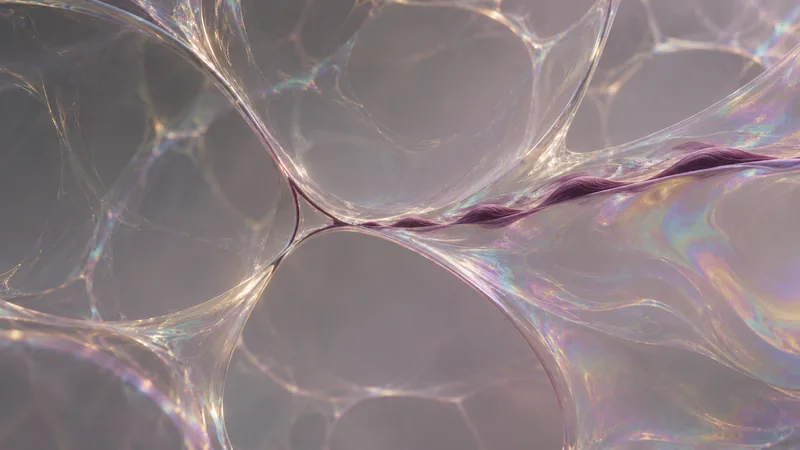
This world’s greatest fear has a name. Small cells in the foam gradually contract while their neighbors expand. At some point a junction, or an entire cell, ceases to exist. This is the Overturn. An old route to the neighbors disappears, while another junction creates a new proximity. Foldling history remembers Overturns as we would remember the disappearance of continents and other great natural catastrophes.
Their settlements therefore watch for early signs of rearrangement, adapt to them and prepare in time. Before an Overturn, a neighboring habitat must be made ready. Everything that can live must be transferred there, with enough carriers of q and enough available work.
We can also imagine a particular craft: the passage-keepers. They know the mechanics of membranes, and the habits of everyone who reads memories across a given seam. A smaller version of the same task faces anyone when a public seam is repaired. This once happened to a Foldling we will call Savaj.
On the public seam, Savaj recognized the signal announcing a repair. He felt it as a small, regular tapping in the membrane. One of his old memories lay on that very patch of surface. He chose a new spot, farther from the seam, and began transferring the pattern, fold by fold.
After each step he sent the same probe to both records. The old one answered quickly and clearly. The new one took longer, but repeated the same shape. Then a long, slow wave passed along the membrane from a contracting cell. The fresh pattern blurred. Savaj sent a probe and received a muddled response, with the beginning missing.
He started again. The tapping from the seam was growing more frequent. The workers waited patiently for his consent. The second transfer reached the end, but the first two folds remained uncertain, and there was no time for a third attempt. He sent his consent.
During the repair, the familiar patch of membrane changed its fold and the old pattern disappeared. Savaj then accessed the new one. The response traveled much longer than he was used to. The middle of the memory arrived, and so did its end. Where the beginning should have been, only a flat vibration returned. Savaj marked the new route in his own arrangement and sent another probe.
Contact between two Foldlings changes the surface they share, so an encounter begins with weak probes and a slow approach. Their art could take the form of a wave of carefully prepared folds, followed by several participants from different places. I think such a civilization would prize above all the skill of preserving a shared surface for many different lives.
How different are we, really?
Author’s reflection
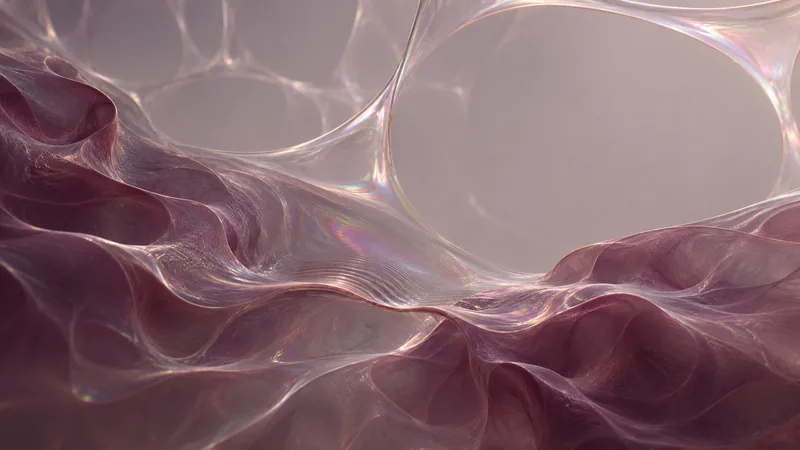
Clearly, Foam’s physical laws are very different from ours. The quantum physics familiar to us involves many fields and particles, including the Higgs boson, other bosons and fermions. In this universe at the edge of imagination, a single field would have four stable states, with laws, excitations and limits of its own. The “matter” and structures of such a world would certainly be incompatible with ours, putting them beyond detection by our instruments. We probably could not even observe that world physically, let alone interact with it in any meaningful or safe way.
Perhaps universes of this kind are interpenetrating our own at this very moment. Perhaps a drama between two Foldlings is unfolding close by, strangely reminiscent of our own relationships, while neither they nor we are aware of one another. Could so-called “dark matter” and “dark energy,” which together make up around 95% of the cosmos’s total matter and energy and are known to us largely through their gravitational effects, consist of some alien matter and energy with laws of their own? Could their structure be rich enough to give rise to conscious beings? Or could the “higher layers” of reality, described by some spiritual explorers as the astral, mental and spiritual worlds, actually be this unfamiliar “dark” matter and energy?
For now, we have no answers. The questions, however, are deeply intriguing.
Established science
Scientific footing
Walls between regions of different field phases are familiar in field theory, and in 1983 Rubakov and Shaposhnikov showed that particles can remain bound to such a wall. The slow rearrangement of cells has been measured in ordinary soap foam. A lasting cosmic network of membranes with life on them belongs to imagination, and the chapter’s question about dark matter remains the author’s speculation. The figure of about 95% refers to dark matter and dark energy in the standard cosmological model.
Sources for this world
- V. A. Rubakov, M. E. Shaposhnikov (1983). Do we live inside a domain wall?. Physics Letters B 125, 136–138.
- A. D. Gopal, D. J. Durian (1995). Nonlinear Bubble Dynamics in a Slowly Driven Foam. Physical Review Letters 75, 2610.
- Planck Collaboration (2020). Planck 2018 results. VI. Cosmological parameters. Astronomy & Astrophysics 641, A6.
Added by the site’s editors. The sources below support the starting idea, while life in this world remains a thought experiment.
Gallery of this world
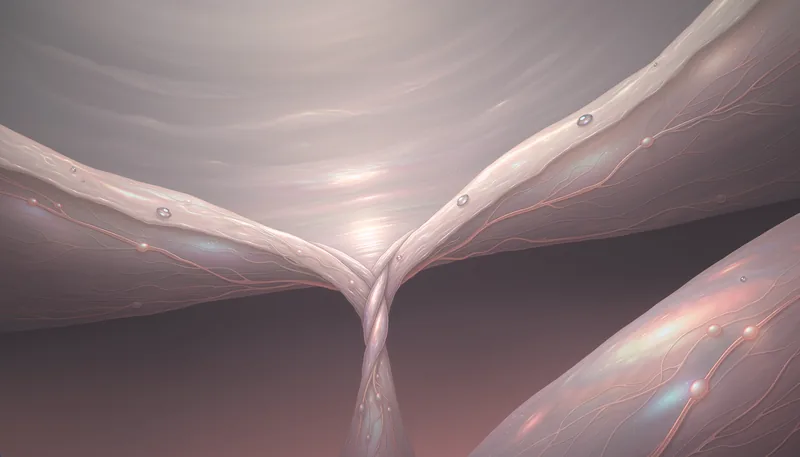
Illustrations are AI-assisted and serve as visual analogies. The rule diagrams are the author’s own. This chapter is part of the essay “Five Different Universes”, published on 15 November 2026. The full essay on the Reintegration System blog.