World 2 of 22 · Different laws
Tetrion
Space has one more direction, and every wall has to close that one too.
- Space and geometry
- Boundary of body and home
- Memory
Text: Nebo D. Lukovich ·
Speculative model
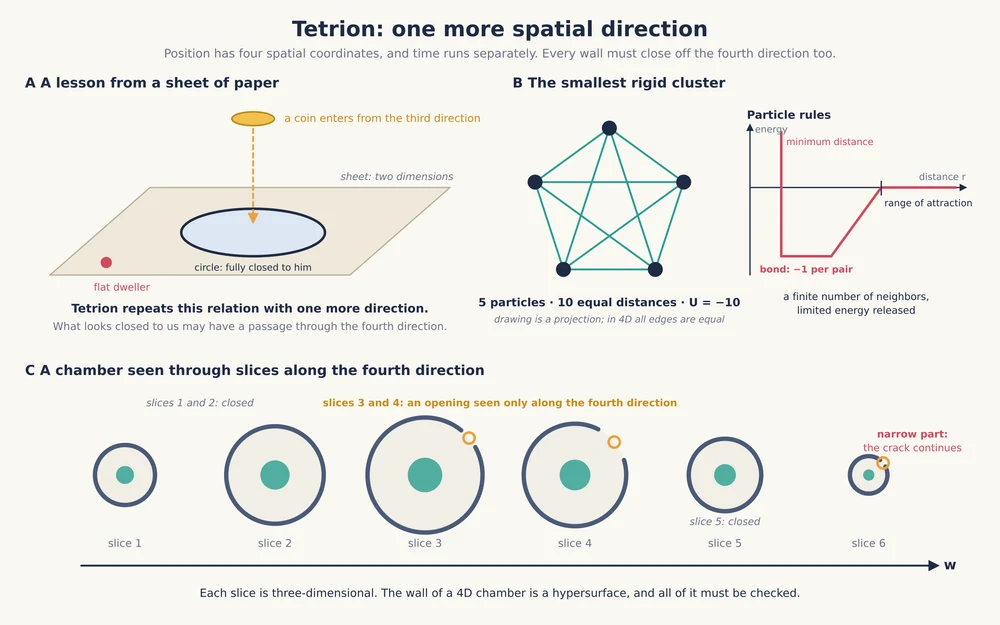
Take a sheet of paper and imagine a being with no thickness living on it. For that being, only forward, backward, left and right exist. Draw a closed circle around it. As it goes around, it encounters the line everywhere, so the circle is a perfectly enclosed space. Now lift a coin above the paper and lower it straight into the middle of the circle. The coin is inside, and the line remains intact. The paper-dweller would struggle to understand what had happened. The direction from which the coin arrived has no name in its world.
A similar relationship would hold between our space and Tetrion, a four-dimensional world. There, a body’s position is specified by four spatial coordinates, while time runs separately, just as it does for us. Every body extends along an additional direction, which we will call the fourth. Every wall must therefore close off that direction too.
How we see it
Imagined beings
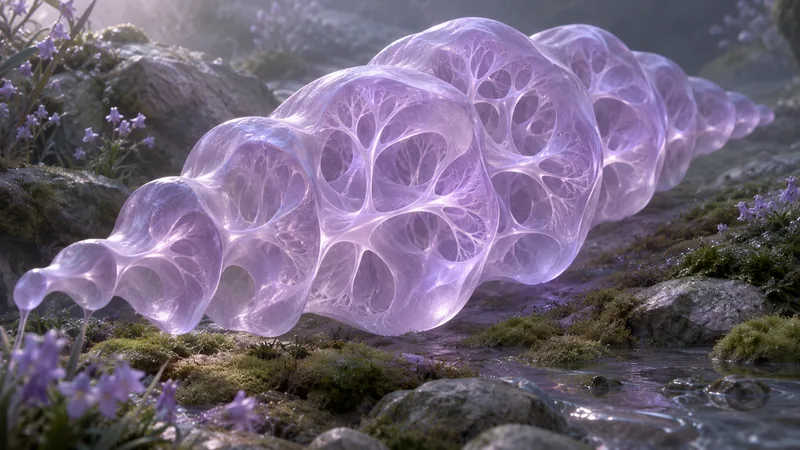
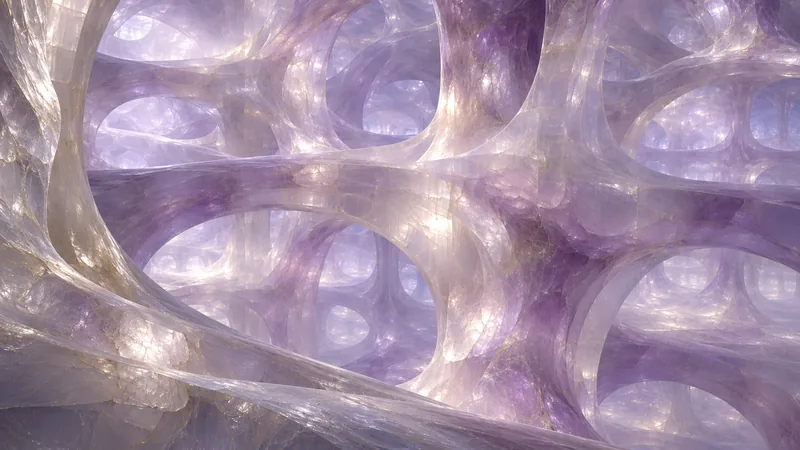
We call an inhabitant of this world a Tetran. We can neither draw nor imagine it in its entirety, so we use slices. A slice is one three-dimensional section of its body, just as a slice of bread is a section of a loaf. As we move the slice along the fourth direction, its shape changes. Some parts of the body suddenly appear, grow and vanish. For the Tetran itself, they all belong to the same connected fabric and remain in their places throughout.
Its senses also depend on physical transmission. The additional direction opens new paths, and each takes time to travel. Sensors gather different slices of the surroundings and combine them into one picture. A Tetran learns its own shape through weak excitations that pass through its body and return in a familiar order. When that order changes, it knows that some part has moved. Imagine the sensation as the sound of our own footsteps, in which one day we hear an unexpected echo.
It stores memories in stable bound states of its fabric. Its offspring must build a body of its own, together with its own closed boundary, which is a much more demanding task.
What it is made of
Speculative model
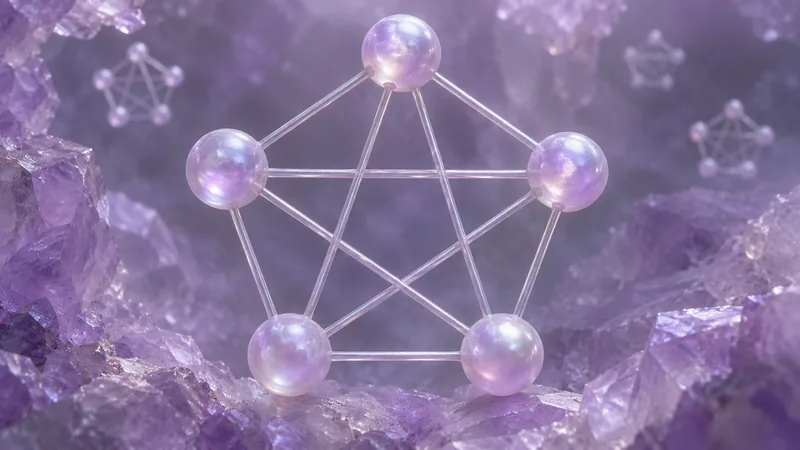
For such a body to exist at all, matter must bind into lasting structures. We therefore give Tetrion’s particles two rules. The first is a minimum allowed separation: two particles cannot come any closer than that. The second is an attraction of limited range and strength. These two rules mean that only a finite number of neighbors can fit around any one particle. They also mean that binding can release only a limited amount of energy. The particles have internal states as well, and the sources of energy will depend on those.
Interestingly, the smallest framework for this kind of matter consists of five particles. In four dimensions, five points can be arranged so that each is equally distant from every other. This is a four-dimensional simplex, a relative of the triangle and the tetrahedron. Five points give ten pairs, and all ten separations are equal. When we place that separation at the minimum of the attractive potential, we obtain a locally rigid structure with an energy of −10 in our chosen units. The negative number means that the bound structure has less energy than five scattered particles. The difference has to go somewhere, so the surroundings take it up.
Of course, there is a long way to go from one rigid framework to a body. Still, this is a first foundation stone that we have checked.
Hypera
Speculative model Imagined beings
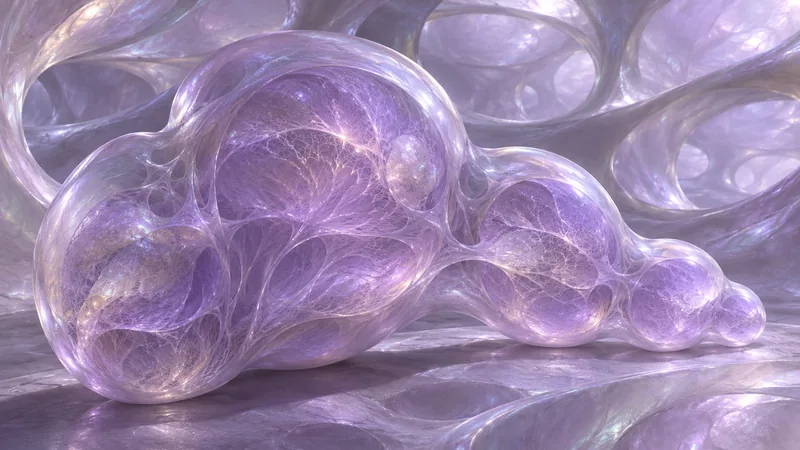
Tetrion’s energy sources are regions whose particles occupy excited internal states. As they pass into lower states, they release some energy into their surroundings, and the inhabitants sustain their bodies with that supply. Naturally, the initial reserve determines how long a source can support them.
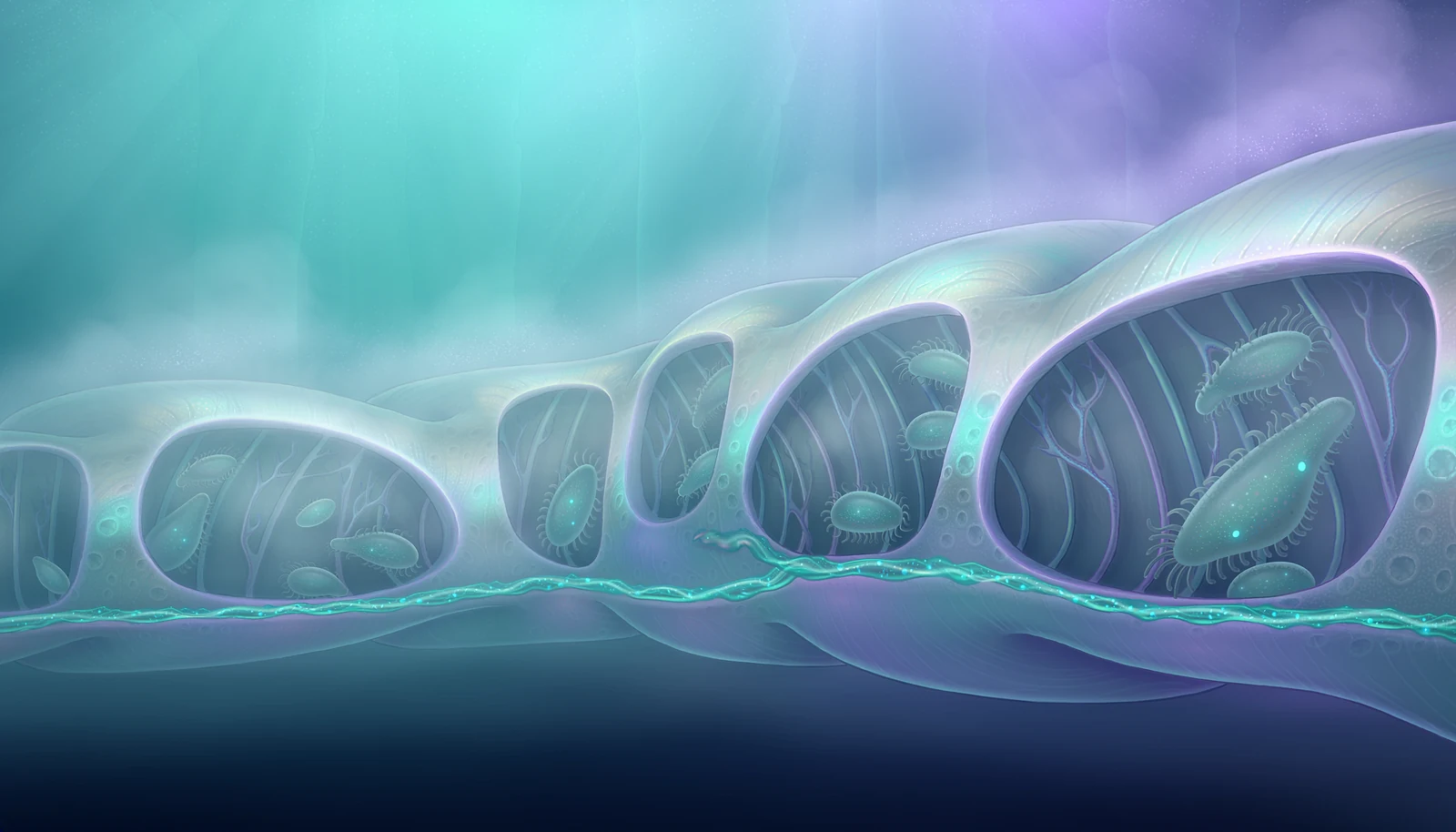
Our habitat is called Hypera. It is a large bound structure with internal passages. Its interior is four-dimensional, so the boundary of that interior is three-dimensional. I think this is the hardest idea in this world, so let us pause over it. Our minds, accustomed to three spatial dimensions, find it difficult to imagine. In our world, a room’s wall is a surface. In Tetrion, the wall is an entire volume, a hypersurface, and the builder must close all of it. What looks to us like a perfectly sealed box may easily leave a route open along that fourth spatial direction.
The greatest danger here is therefore a particular kind of injury. An opening visible only from the extra direction disrupts exchange with the surroundings, even though all the usual slices look sound. That was how trouble began for our imagined protagonist, Ilan.
Ilan reached the familiar chamber and sent a probe along its usual slice. The enclosing wall gave a clear response, as it always did. A second probe, shifted along the fourth direction, reached the internal structure earlier than he expected. Too early, and without an echo. Somewhere, a passage had been left open, probably during the last repair.
He called the chamber’s owner through an external channel. Together they followed neighboring slices, one at a time. In the third, the opening was a narrow crack. In the fourth, it was wider. In the fifth, it was gone, so they concluded that they had found the whole edge. They prepared a new protective hypersurface and sealed it.
The last probe returned too early again. The crack continued beyond the fifth slice, into a part of the chamber so narrow that neither of them had examined it. A second patch would need more material, and their shared reserve had gone into the first. The owner went to look for material nearby. Ilan stayed beside the chamber. Every few beats he sent the same probe along the fourth direction, listening as it returned too early.
A home with every approach secured
Imagined beings Author’s reflection
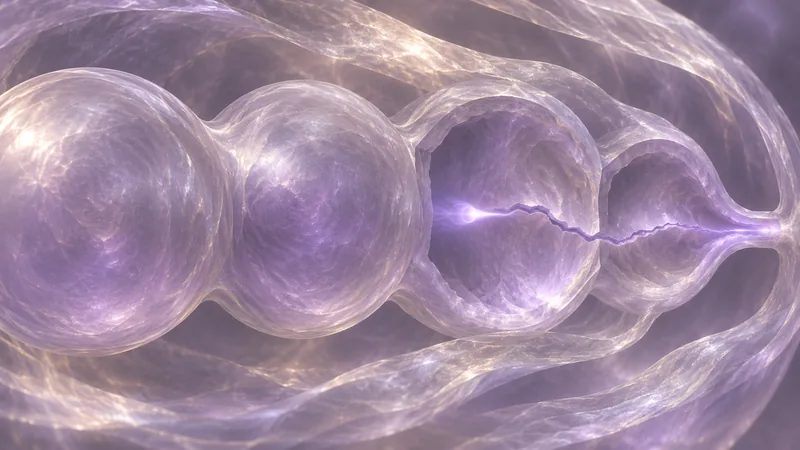
To be safe, an imagined home in Tetrion must secure every actual route of entry. A partition that encloses space in our drawing may leave an opening along the fourth direction, so the builder must follow the habitat’s entire three-dimensional boundary. As in our world, privacy depends on how well the host knows every approach and how they open it to a guest. Art, moreover, could guide a viewer through carefully chosen slices. The order of discovery itself would become part of the work.
Four-dimensional space has received much attention in mathematics, physics and science fiction. Still, I think it would be a pity for this article to leave out a cosmos with such properties: strange and still hard for our minds to grasp, even with physical laws somewhat similar to our own. We might wonder how entirely different laws would work in such a space!
Established science
Scientific footing
Four-dimensional geometry is rigorous mathematics, and the regular simplex with five vertices and ten edges is one of its familiar objects. The physics is stricter. If gravity and electrostatics followed the same law in four spatial dimensions as they do here, force would fall with the cube of distance, leaving planetary orbits and atoms unstable. Tetrion therefore receives binding rules of its own, with a minimum separation and a limited range.
Sources for this world
- P. Ehrenfest (1918). In what way does it become manifest in the fundamental laws of physics that space has three dimensions?. Proceedings of the Royal Netherlands Academy of Arts and Sciences 20, 200–209.
- M. Tegmark (1997). On the dimensionality of spacetime. Classical and Quantum Gravity 14, L69–L75.
Added by the site’s editors. The sources below support the starting idea, while life in this world remains a thought experiment.
Gallery of this world
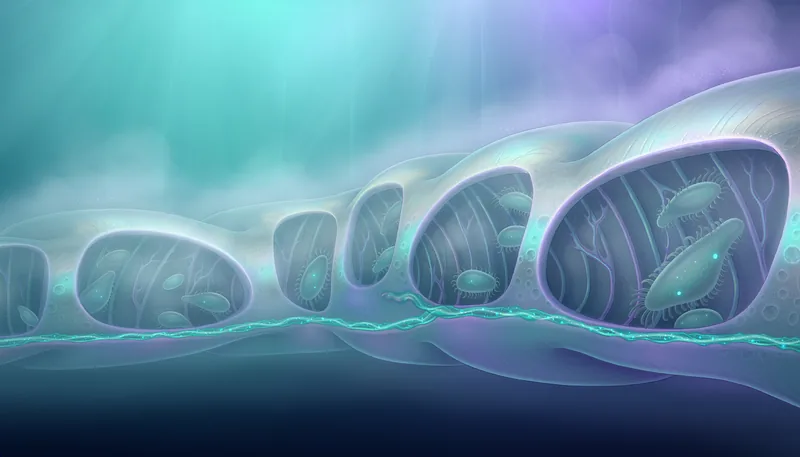
Illustrations are AI-assisted and serve as visual analogies. The rule diagrams are the author’s own. This chapter is part of the essay “Five Different Universes”, published on 15 November 2026. The full essay on the Reintegration System blog.