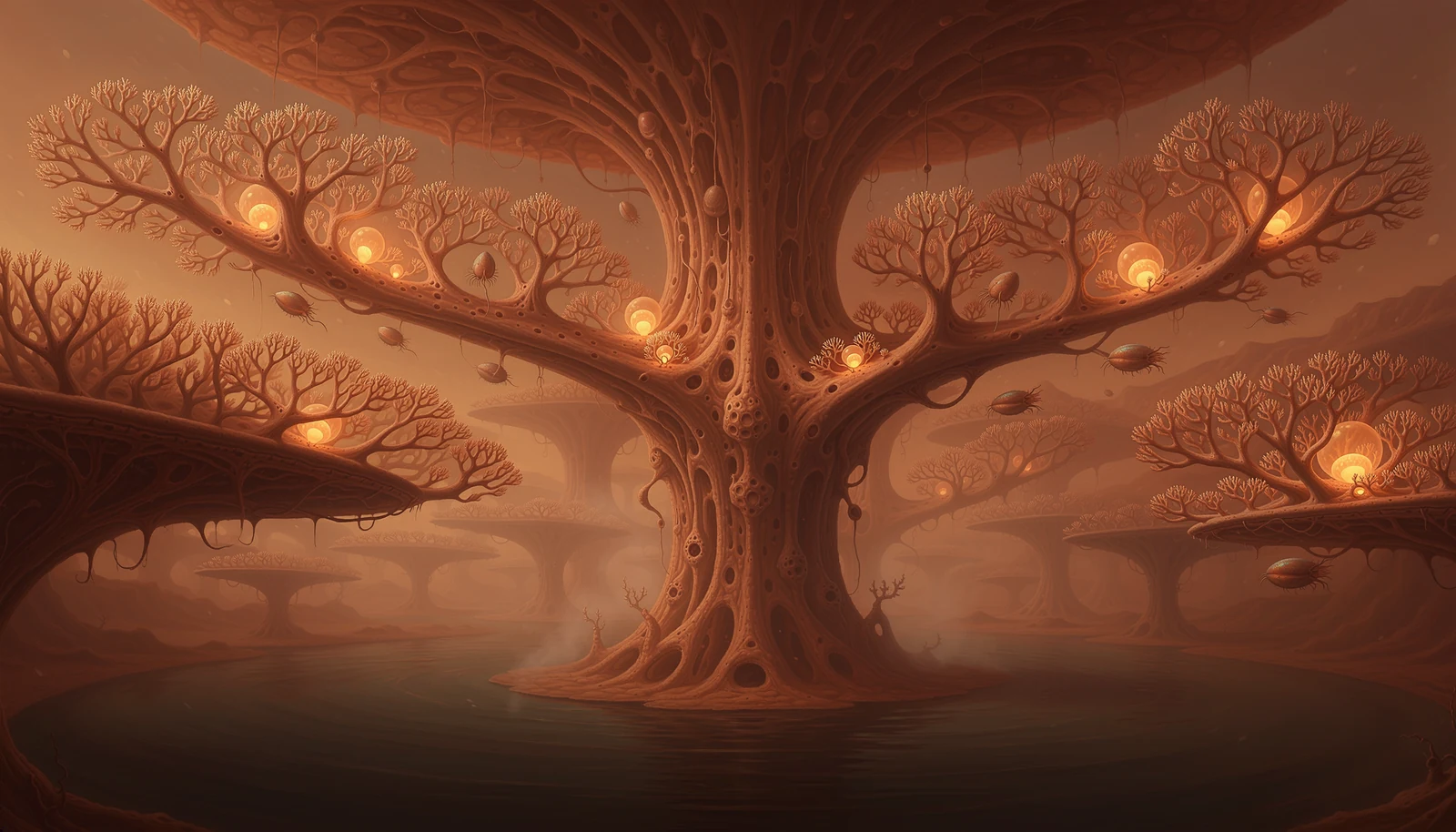
World 1 of 22 · Different laws
The Scaleless World
Every being carries whole communities within it and is itself part of a larger life.
- Space and geometry
- Communication and delay
- Memory
- Identity
- Boundary of body and home
Text: Nebo D. Lukovich ·
Imagined beings
Sela first sensed the silence. A faint murmur usually rose from one of her lower branches, like the humming of a hive that we stop noticing over time. Now it had fallen silent in one spot. Around that spot, it had grown denser and more urgent.
By the time she began to recognize the change, everything in the branch was already different. An entire community of tiny inhabitants lived there. They had noticed the crack in the wall of their passage immediately. They diverted flows of material around the damage and built a temporary barrier. Then they sent Sela a brief report. The senders knew that only those who came after them would live to receive her reply.
The report reached Sela as a single sharp prick. She decided to open a larger reserve and send work through the old passage, the one she remembered. That was where things went wrong. In the meantime, the original builders’ successors had sealed the passage because the crack was advancing toward it. The work arrived at a blocked entrance. Some spilled into a neighboring cavity, where nobody was waiting for it, and dissipated there.
The new generation sent a second report, shorter and sharper than the first. This time Sela released the work more slowly, through a detour. The barrier held until it arrived. The community then spent several of its own lifetimes patching the wall. It remembered the lost delivery as a disaster from the distant past. For Sela, all this was one anxious conversation with a part of her own body.
The repeating rule
Speculative model
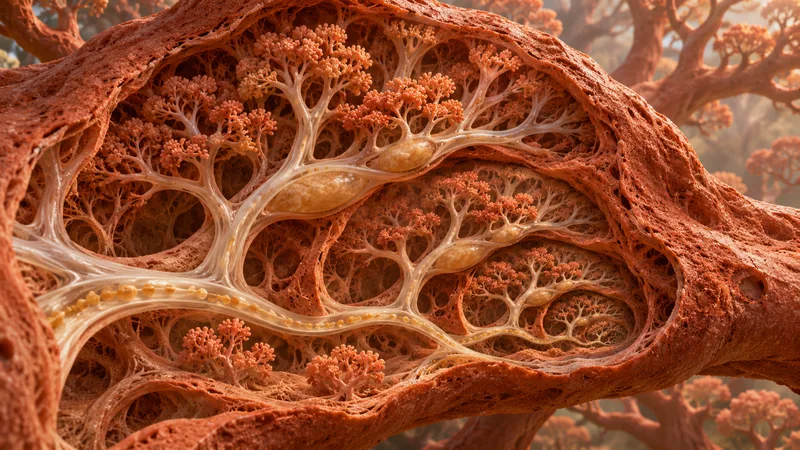
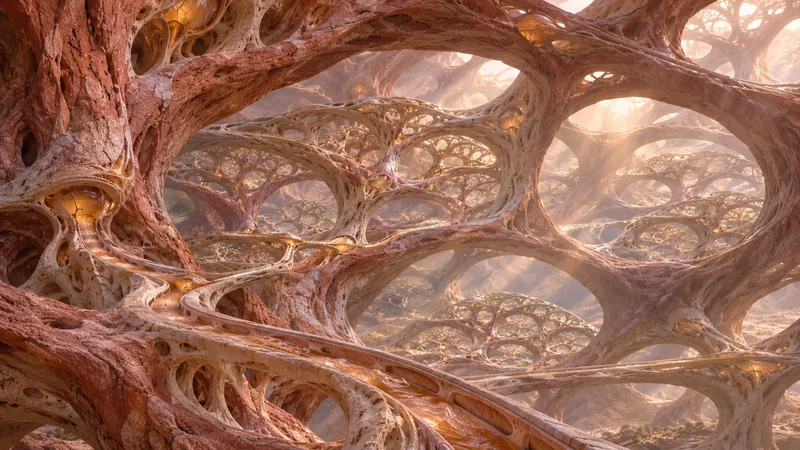
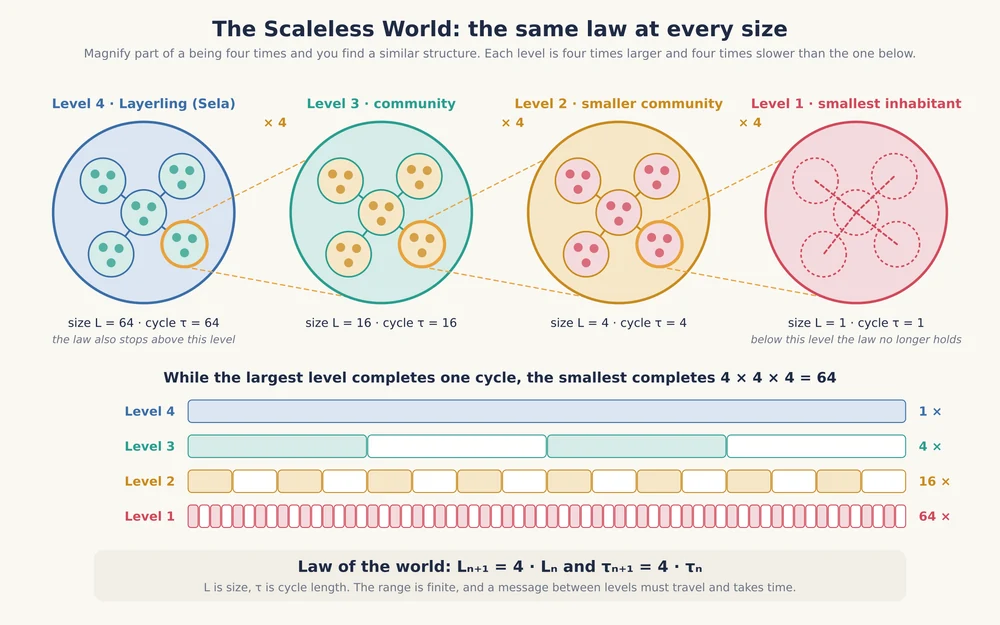
Sela is a Layerling. In her world, the same relationship between parts and whole recurs at several sizes. Let us look at a living being there and magnify a small part of its body enough. We would find an entire community, and each of its inhabitants would have a similar internal structure of its own. If we drew back, the first being would reveal itself as part of an even larger life.
We call this property self-similarity. In our example, a similar organization recurs whenever we magnify something fourfold. Messages always travel at the same limiting speed, so a path four times as long means a wait four times as long. In a compact notation, size L and cycle duration τ grow together: Ln+1 = 4Ln and τn+1 = 4τn. We choose four to keep the example easy to follow. The mathematics of this repetition at a particular magnification also exists in real science, under the name discrete scale invariance.
The consequence is simple and unyielding. In Sela’s family, we follow four active levels. While the largest level completes one cycle, the smallest goes through sixty-four, because four times four times four is sixty-four. The different rhythms of life therefore follow from the world’s very arrangement. Nobody chose them.
Of course, repetition in this universe comes to an end, unlike the repetition in mathematical fractals. We choose a finite series of levels, with lower and upper bounds beyond which this description ceases to apply. Each inhabitant also uses a definite amount of material. Its bodily boundaries show us how far the repetition is actually sustained.
A home on many levels
Speculative model
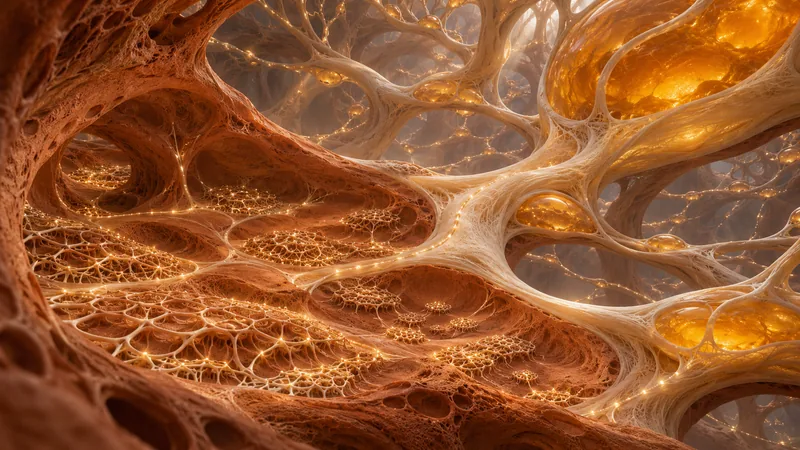
We call the largest whole in the Scaleless World the Great Layer. A close look at its fabric would reveal a network of smaller habitats. A more distant observer would recognize it as just one part of an even larger structure. The Great Layer would thus resemble a galaxy in our universe, although that comparison makes sense only once we specify the level from which we are looking.
Work flows through this hierarchy by way of focal sources. From a distance, we might describe them as counterparts of our stars, on a structural level below that of a galaxy. Each focal source has a finite capacity, a fund that is spent through exchange. To a tiny inhabitant, its source lasts an entire lifetime. To a community on a larger level, the same event looks like a brief flicker in one part of its body.
Sela’s habitat is called Layer, the counterpart of our planet, and spans several connected levels. A smaller level carries out fine repairs, while a larger one holds slower, bulkier reserves. This division of work can succeed, and it can fail. Its survival depends on actual exchange through the passages, just as we have seen.
What counts as one being here
Imagined beings
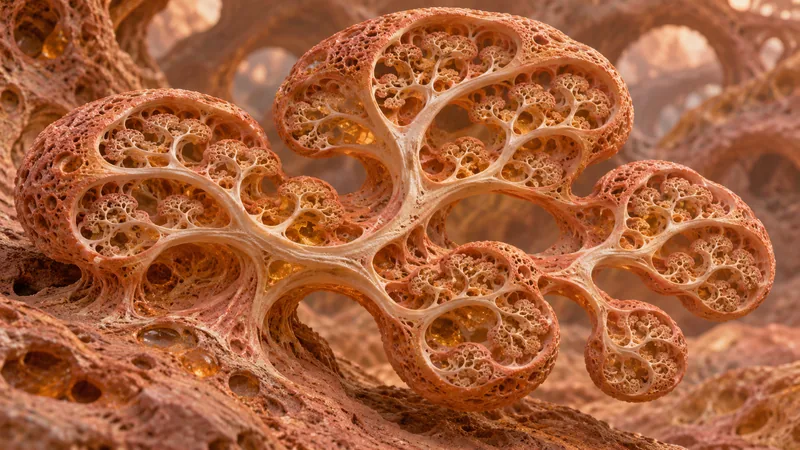
A Layerling’s branching body repeats a similar structure in many places. Cavities in its larger parts house smaller systems with their own much faster activities. We imagine such a being’s senses as a kind of listening inward: the murmur of communities, a blockage in a passage, a delivery running late. The memory of the larger whole rests in enduring relationships among these communities. Recollection therefore requires exchange between them, and Sela must literally wait for a memory.
Let us look at the same life from below. To a tiny inhabitant of Sela’s branch, she is both ground and sky. Her voice arrives rarely, once in many generations, always answering some ancient question the ancestors asked. Children in that community would therefore learn two skills. The first is reading old messages. The second is writing new ones so that someone living among wholly altered passages can understand them.
A Layerling’s offspring comes into being when one community separates, receives enough material and establishes its own maintenance on every level it uses. Death is just as layered. Severe damage may end the life of the whole while some of its tiny inhabitants go on living elsewhere. I think this raises an unusual question about the boundaries of a self. Does Sela have an experience, or do her communities, or do all of them at once, each at its own pace? Where does an individual’s experience begin and end? In my view, these questions may apply to our world too. Perhaps they do so to a lesser extent, but their importance is clear.
Layerling culture would have to take other beings’ time into account. A large neighbor on a higher level replies only after many local events have passed, so patience is a basic form of courtesy here. It seems to me that such a world would value, above all, the reliable handing on of unfinished work.
Do we have anything in common?
Author’s reflection
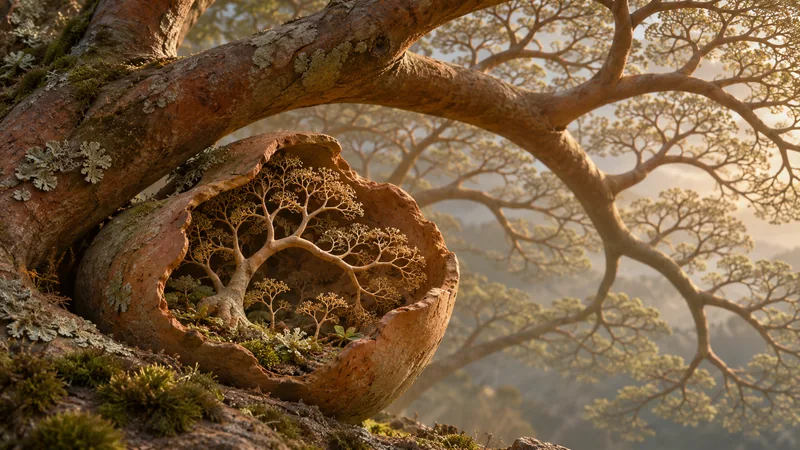
Does this world seem to bear a strange, allegorical resemblance to our own? There are fractals, with patterns that repeat at every level, and hierarchical structures, so widespread in our society. Or we might think of higher and lower layers of reality that struggle to communicate while influencing each other in deep and subtle ways. More intriguingly still, might the holographic principle1 be a subtle feature of our own world, as it is, in its particular way, of this one?
Napomene · Notes
-
By the holographic principle, I mean here the idea that every part of reality carries information about the whole, just as every fragment of a hologram contains the entire image. Inner and outer then reflect one another. In physics, the same term refers to a narrower idea: that information about a region of space can be recorded on its boundary. I have described my understanding of this principle on the page The Holographic Principle. ↩
Established science
Scientific footing
Discrete scale invariance is a studied symmetry. A system that has it looks the same only under magnification by a specific factor, and its signature is log-periodic oscillation. It has been described in hierarchical lattices, fractal growth and rupture processes. Observations of our cosmos show no such construction across all scales.
Sources for this world
- D. Sornette (1998). Discrete scale invariance and complex dimensions. Physics Reports 297, 239–270.
Added by the site’s editors. The sources below support the starting idea, while life in this world remains a thought experiment.
Gallery of this world
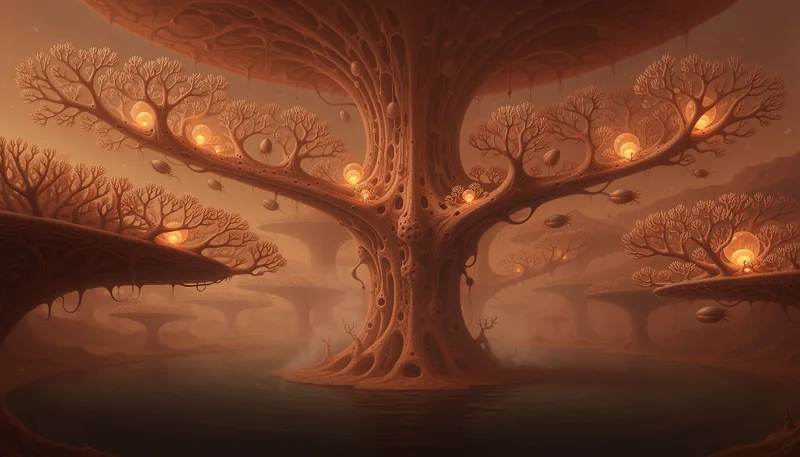
Illustrations are AI-assisted and serve as visual analogies. The rule diagrams are the author’s own. This chapter is part of the essay “Five Different Universes”, published on 15 November 2026. The full essay on the Reintegration System blog.