World 8 of 22 · Other universes
The Deep
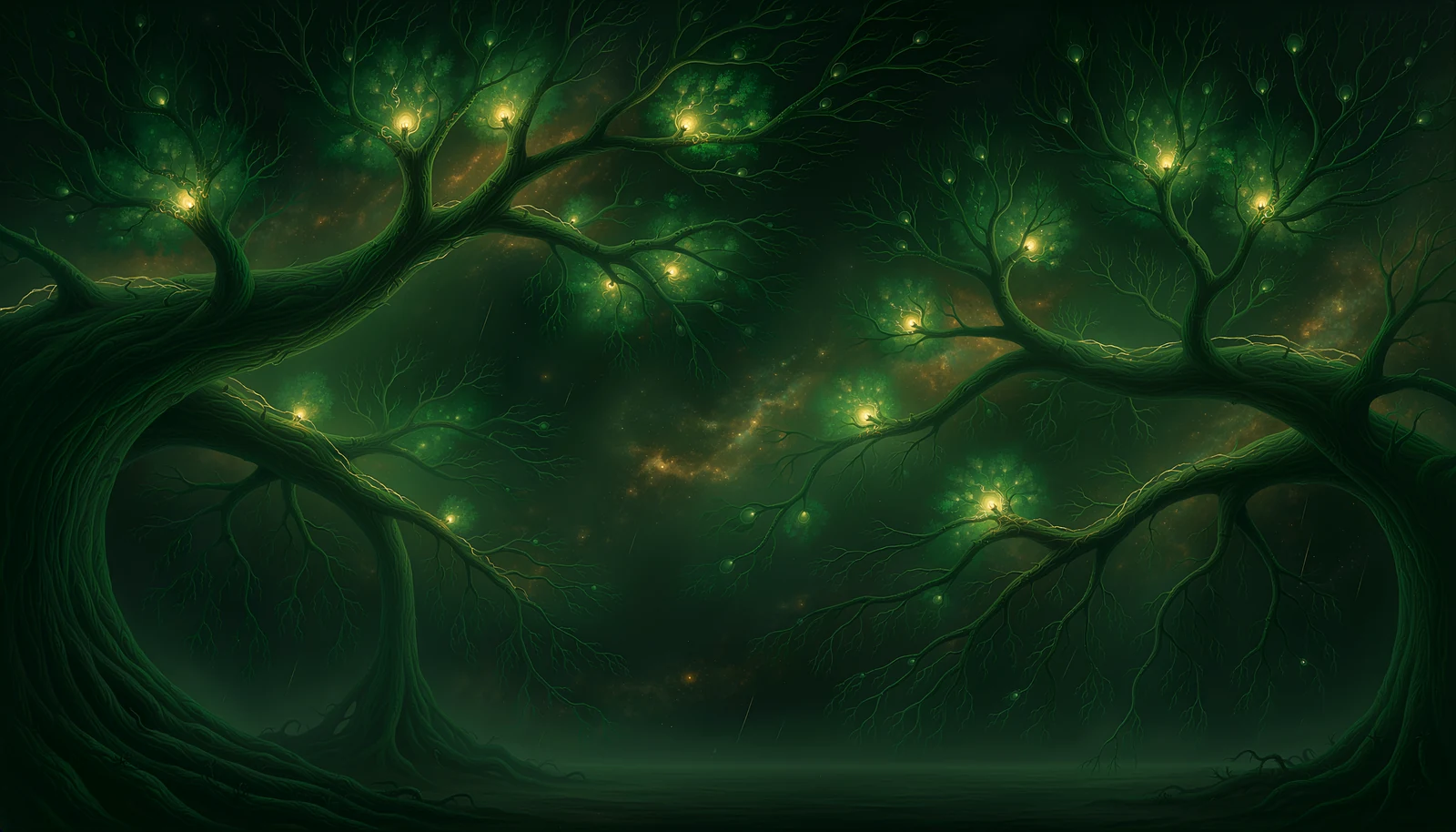
Every place is a branch of one tree, and conversation runs through a common ancestor.
- Space and geometry
- Communication and delay
- Identity
Text: Nebo D. Lukovich ·
Speculative model
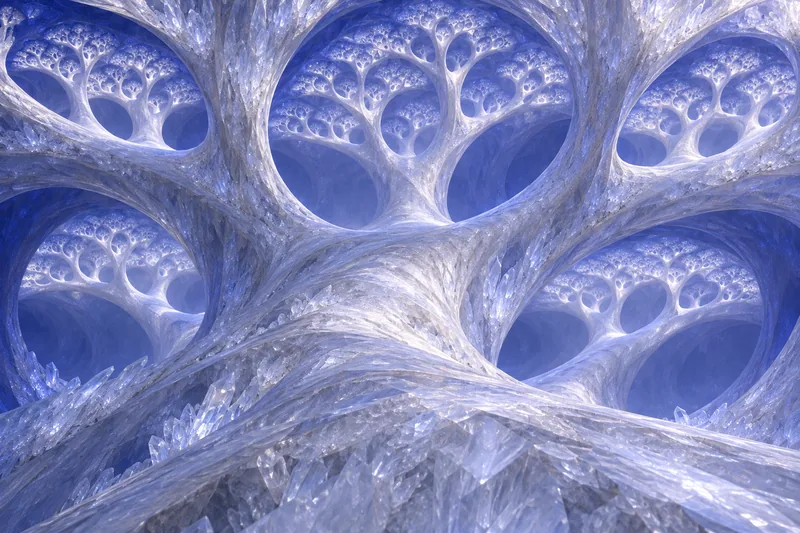
Imagine two households that can talk only through a shared exchange. In a larger region a message has to pass through one more exchange. That is how the space of the Deep is organized. Two regions either belong to the same nearer branch or meet only through a much more distant fork.
The body of a Deepling is subject to the same rule. A small part of it can react quickly to a touch, while a decision involving the whole body has to wait for return messages. Imagined life therefore calls for several connected rhythms. Each must have its own role, with enough time for their decisions to be reconciled.
The world’s rule
Speculative model
The Deep has the space of a finitely branched tree. The smallest regions carry addresses. The longer the common beginning of two addresses, the closer their regions are in the chosen metric. If the length of the common prefix is r, we write the distance between different leaves as d = 2-r.
The later two addresses part, the closer they are in this hierarchy. If their first three address steps coincide, r is three, and the expression gives a distance of one eighth. That value describes hierarchical nearness. How long a conversation lasts we reckon by the number of actual crossings along branches.
Such a geometry determines hierarchical nearness. The duration of a conversation is calculated separately. A message travels along the real links of the tree, and each crossing takes one step. Two leaves whose common ancestor lies h links above them exchange a message and a reply in at least 4h steps. Waiting at a busy node lengthens that time.
Each node can let through a limited amount of messages at once. To change their direction it spends part of the available work. If it starts with ten units and spends three on switching, seven are left for the next tasks. Those three still enter the overall account as the spent part. So a change of route through the Deep has its price too.
A cosmic home
Speculative model
The Fourth Crown is a large branch with a multitude of smaller offshoots. At its start there is a node that distributes a finite reserve to those regions. Many inhabitants may depend on the same main passage. When numerous messages have to pass through it, the whole community must wait longer for its shared reply.
For the inhabited world we choose the Inner Branch. In our illustrative example it has a depth of twelve. A return exchange between its most distant ends then takes at least forty-eight steps. That number follows from the chosen construction. Other branches may have different proportions.
We can imagine the first step towards life in a small sub-branch that keeps renewing the same flow of messages. For an offspring, a new routing arrangement and a supply of work have to be prepared. Every new individual thereby also acquires a certain dependence on shared passages. Their reliability becomes a condition for the long life of the whole community.
The being and its life
Imagined beings
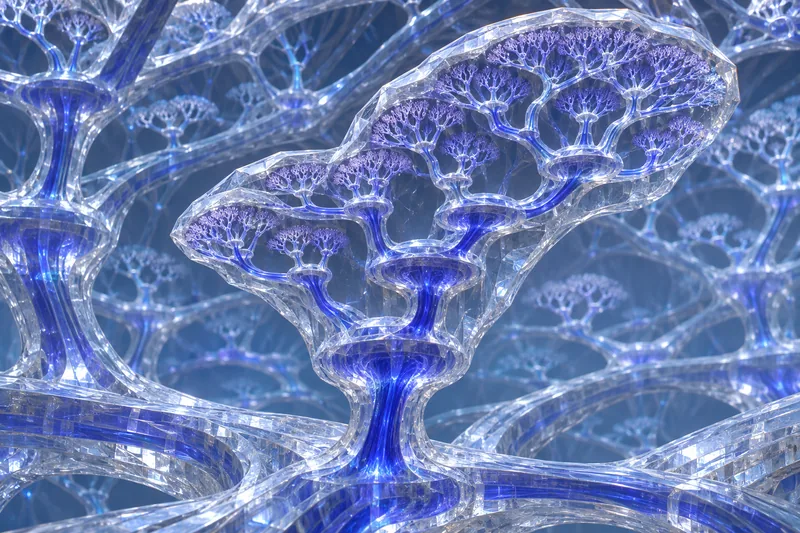
A Deepling exists through the coordinated routing of messages in its body. Its memories lie in the states of its nodes. When an arriving message changes the next direction of transmission, an encounter with the surroundings affects its behaviour. It can assemble the wider picture only after the necessary replies have returned through the branches and reached the parts that connect them.
A larger body therefore has a particular problem. Its local parts can complete many operations while the shared reply is still travelling. We imagine an organization that resolves this with layers of control. Quick decisions stay in the small sub-branches, and a slower shared cycle settles what requires access to the whole process.
Imagine how a Deepling would experience the difference between a quick touch and the slow reply of its whole body. We attribute that experience as part of our story about life. News from a distant branch first has to reach it. If the shared passage is cut, the parts can carry on with their local tasks. Reconnecting calls for learning about the changes that have arisen in the meantime.
Offspring take over a free subtree with allotted impulses. Independence grows when the offspring establishes enough return paths of its own. Its origin still determines through which ancestors it can talk to the wider surroundings.
Life under those laws
Imagined beings
Here the scale of an institution would directly determine its rhythm. A decision involving a wide branch would have to leave time for all the necessary replies to return. Local business could go forward during that wait. It seems to me that courtesy would apply especially to respecting another’s period of reconciliation.
A Deepling’s work of art could begin with the brief reply of one small branch. Only much later would it become clear how that reply fits into the wider whole. The audience would come to know the work in several rhythms. It seems to me that such a culture would especially value the skill of keeping a first impression open until all the important messages have returned.
Coming home could carry a special cultural meaning. A traveller would keep the sequence of actual forks and access to the routers needed for a return message. A loss of capacity at one shared passage would change its relation to the entire home branch. What is more, a long journey could bring it back to a community whose slow conversation is only just concluding, while it has meanwhile gone through many local experiences. Such a difference in the rhythms of life follows already from the size of their processes and the duration of transmission.
A scene
Imagined beings
Talu sent a question to a process that occupied a much wider branch. Its local assemblies could react at once. For the shared reply it had to wait for passage through a distant ancestor. In the meantime Talu prepared two possible arrangements of work. Both kept an adequate supply for the neighbouring offspring. After the expected interval the first part of the reply arrived. It carried a mark saying that one distant subtree was still reconciling its assessment. Talu postponed the final rewiring. When the complete pattern finally arrived, its earlier preparations were still usable. It chose the arrangement that left more free capacity. The shared thinking had just been given the time it needed.
Established science
Scientific footing
A distance given by the length of a shared address prefix is an ultrametric, a rigorously defined mathematical structure. In physics it appears in the description of spin glasses and hierarchical systems. Observations give no sign that our space has such a geometry.
Sources for this world
- R. Rammal, G. Toulouse, M. A. Virasoro (1986). Ultrametricity for physicists. Reviews of Modern Physics 58, 765–788.
Added by the site’s editors. The sources below support the starting idea, while life in this world remains a thought experiment.
Gallery of this world
Illustrations are AI-assisted and serve as visual analogies. The rule diagrams are the author’s own. This chapter comes from the author’s unpublished material around the manuscript “Fifteen Other Universes” (2026) and is published here for the first time. The English translation was prepared by the site’s editors.