World 9 of 22 · Other universes
The Sliding Dimension
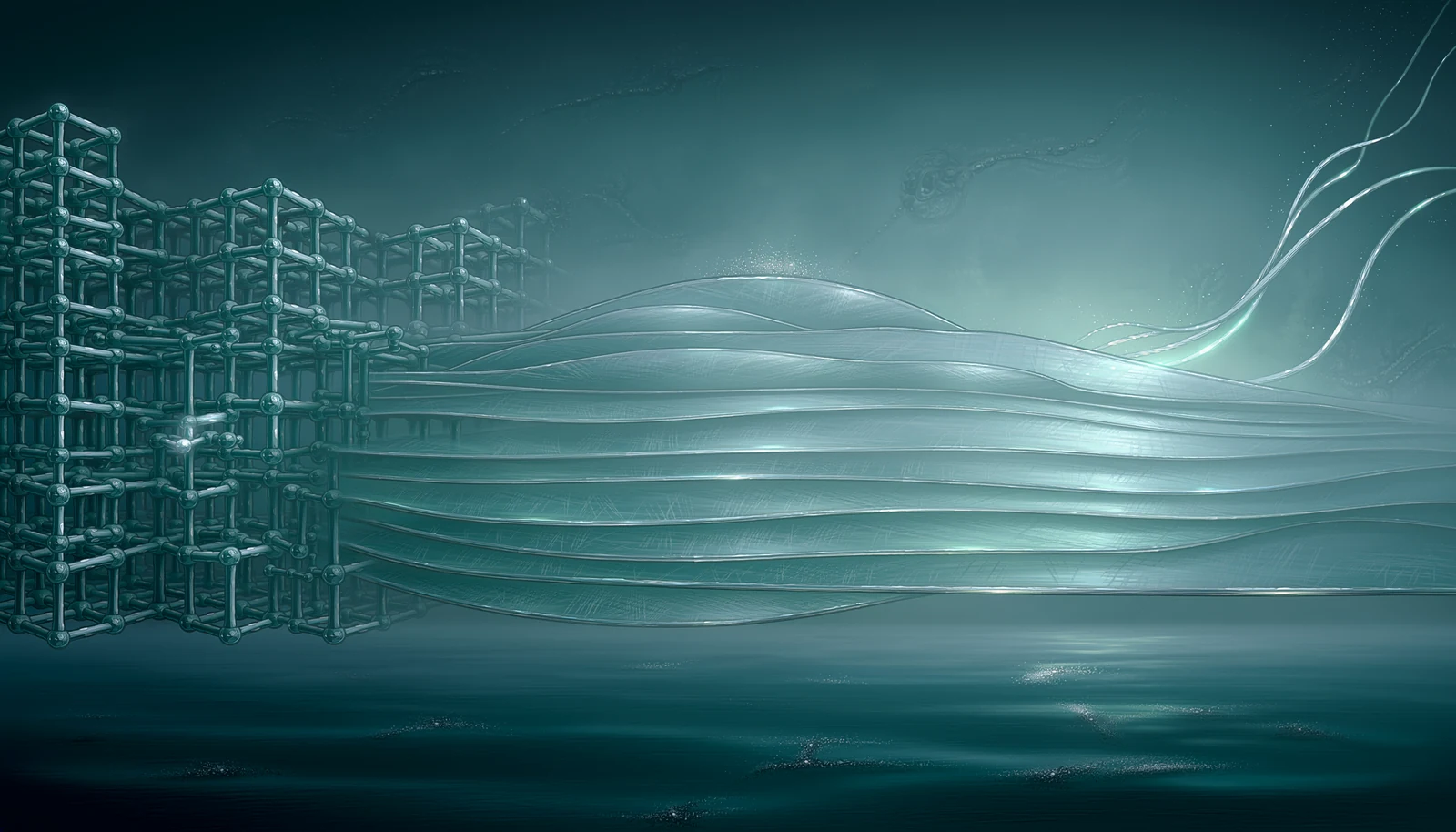
The number of directions open to movement changes from place to place.
- Space and geometry
- A changing ground
- Boundary of body and home
- Identity
Text: Nebo D. Lukovich ·
Speculative model
Imagine a city in which streets are at first open on every storey. Then the passages between storeys gradually close, so that almost all journeys stay in one plane. In a still narrower band only a few lengthwise roads remain. For the inhabitant, the way space can be used is changing.
From that picture we make a physical assumption: the local state of the medium governs the couplings that allow movement in particular directions. That is why we speak of an effective dimension, that is, of how many directions a process can actually explore at a given scale. The greatest challenge for life is rearranging the body in time. A channel left without a passage can cut one part of the organism off from the rest.
The world’s rule
Speculative model
In our limited model the medium is represented by a network with links in three directions. A local field changes the strength of those links. When all are roughly available, a message explores the volume. When one direction weakens considerably, the process spreads mainly across connected sheets. Under further restriction, mostly narrow paths remain.
The term sliding dimension describes such a change in the availability of space. The number we measure also depends on the scale of the probing. During a short probe, for example, a message stays within one sheet; during a longer one it can find a rare crossing to the next. A fractional value of the effective dimension sums up such behaviour. It requires measurement within the chosen model. For the inhabitant it describes a real possibility of transmission.
Research on quantum geometry considers different values of the spectral dimension as the scale changes. Our temperature that governs macroscopic passages we add as a separate law of the fiction. A way of changing has to be chosen for it, and a limited speed at which it advances. Changing the couplings requires work, and the released part of the energy enters the surroundings. Ambjørn and colleagues; Carlip
A cosmic home
Speculative model
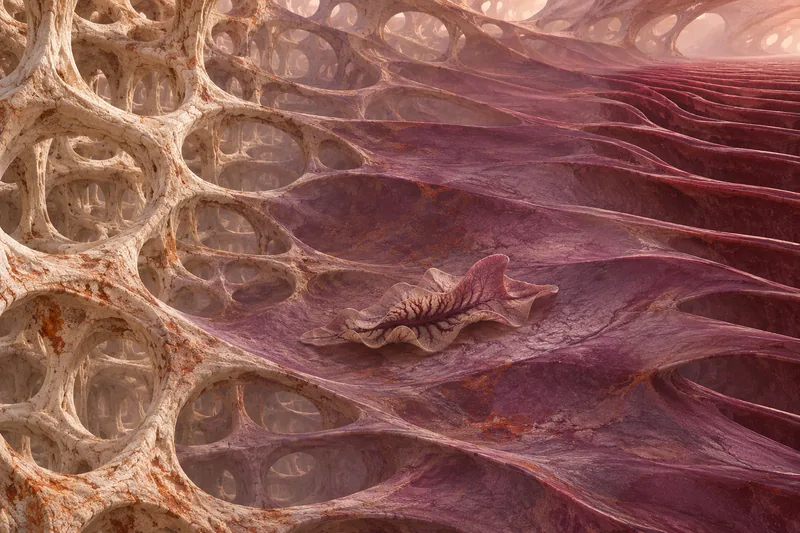
We will call the large whole the Belt. In its various regions movement has different availability. Reserves maintain slow gradients of the local field. Their gradual depletion can shift the boundary between the mainly volume and the mainly surface mode of transmission.
The habitat Edge lies in a broad transitional band. In it, some links still allow exchange through the thickness, while most routes follow thin layers. A slow enough transition gives time to adapt. A sudden change can cut passages before an inhabitant has moved an important process.
For the origin of life we assume first patterns that change the arrangement of their channels according to the state of the surroundings. Those that keep their supply and close a return path can sustain themselves longer. For offspring they would also have to pass on the ability to prepare in that way. That remains a task for the imagined biology.
The being and its life
Imagined beings
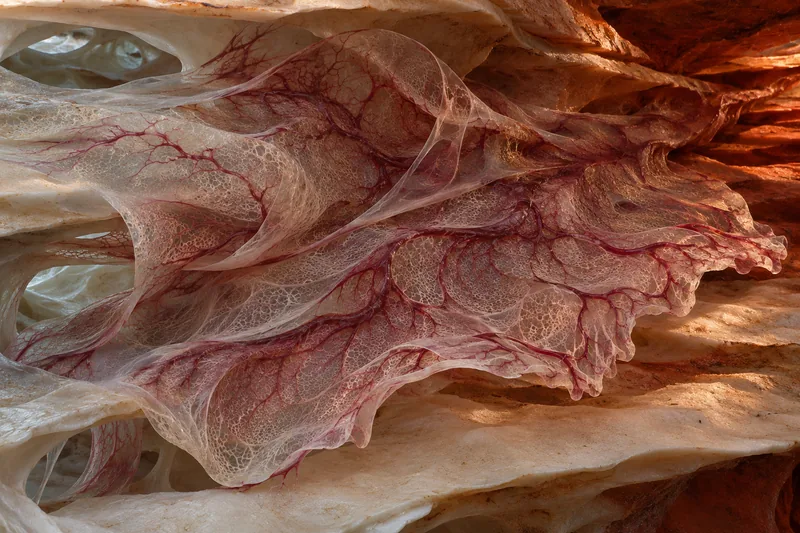
A Crossling has a thin, branching body. Connected channels run through its layers. In more favourable surroundings part of the body can use crossings through the thickness. When those crossings weaken, the organism gradually reroutes its flows along the available sheets. Its appearance changes together with the arrangement of its work.
We imagine the sense for dimension as a set of physical probes. One is sent along the surface, another towards the neighbouring layer. The difference in their return warns of a change. From that reply the inhabitant estimates how much time it has left. The sense requires available routes and can err when the surroundings change faster than the probe.
Memory is carried by an arrangement of connected parts that must stay reachable after a rearrangement. Reproduction begins with preparing a new assembly with channels of its own. An individual’s end may come when it loses key links through the thickness and has no time to transfer their work into the remaining directions. Its material then goes on taking part in other processes of the medium.
Life under those laws
Imagined beings
The cities of the Crosslings would be mobile communities of channels. Before the boundary shifts, inhabitants would check return routes and prepare a neighbouring habitat. A traveller would choose a route according to its own ability to adapt. A passage safe for one individual could be too fast for another.
Their maps would show the expected duration of passages. Older inhabitants might remember routes that once connected entire layers. Art could preserve the experience of those vanished links through a series of available rearrangements of the body. Here, indeed, the story of a journey would include the story of the traveller’s change.
A scene
Imagined beings
Oma sent a probe towards the neighbouring layer. The reply came late. The probe along the surface returned in good order, so she opened a spare arrangement of channels. One part of her body had already switched to the slower detour, while other parts were still using the old links. She waited for both return replies to fall into a common sequence. Then she closed the weakened passage and moved towards the cooler edge. Behind her the same piece of the medium behaved more and more like a sheet. Oma continued on her way with a differently arranged body.
Established science
Scientific footing
In some approaches to quantum gravity the spectral dimension depends on scale: in the calculations of Ambjørn, Jurkiewicz and Loll it falls at very small distances. That is a property of theoretical models at microscopic scales. Macroscopic regions with a different number of available directions are something we add as a law of the fiction.
Sources for this world
- J. Ambjørn, J. Jurkiewicz, R. Loll (2005). The Spectral Dimension of the Universe is Scale Dependent. Physical Review Letters 95, 171301.
- S. Carlip (2017). Dimension and dimensional reduction in quantum gravity. Classical and Quantum Gravity 34, 193001.
Added by the site’s editors. The sources below support the starting idea, while life in this world remains a thought experiment.
Gallery of this world
Illustrations are AI-assisted and serve as visual analogies. The rule diagrams are the author’s own. This chapter comes from the author’s unpublished material around the manuscript “Fifteen Other Universes” (2026) and is published here for the first time. The English translation was prepared by the site’s editors.