World 10 of 22 · Other universes
Vortex
A body is an eddy that lasts while the world flows through it.
- Body as process
- Memory
- A changing ground
- Boundary of body and home
Text: Nebo D. Lukovich ·
Speculative model
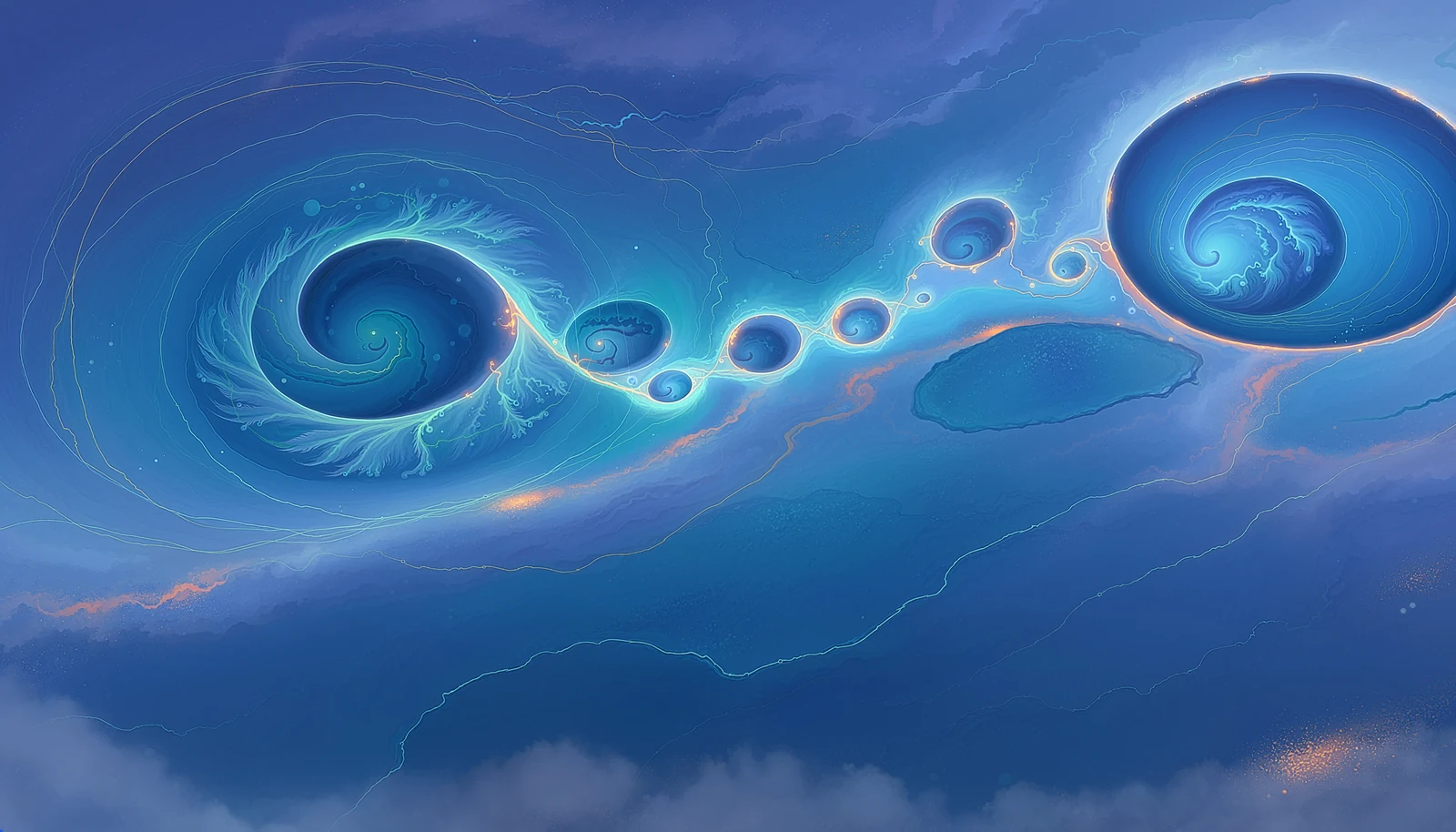
An eddy in a river keeps a recognizable shape while new water passes through it. Starting from that phenomenon, let us imagine a far more complex flow whose own motion helps it stay whole. That maintained arrangement would be the body of a Whorl.
For life, the hardest thing is to preserve something that an encounter can change. A simple vortex easily loses the trace of an earlier disturbance. So we imagine several connected circulations, with arrangements stable enough to carry memories. A change in the public current then becomes a personal event as well: the inhabitant has to renew its own body from the very fluid that is changing.
The world’s rule
Speculative model
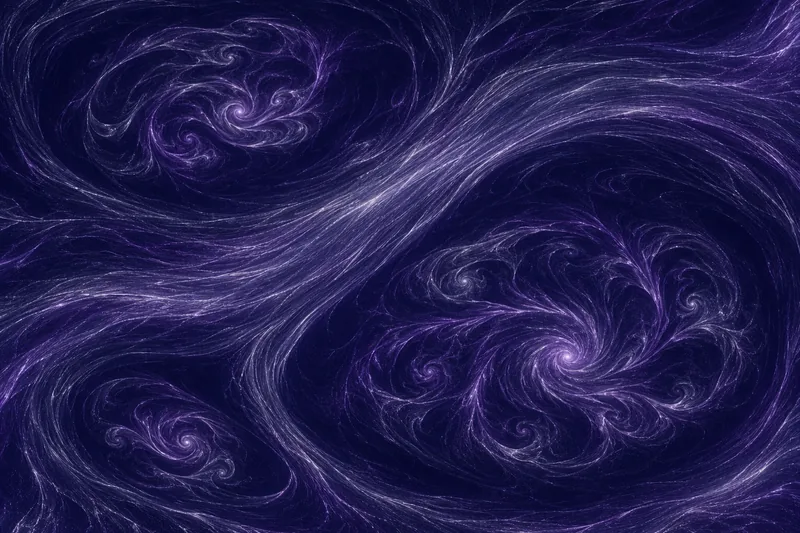
Vortex is filled with a fluid that moves in two spatial directions. At every place it has a certain density and velocity, along with internal energy. From finite reserves it can obtain the work needed to maintain its flows. Every body arises in that same fluid. Its shape lasts for as long as the motion renews the relations among its parts reliably enough.
For this world we choose a compressible model. Pressure responds to the state of the fluid, and small disturbances are carried at the finite speed of sound. That property allows messages with a definite delay. The link between small disturbances and the transmission of sound has a well-known physical basis; here we give it specially chosen two-dimensional conditions. NASA Glenn
Our region is finite, and its opposite edges are joined. When a flow leaves across one, it continues across the corresponding other edge. The account includes all the mass, momentum and energy of the sources. If a source delivers three units of work, two may strengthen the flow while one passes into internal energy. Pressure helps carry changes through the fluid.
A cosmic home
Speculative model
Great vortex basins form the widest wholes of this world. Their lifetime depends on the initial motion and the exchange of energy. For our habitat we choose Talasia. Its flows leave enough calm regions in which more delicate assemblies could sustain themselves. Such a calm place nevertheless depends constantly on motion in the wider surroundings.
Sources locally turn a finite reserve into ordered streaming. A change in the direction of that flow has to be accompanied by a corresponding exchange of momentum with the surroundings. When the reserve runs out, a once favourable region may become unfit for complex life. Keeping up a settlement therefore requires constant monitoring of the wider motion.
We can picture the forerunner of the Whorl as a small weave of vortices that re-establishes its arrangement after a mild disturbance. For life we add the ability to steer incoming work exactly to where renewal is needed. The next requirement would be an offspring that inherits that ability. The emergence of such an organization remains an open part of our imagined world.
The being and its life
Imagined beings
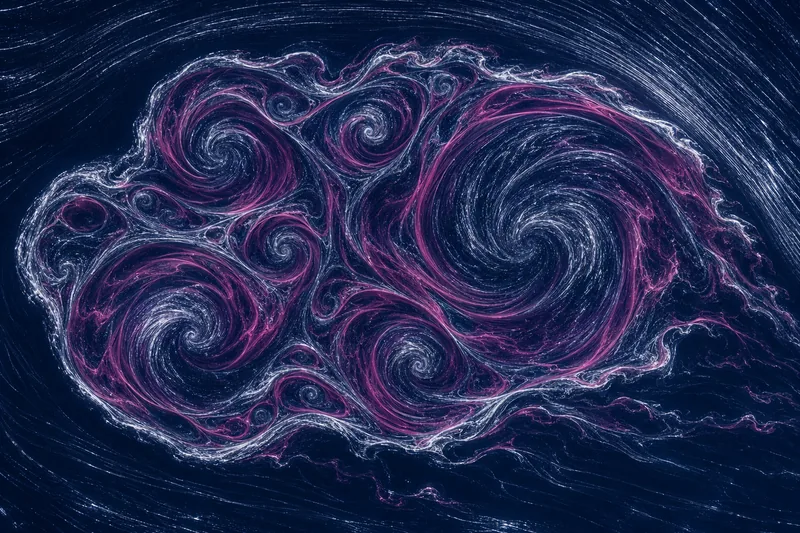
A Whorl is a connected weave of vortices that maintains its own boundary. Fluid passes through it constantly, and the familiar pattern of motion stays stable enough. When the surrounding inflow changes, the Whorl has to adjust the arrangement of its parts. The boundary of its body may then shift as well. What we follow as one individual is that coordinated continuation of its motion.
A Whorl would come to know its surroundings through changes in flow and waves of pressure. For a memory it needs something more lasting than one simple vortex. So we imagine several connected parts that can hold different arrangements. An arriving excitation would have to change the chosen part with care. How to carry out such a write while preserving the rest of the body remains a concrete task of construction.
If we attribute experience to this assembly, we might imagine that it feels directly which directions of motion are open to it. A favourable inflow would allow easier responses to the surroundings. A sudden change would demand more work to maintain the body. Its experience could then narrow around the procedures on which the next moment of life depends.
An offspring arises through controlled separation. It needs an adequate amount of the medium and an independent capacity for regulation. Destructive mixing can break up the unified organization, while the conserved mass goes on moving through the surroundings.
Life under those laws
Imagined beings
In Talasia the public flow takes part in maintaining every body. Building a habitat would mean preparing sufficiently stable paths of streaming and renewing them constantly. Every shelter is made of the same fluid. When the wider flow changes, the inhabitants must adjust their settlement too. Their safety therefore depends on watching those changes together.
Different communities could value different degrees of calm. Some would invest almost all available work in spaces for long concentration. Others would keep up frequent exchanges with the wider basin. Such choices would give them different rhythms of life, even when they use the same physical foundation.
A scene
Imagined beings
The public flow began to change direction. The Whorl first received a faint change in pressure, and later the altered current itself. Its outer vortex had to take on more work. It informed its neighbours with a carefully shaped wave. The reply arrived with a delay matching their distance. Together they prepared a transitional pattern around the most delicate region of the settlement. While the new flow was passing, the Whorl reduced its exchange with one memory assembly to preserve its arrangement. After things settled it accessed it again. The memory replied in the familiar rhythm. The settlement then entered into the common account how much each inhabitant had paid for the redirection.
Established science
Scientific footing
In two-dimensional flows energy moves towards larger scales, so vortices merge into long-lived structures; this has been measured in experiments and simulations. Small disturbances in a compressible fluid are carried at the speed of sound. A vortex that remembers and leaves offspring remains our hypothesis.
Sources for this world
- G. Boffetta, R. E. Ecke (2012). Two-Dimensional Turbulence. Annual Review of Fluid Mechanics 44, 427–451.
- NASA Glenn Research Center (2023). Speed of Sound. Beginner’s Guide to Aeronautics.
Added by the site’s editors. The sources below support the starting idea, while life in this world remains a thought experiment.
Gallery of this world

Illustrations are AI-assisted and serve as visual analogies. The rule diagrams are the author’s own. This chapter comes from the author’s unpublished material around the manuscript “Fifteen Other Universes” (2026) and is published here for the first time. The English translation was prepared by the site’s editors.