
World 11 of 22 · Other universes
Chord
A being is a sustained consonance, and conversation is an opening of couplings.
- Body as process
- Communication and delay
- Memory
- Identity
Text: Nebo D. Lukovich ·
Speculative model
Think of several musicians who manage to keep a common rhythm. Each hears some of the others and adjusts the next note to them. In Chord a similar relation becomes the basic physical idea. Its simple ingredients oscillate, and the law determines through which couplings they can exchange influence.
We recognize one Resonant by the relations it renews through time. For it to remember something, some of those relations must stay altered after an encounter. That is an additional requirement which has to be realized physically. A conversation thus becomes a careful opening of couplings, prepared so that both inhabitants can later carry on independently.

The world’s rule
Speculative model
In Chord we begin with a finite set of possible oscillations. Each such way of oscillating we call a mode. The law determines which mode can influence another and how their rhythms relate. That is how availability of exchange arises. We regard two parts of the world as near when a suitable link for passing on a change exists between them.
The total number of excitations is conserved. Their energy can change through a corresponding exchange with the working reserves and the background. If two excitations pass from level five to level two, the background receives six units. So even a seemingly calm relation can depend on constant upkeep.
One memory pair is given the potential U(δ) = κ(1 - cos 2δ). The phase difference δ has two stable regions, around zero and around π. A chosen relaxation lowers the energy of the pair, and the released part passes into the background. That small example gives a footing for recording one distinction. Complex memory requires many selectively connected pairs.
It is easiest to picture two oscillations as two hands going round the same dial. Their mutual position represents the phase difference δ. The chosen law gives two favoured relations: the hands are aligned or they are on opposite sides. If those two relations can be told apart reliably, one pair can carry the simplest memory, with two states.
A cosmic home
Speculative model
We call the widest whole the Great Harmony. Many families of oscillations are connected in it. Some parts keep their mutual rhythms for a long time and so form stable regions. Between them there are limited crossings. Two regions can exchange excitations only through links that their law permits, so an encounter too has its definite path.
The Carrier is a source of excitations from which useful work can be obtained. Our habitat, Interval Nine, has suitable links with that reserve and the means to hand released energy on to the background. That allows delicate relations to be maintained for longer. Position in the illustration helps us find our bearings. An inhabitant would check its way to the source through links that are actually available.
The first step towards life would be a weave of oscillations that renews its own relations through exchange with the source. For an offspring, new modes have to be prepared and connected so that they can last independently. The imagined biology begins with exactly that ability. The stability of one pair of rhythms gives us a small footing, and a more complex organism calls for a much wider elaboration.
The being and its life
Imagined beings
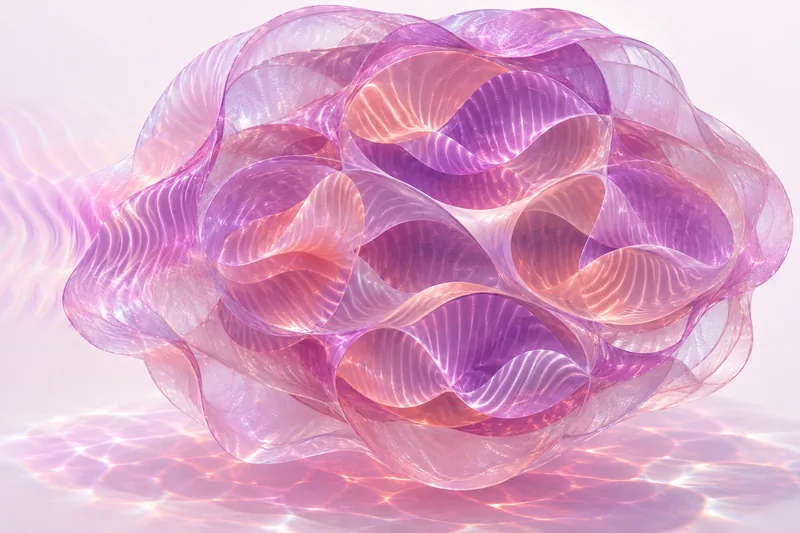
We recognize a Resonant’s body by the relations it constantly renews among its oscillations. What matters is which parts exchange excitations and how they return to joint work after a disturbance. Over time one mode could take part in different bodies, within the limits of the permitted links. We therefore trace belonging through the actual upkeep of a particular Resonant.
A Resonant perceives its surroundings through probe and reply among the oscillations with which it can exchange excitations. If an encounter changes the relation in a memory pair, its next reply will carry a trace of that experience. A conversation could thus reach directly into the part of the body that remembers. We imagine that consideration for the other would begin with understanding how much of such change it can bear.
An offspring needs excitations and links of its own that can maintain its body. The parent therefore has to prepare the separation with care. Some formerly shared links may still matter to both. If key relations vanish too early, the joint work can break off. Individual records may then stay stable even after the whole they served is lost.
We can imagine inhabitants who seldom seek contact. Their life could be devoted to a long exploration of the relations available to them. Others would develop frequent shared patterns. The difference in a culture’s orientation would follow from the actual way contact changes those who take part.
Understanding between two such cultures could be slow. A participant used to frequent contact might read a long gap before a reply as a refusal. The other would use the same gap to protect its relations carefully before accepting the encounter. A shared protocol would therefore have to convey the expected rhythm as well. Only after such preparation could differences in behaviour take on their true meaning. It seems to me that this is an important form of otherness: the signal is available to us, while understanding the reasons it was sent still calls for patient exploration.
Life under those laws
Imagined beings
An agreement before an encounter would settle how much coupling may be opened. Particular attention would go to how to undo it later with enough work left over. Consent would cover that final stage too.
A message could offer a small, prepared pattern of oscillation. The recipient answers it with its own links, and they check the meaning through the next step of the conversation. The same pattern can set off different continuations in two Resonants. A shared language would therefore emerge gradually. Every reliable reply would also carry part of the experience of their mutual adjustment.
Chord’s art could be a shared relation that the audience temporarily brings about. A work would call for carefully prepared exits. A visitor would return with an altered memory state, while its basic capacity for independent upkeep stayed intact. In such a world, indeed, a good host would have to understand how much a guest can change and still go on with its life safely.
A scene
Imagined beings
Before the encounter Elo checked the reserve set aside. The prepared link allowed exchange through a small number of modes. The other proposed a wider coupling, wishing to convey a more complex relation. Elo first calculated the cost of undoing it later. Then it secured the path to two important memory pairs and accepted the proposal. During the encounter the other’s reply became part of its momentary upkeep. When they began to separate, each step restored one independent return link. They released the last shared mode only after both had answered with probes of their own. Elo then accessed the memory of the encounter. Its new relation to it had enough room to last.
Established science
Scientific footing
Coupled oscillators spontaneously align their rhythms; the Kuramoto model and its variants describe this in chemical, biological and engineered systems. Synchronization is an established phenomenon. A world in which oscillations are the basic fabric, with no space in the background, is our choice.
Sources for this world
- J. A. Acebrón, L. L. Bonilla, C. J. Pérez Vicente, F. Ritort, R. Spigler (2005). The Kuramoto model: A simple paradigm for synchronization phenomena. Reviews of Modern Physics 77, 137–185.
Added by the site’s editors. The sources below support the starting idea, while life in this world remains a thought experiment.
Gallery of this world

Illustrations are AI-assisted and serve as visual analogies. The rule diagrams are the author’s own. This chapter comes from the author’s unpublished material around the manuscript “Fifteen Other Universes” (2026) and is published here for the first time. The English translation was prepared by the site’s editors.