World 6 of 22 · Other universes
The Braid
Nearness is set by links. Change a link and you have changed the distance.
- Space and geometry
- Communication and delay
- Memory
- Boundary of body and home
Text: Nebo D. Lukovich ·
Speculative model
Imagine that the way to a friend leads through ten doors. If someone opens a new door between two rooms, we arrive sooner. In the Braid, exactly that kind of relation decides what is near. An inhabitant comes to know its world through the replies that reach it along links. Our picture of nodes helps us follow that.
How would a living being arise there? We need an assembly able to renew the links it depends on. It must then keep a trace of experience and use it at the next encounter. We add that as an assumption about possible life. Every repair spends part of the available work, so the same world can suit one organization and be too depleted for another.
The world’s rule
Speculative model
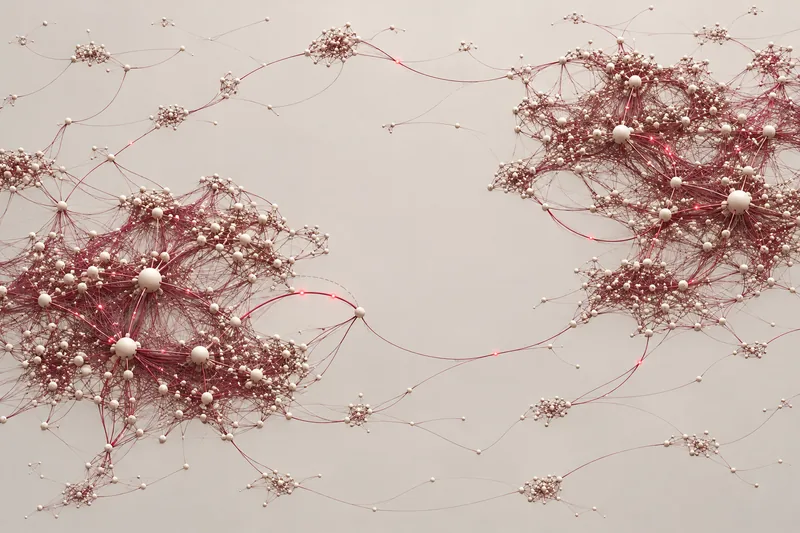
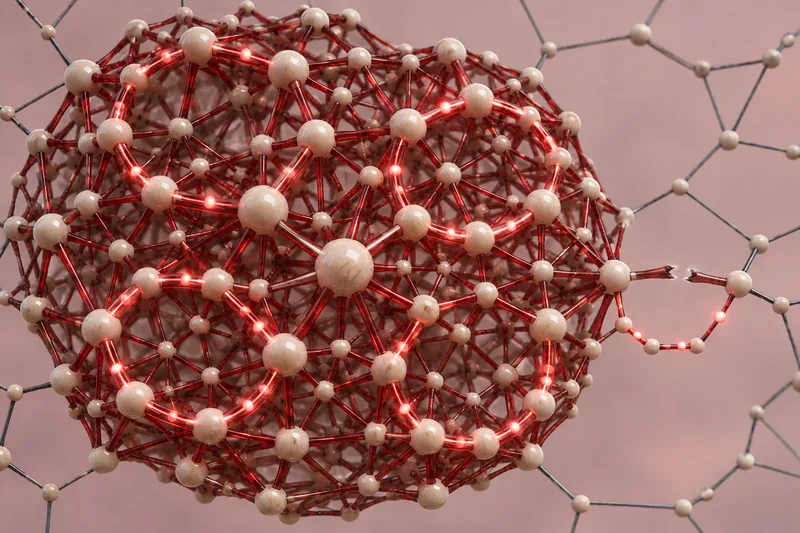
This universe, which we have called the Braid, does not rest on space and on distances between elements that we would recognize. Unlike ours, this world is built from a network of nodes, each with a limited number of ports. In one step an excitation crosses one link, so the distance between two nodes is set by the shortest available path. Change the neighbourhood, and we have changed the distance.
That change takes place within the limited surroundings already available, and for every new connection we must free the appropriate ports and pay a certain amount of work. Imagine a fund of eight working excitations. If a procedure spends two, six usable ones remain and two in spent form. The sum is conserved. For further work, however, more available reserve has to be found.
In the illustration links look like lines in space. That is our map. For the inhabitant, neighbourhood is the basic datum, and a crossing of lines in the drawing gains physical meaning only when we assign a node to it. This difference also determines how one travels. A new destination comes closer through a series of permitted changes within the existing network.
A weave has to tell a change it can accept from damage that threatens its life. Imagine a small disturbance setting off local responses that close an important loop again. Such renewal requires an available reserve and a passage to the damaged place. We would measure the ability of a living assembly partly by how many different disturbances it can ride out while still directing the repair itself.
A cosmic home
Speculative model
The Great Interlace consists of densely connected regions. Within each, a message can find several return paths. Between those regions there are fewer crossings, so a more distant encounter becomes slower and more delicate. We choose such surroundings as a possible home for more complex inhabitants.
The Unbinder holds an initial store of excitations from which the surrounding assemblies draw work. Seventh Knot, our habitat, has several supply paths. If one is damaged, another can take over its job for a while. When all of them become too slow, the same place turns unfavourable even though a large part of the network still exists.
We picture the first step towards life as a small loop that uses part of the incoming flow to renew its own links. The next step would be preparing a similar loop nearby, with a separate supply. For that transition, rules must be found that really pass the organization on to an offspring. A single permitted local change gives a starting mechanism that we are only beginning to develop.
The being and its life
Imagined beings
We will call the inhabitant a weave. Its body comprises the links that together renew its responses. We trace its boundary by asking which paths take part in its independent upkeep. Over a lifetime some nodes may change role and become part of another assembly.
A weave gets to know its surroundings through probes it sends along available links. Their return tells it whether a path is open. A memory is a stable arrangement that gives a recognizable reply to a familiar probe. When the path to that arrangement lengthens, even a familiar thought can take longer.
An offspring begins to live independently when it receives a connected organization and a supply of its own. Enough ports and work must remain for both it and the parent. A weave stops living when its parts can no longer put together a shared response. Some traces may remain in the network and later become available to another inhabitant.
Life under those laws
Imagined beings
In the Braid a public path can at the same time take part in someone’s thinking. The right to change a link would therefore include checking whom that change slows down. Ownership of a single node would hardly account for all the obligations of its users.
Finding one’s way could rely on the recognizable replies of a few dependable nodes. An inhabitant would remember the paths to them and the duration of the probes. When the public interlace changes, that personal map changes too. Imagine link-keepers who notify users of such changes and maintain return links while work is under way. Their skill would join traffic with care for other beings’ memory.
Art could offer a temporary way of connecting. A visitor would pass through prepared relations and then return to its own organization. Preserving the way back would be part of the artistic procedure. I think it is the origin of a path that would give such inhabitants a particular sense of closeness.
A scene
Imagined beings
Iri sent a friend a familiar probe. The reply arrived seven crossings later than before. The recognizable mark was intact. The path to it had changed. Iri went through the spare connections and set aside a flow it could slow down for a while. The friend, for its part, prepared the neighbouring region. They worked in stages. After each change they checked that both still had access to their most important loops. When the shorter path began to work, Iri saved a record of how it came about. Maintaining that passage will from now on require their joint decisions. Their closeness had taken a form that both could look after.
Established science
Scientific footing
Models in which space and nearness emerge from a network of relations are studied in quantum gravity; one example is the “quantum graphity” of Konopka, Markopoulou and Severini. They are theoretical proposals without experimental confirmation. Living weaves and their economy of ports belong to our construction.
Sources for this world
- T. Konopka, F. Markopoulou, S. Severini (2008). Quantum graphity: A model of emergent locality. Physical Review D 77, 104029.
Added by the site’s editors. The sources below support the starting idea, while life in this world remains a thought experiment.
Gallery of this world
Illustrations are AI-assisted and serve as visual analogies. The rule diagrams are the author’s own. This chapter comes from the author’s unpublished material around the manuscript “Fifteen Other Universes” (2026) and is published here for the first time. The English translation was prepared by the site’s editors.