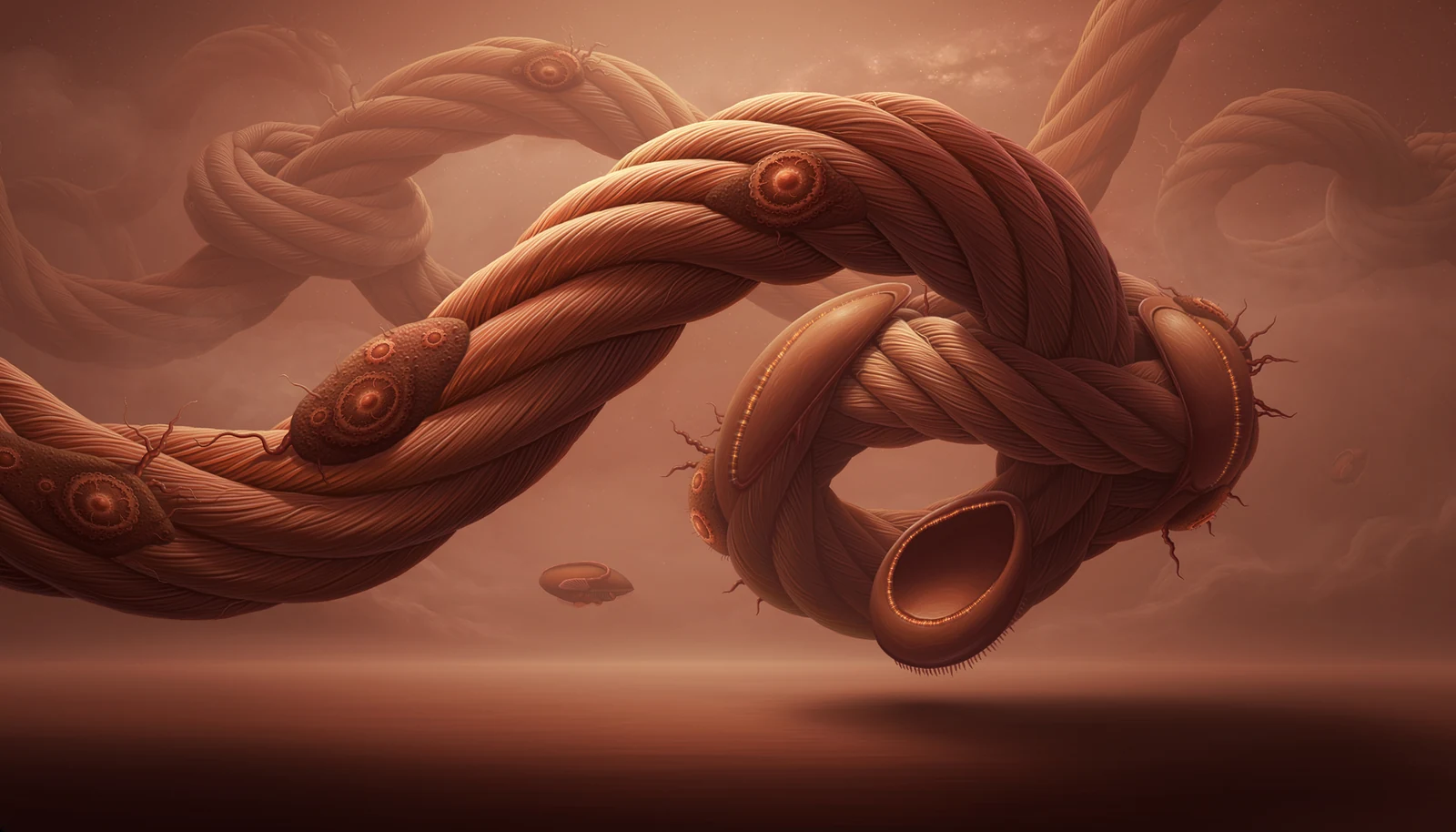
World 7 of 22 · Other universes
Cordia
Matter is plaited from strands, and a knot keeps what a body is.
- Space and geometry
- Memory
- Identity
- Boundary of body and home
Text: Nebo D. Lukovich ·
Speculative model
Take a piece of rope and tie a knot. We can move it and bend it, and it will keep certain relations for as long as the strand stays whole. In Cordia such properties become part of the physical foundation. Its strands carry excitations and can build far more intricate assemblies than our rope.
The long life of a knot, however, is only the start of a story about life. A Cordion has to change as it learns. So we imagine tougher parts that preserve the basic structure and more mobile loops in which experience leaves a trace. The most delicate question becomes how to repair a body while keeping the memory that its arrangement carries.
The world’s rule
Speculative model
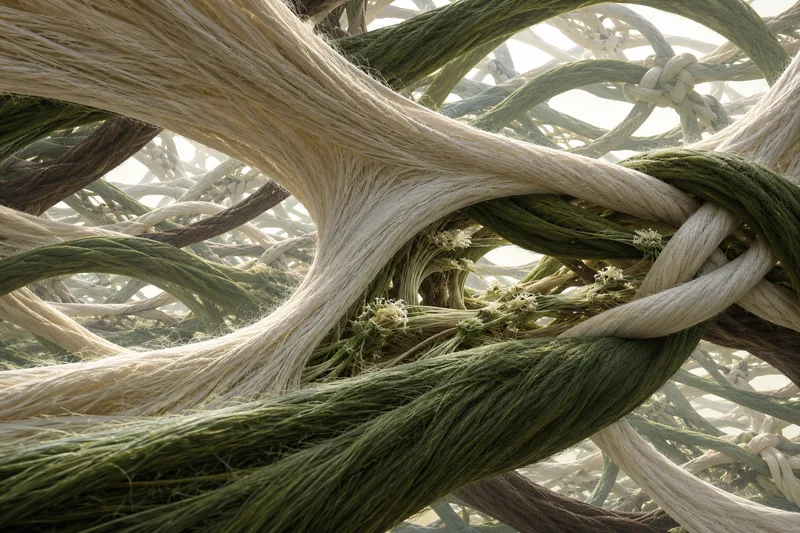
Cordia is filled with elastic strands that have thickness. We can picture them bending and touching in three-dimensional space. Excitations travel along them, so the reply of a distant part arrives with a delay. Tightening the strands also changes the energy of the assembly. Every rearrangement of a body therefore has to include a change in its tension.
A knot limits the ways in which an assembly can change. While a closed strand is whole, part of its relations stays preserved. Breaking and rejoining call for suitable local conditions. For memory we also need parts whose arrangement can be changed. So we place the trace of experience in the bending of loops or in the internal properties of the strands.
For every reconnection we require a threshold of work. If the rearrangement releases three units of bending energy, and the operation itself takes two more from the working fund, the background receives five in the end. Both the opening and the closing account include all these parts. Real research on stable knotted solutions shows interesting possibilities in particular models; a living Cordia is our further step. Jäykkä and Palmu
A cosmic home
Speculative model
The largest wholes of Cordia are connected bundles of macrostrands. Imagine a great knot that has long stored energy in its bent shape. As it gradually relaxes, it hands that energy on along the surrounding strands. The inhabitants would feel the change through the tension of their habitat and the rhythm at which the work they need for life reaches them.
Our inhabited world is called Plait. It is a large, protected interlacing of loops with calmer parts in its interior. Delicate assemblies can survive there. As the energy source runs down, the places suited to life change as well. Migration therefore starts with the preparation of new joints, with tension carefully transferred from the old habitat to the new.
We can picture the forerunner of the Cordion as a knot that steers passing excitations towards its own damage. For more complex life we add the ability to prepare a new interlacing and provide it with enough material. The offspring must then coordinate its parts itself. The emergence of exactly that ability remains the open step in our idea of a living Cordia.
The being and its life
Imagined beings
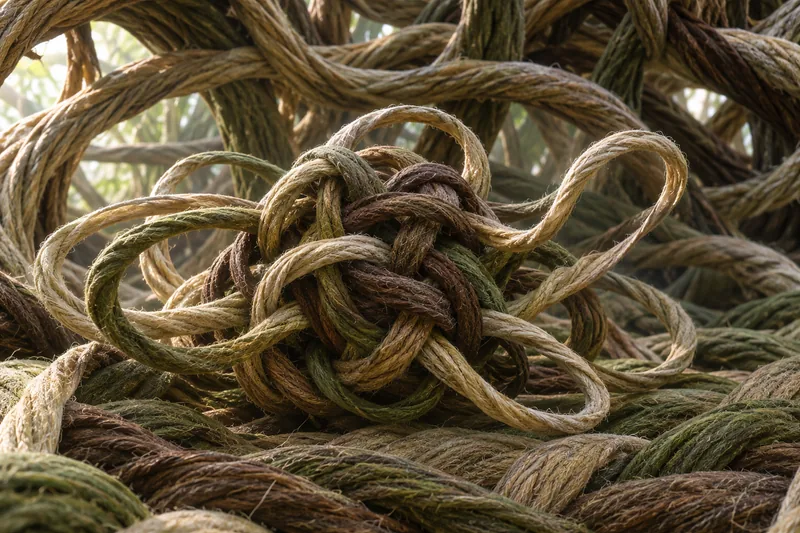
A Cordion’s body consists of active loops joined into a whole. What has happened to it leaves a trace in their arrangement. A vibration arriving through a strand can change its next response. That is how we might imagine perception. Its immediate world would depend on the paths through its body and on the time an excitation needs to return.
Imagine a memory loop that can hold two different shapes. When the Cordion sends the same faint excitation, each shape returns a different reply. In that way it would tell two recorded states apart. Learning would mean carefully moving a loop from one shape to the other while preserving the surrounding memories. More complex memory would require a whole network of such relations.
A Cordion acquires an offspring by building a new interlacing and gradually establishing its links. The parent can keep the same basic knot while a different life develops in the new body. Two Cordions can therefore have the same kind of knot and entirely different memories. An injury too can preserve the knot and still break the joint working of the body.
How would a Cordion recognize a friend? It would send a faint test vibration and wait for the familiar reply. During recovery the tension of a body can change, and that greeting changes with it. A friend might recognize the familiar interlacing through a different response. A stranger would need more time. A courteous encounter would therefore begin with an excitation gentle enough for the other to show its present state safely.
Life under those laws
Imagined beings
Cordia’s medicine would have to distinguish two aims:
-
To preserve the properties that protect the body from falling apart.
-
To preserve the changeable relations through which an individual remembers and recognizes its experience.
Repairing a body would sometimes alter the arrangement of an important memory. The healer would therefore choose, together with the Cordion, which shape of the loop to restore. We can imagine similar care in art. An audience would follow the gradual unwinding of one assembly, and the final form would keep a trace of that journey. The experience of the work would stay inscribed in its new organization.
A scene
Imagined beings
A Cordion recognized the incoming rhythm, but the reply of one memory loop no longer fitted it. The damaged place allowed two safe arrangements. Both kept the basic knot. Only one restored the expected link with an older memory. The healer first eased the tension of the surrounding strands. Then it sent a probe along both prepared paths. The Cordion waited for them to return and chose the slower one. In that response it recognized the beginning of a conversation from long ago. The operation used up the rest of the reserve set aside. Its body now needed a longer recovery. The preserved memory, however, was taking part in its responses again. The loop had gained a new arrangement and a familiar place in its life.
Established science
Scientific footing
Stable knotted solutions exist in particular field models; Jäykkä and Palmu found them in a modified Ginzburg–Landau model. From such a solution to matter made of strands, and to a body that remembers, leads a series of assumptions that we introduce ourselves.
Sources for this world
- J. Jäykkä, J. Palmu (2011). Knot solitons in a modified Ginzburg-Landau model. Physical Review D 83, 105015.
Added by the site’s editors. The sources below support the starting idea, while life in this world remains a thought experiment.
Gallery of this world
Illustrations are AI-assisted and serve as visual analogies. The rule diagrams are the author’s own. This chapter comes from the author’s unpublished material around the manuscript “Fifteen Other Universes” (2026) and is published here for the first time. The English translation was prepared by the site’s editors.