World 12 of 22 · Other universes
Morphia
Life is a spot that grows, divides and remembers.
- Body as process
- Memory
- Identity
- A changing ground
Text: Nebo D. Lukovich ·
Speculative model
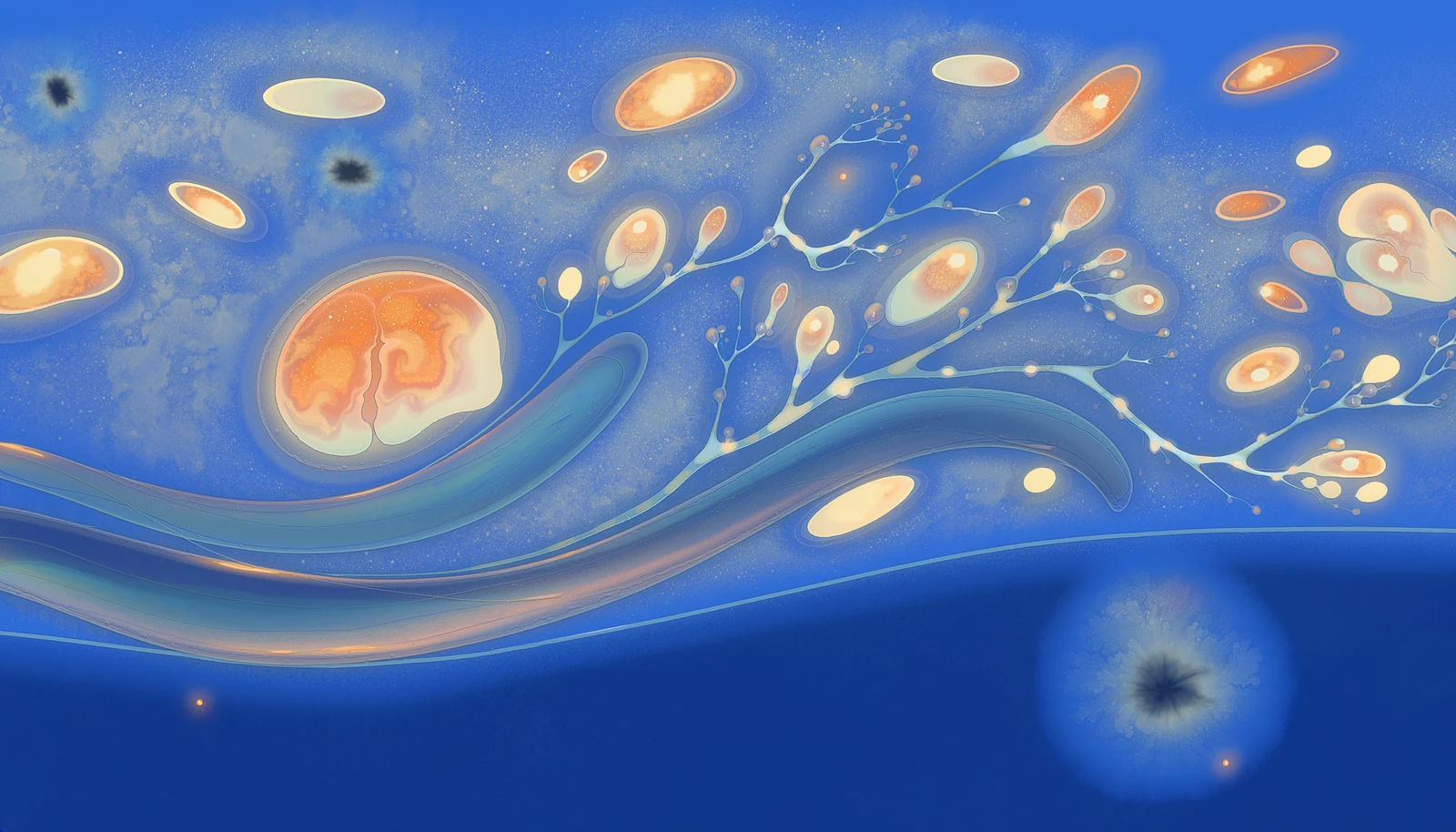
A drop of dye in water spreads slowly. Now imagine ingredients that, on meeting, prompt the formation of a new active ingredient while another part is used up. Their exchange can create recognizable spots and fronts. We look for Morphia’s life among more complex versions of such patterns.
A Morphion would constantly renew its boundary from the material that arrives. The greatest obstacle is reliable memory. If all the material is replaced quickly, experience has to leave a trace in something stable enough. So the model is given separate memory carriers, and only then do we ask how the organism selectively changes and uses them.
The world’s rule
Speculative model
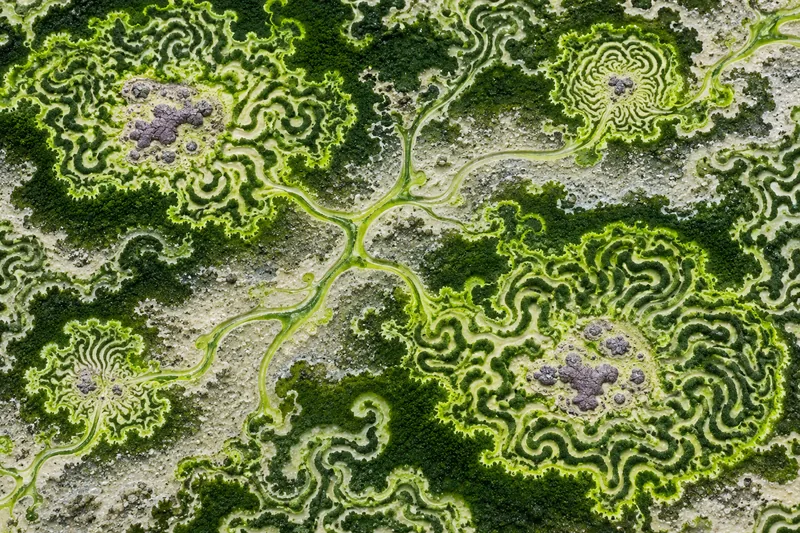
Morphia consists of reaction fields on a two-dimensional region. For a small model we choose a substrate S and an activator A, along with a spent form W. The reaction S + 2A → 3A lets the activator present prompt the formation of more. Through a second reaction, A → W, it passes into the spent form. The sum of their amounts stays conserved.
The letter S stands for the available raw material, A for the active ingredient, and W for the spent form. The first reaction says that two active ingredients present can, with one unit of raw material, make one more. The second says that an active ingredient can be used up. Such exchange allows local patterns to grow and die out.
In the finite model, transport proceeds in local steps between neighbouring regions. The familiar diffusion equation can serve as an approximate description of such exchange at larger scales. For messages we will follow actual paths through our chosen system.
Memory is given separate carriers in the states M0 and M1. Their total number is limited. Writing uses substrate to turn M0 into M1. Erasing also spends available difference and alters the energy balance. The memory state then affects the future local reaction. A memory thereby acquires a definite place and a price. It remains for us to construct an organization that uses such records reliably.
A cosmic home
Speculative model
Large networks of reaction regions are the cosmic wholes. Sources bring substrate from finite reservoirs. The account also includes the place where the spent form collects. When the useful difference weakens, a source changes the conditions of the whole connected ecosystem.
Autocatalia is a region of long-lasting exchange with those reserves. On our map there appear spots that grow and reaction foci joined by waves. Colours help us follow the states. We will attribute perception to the inhabitants through a physical response to a change in composition.
Here we have a concrete scientific starting point. Lee and colleagues observed experimentally the growth and repeated division of spots in a reaction–diffusion system. Such a result shows a definite possibility of self-organization. Morphia’s heritable learning we introduce as a further constructional hypothesis. Lee and colleagues
The being and its life
Imagined beings
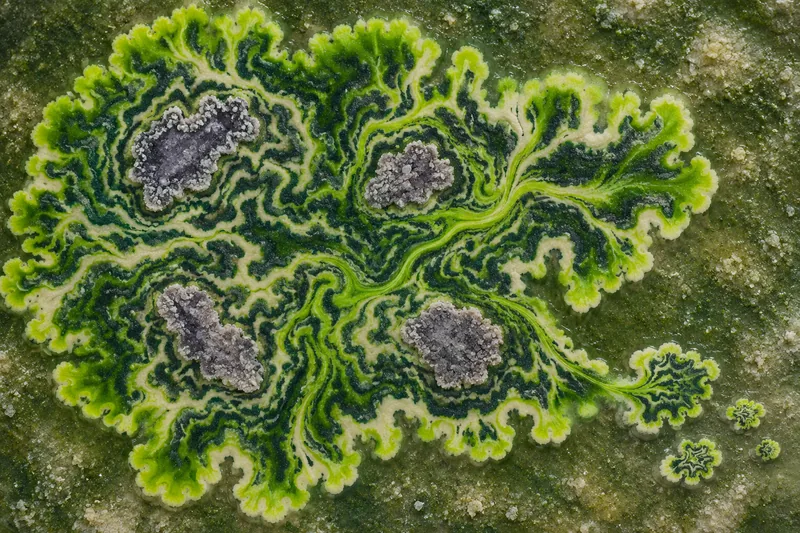
A Morphion is a self-sustaining spatial process. Its boundary determines which reactions jointly renew the organization. Components pass through it continuously. A stable enough relation among the processes preserves its biography despite the change of material.
Perception arises when an arriving composition changes its response. If the memory carriers are rearranged in the process, a future reaction can depend on an earlier encounter. That takes stable states and sufficiently selective writing. The simple initial reactions by themselves supply only part of the necessary conditions.
Reproduction involves a division that leaves both new wholes with a viable arrangement. The offspring must gain access to substrate. If neighbouring processes supply most of the components needed, an individual’s origin also includes an inheritance of ecological relations.
Let us now imagine a Morphion’s possible experience. A familiar signal might appear as its body’s readiness for a particular continuation of the reaction. A memory would be present through a different response to the same composition of the surroundings. This description of experience remains our hypothesis. The loss of shared internal regulation would mark the end of the individual, even while the remaining reactions continue in the settlement.
Neighbouring Morphions could share some ecological functions while keeping separate autobiographical processes. In another region there might be a much wider organization with a slower shared response. On meeting, it would be hard to decide at once to which scale a question should be addressed. A small active front could be an independent interlocutor, or part of a process whose reply is still on its way from a wider network. Our story therefore leaves room for several forms of community. We would trace their division by actual control and by access to records, with a separately argued attribution of experience to each of those scales.
Life under those laws
Imagined beings
An Autocatalian community could maintain several mutually dependent kinds of process. Some would prepare the flows that others need. Different individuals would react within different intervals, so a common agreement would have to respect those whose reliable reply takes shape more slowly.
In such a culture a change in the public supply would reach into inheritance. An offspring can take over a good internal arrangement and still be left without the composition needed to maintain it. The success of a new generation would therefore be reckoned through a renewed network of relations. Art could be the gradual emergence of a pattern that different participants complete with their own reactions.
A scene
Imagined beings
In one part of Autocatalia, new patterns were ceasing to sustain themselves soon after division. An older Morphion compared their response with its own records. The shared supply had changed. It sent an organized impulse to a neighbouring process that prepared the necessary component. That process’s reaction had a longer reliable interval, so the Morphion kept up a temporary feed while it waited. When the reply arrived, they rearranged the exchange together. The new offspring then held its boundary and repeated the expected probe. The settlement maintained both flows for a while longer. Only after stable replies did it shut down the temporary one. A successful birth now included a renewed relation with the surroundings.
Established science
Scientific footing
In 1994 Lee and colleagues observed spots that grow and divide in a laboratory reaction–diffusion system. That shows simple chemistry can build and multiply patterns unaided. Heritable memory in such patterns was not shown in the experiment; we introduce it as a constructional hypothesis.
Sources for this world
- K.-J. Lee, W. D. McCormick, J. E. Pearson, H. L. Swinney (1994). Experimental observation of self-replicating spots in a reaction–diffusion system. Nature 369, 215–218.
Added by the site’s editors. The sources below support the starting idea, while life in this world remains a thought experiment.
Gallery of this world
Illustrations are AI-assisted and serve as visual analogies. The rule diagrams are the author’s own. This chapter comes from the author’s unpublished material around the manuscript “Fifteen Other Universes” (2026) and is published here for the first time. The English translation was prepared by the site’s editors.