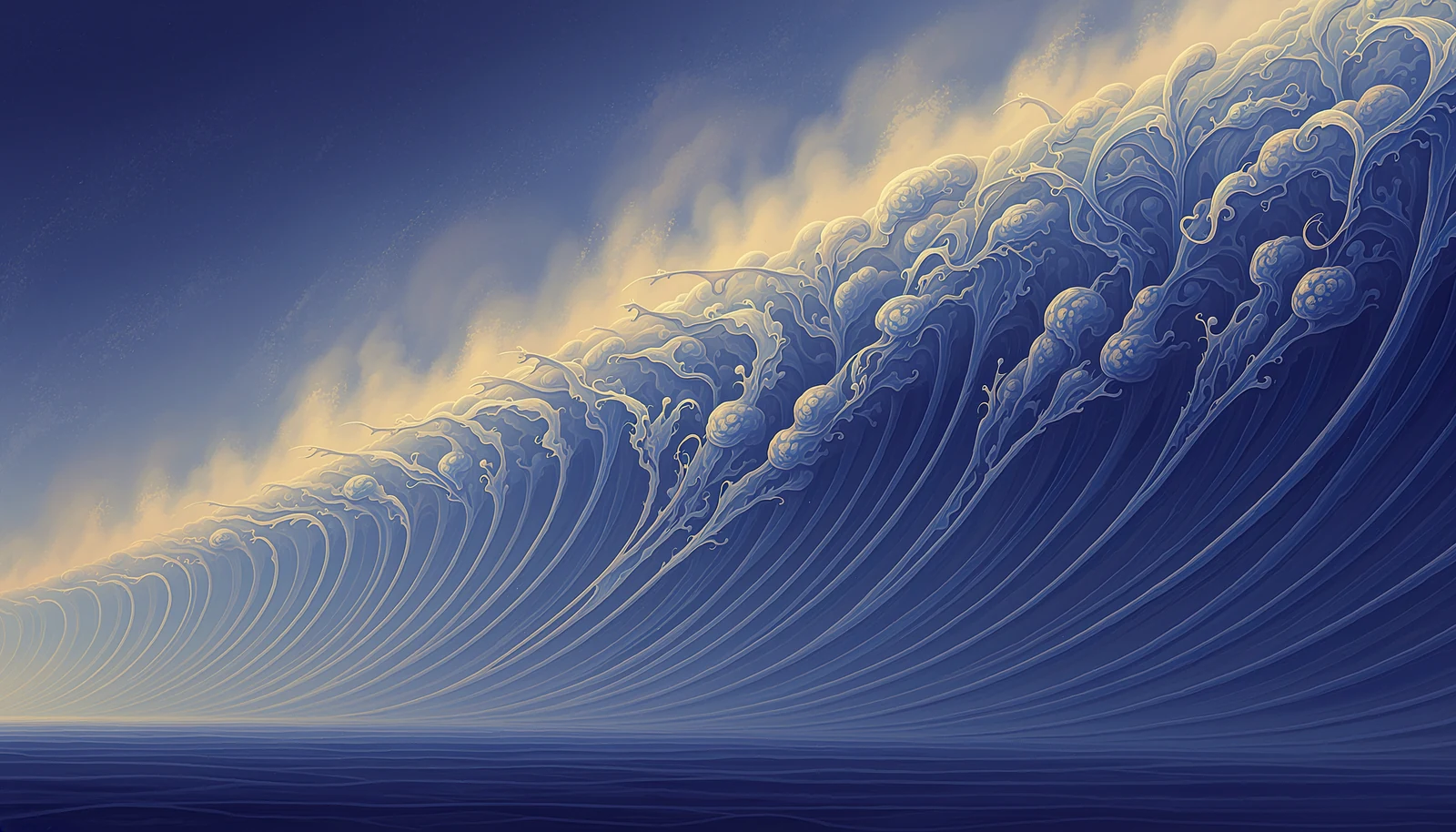
World 13 of 22 · Other universes
Two Times
Every event has two time labels, and a body must know which sequence it can follow.
- Time
- Communication and delay
- Memory
- Identity
Text: Nebo D. Lukovich ·
Speculative model
On a map we can head north and at the same time veer a little to the east. Let us now try to grant a similar freedom to development in time. A single event receives two time coordinates. An inhabitant has to know which sequence of changes its body can follow.
That is where the main problem begins. If we allow every direction in time, it is hard even to state rules for reliable prediction. So we will give this world a limited set of permitted steps. Their local alignment can change, and every step must advance against a common clock. In that way we set clear conditions for our thought experiment.

The world’s rule
Speculative model
We will call the time coordinates T and S. For every permitted step we require ΔT > 0 and |ΔS| ≤ aΔT, where a is a finite chosen bound. T is the common clock, and S describes a transverse position in time within a limited range. The wedge set by the inequality shows which continuations the model allows at all.
An alignment field determines which direction within that wedge is locally most favourable. In one region a process can advance further along S than in another, always with the common clock moving forward. The law must separately specify the next state and the initial data required. The constraint on T prevents a permitted path from bringing us back to the same earlier T.
This is a clear construction for our story, with two time labels and a limited set of continuations. A full physical theory with two independent time dimensions would demand far more. Tegmark considers the difficulties of predictability in certain models with more than one time, and Bars uses additional symmetries and constraints in his approach. Our alignment field and the Turner’s biology are additional assumptions. Tegmark; Bars
A cosmic home
Speculative model
We will call the large whole the Time Arc. Its regions have different local alignment, so a traveller crossing between them has to adjust the rhythm of its internal processes. In calm regions the field changes slowly. There it is easier to keep a reliable relation between perception and response.
Sources maintain the calmer regions from their finite reserves. We will call them alignment anchors. Their role in the model is to support stable working conditions. When a reserve dwindles, the protected region weakens. The cost of adjusting then rises, and settlements must judge whether they can carry on in the same place.
The habitat Tiva covers a wide region of gentle gradient. Its inhabitants keep a calendar of ordinary bodily cycles and a calendar of changes in alignment. The first helps them schedule daily work. The second sets the favourable moments for travel and for renewing shared devices. The origin of such stable surroundings remains a cosmological assumption.
The being and its life
Imagined beings
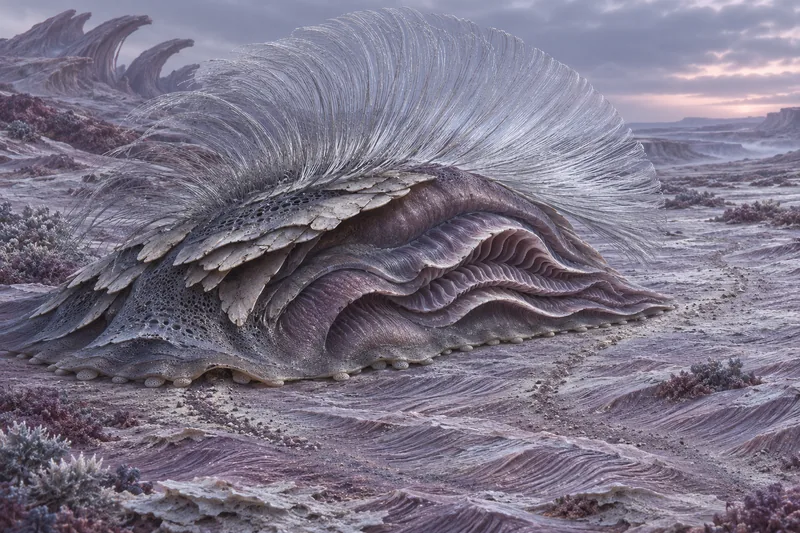
A Turner has a layered body with several connected internal rhythms. A sensitive crest sends faint probes through the surroundings and receives their return. The difference between the replies tells it how the local alignment affects its processes. The body then rearranges the links between its rhythmic parts.
An imagined sideways computation distributes subtasks across the available positions in time. Their results have to meet in a permitted later state. Every subtask uses working reserve, and every reply has a physical path. The benefit of such an organization depends on the precise dynamics we choose. The second time label by itself leaves open how fast a computation could be.
A Turner’s memory consists of the traces available in its present state. It follows their reliable order by increasing T. An offspring receives enough material and begins to coordinate its rhythms separately. Danger arises when a change in the field pulls the necessary processes so far apart that they can no longer put together a shared response. A possible experience of breadth in time belongs to our literary hypothesis.
Life under those laws
Imagined beings
The journeys of Turners would require agreement on places of renewed alignment. Two companions could take different permitted paths through the time band and then exchange records in a shared later state. Preparing an encounter would include checking that both bodies can bear that crossing.
Their art might arrange relations among several bodily rhythms. A visitor would leave a work with a differently connected memory of its course. The community would therefore value reliable guides through changes of alignment. I think the notion of punctuality would also cover the way a promised encounter stayed reachable for both sides.
A scene
Imagined beings
At the edge of a calm region Naja felt the mismatched return of two probes. Her companion had already prepared for a different slope of process. They exchanged the schedule of the encounter and set aside the necessary reserve. Naja first adjusted the slowest part of her body. Only after receiving an orderly reply from it did she change the other rhythms. They reached the meeting place by different permitted paths. Both could read the record of the agreement and confirm that the common clock had advanced. Their conversation continued in the prepared later state.
Established science
Scientific footing
Tegmark showed that in worlds with more than one time dimension the equations of physics lose predictability, so an observer there cannot reliably compute the future. Bars develops two-time physics with additional symmetries that remove the problem. Our wedge of permitted steps and the alignment field are chosen rules of the story.
Sources for this world
- M. Tegmark (1997). On the dimensionality of spacetime. Classical and Quantum Gravity 14, L69–L75.
- I. Bars (1998). Two-Time Physics. arXiv:hep-th/9809034.
Added by the site’s editors. The sources below support the starting idea, while life in this world remains a thought experiment.
Gallery of this world
Illustrations are AI-assisted and serve as visual analogies. The rule diagrams are the author’s own. This chapter comes from the author’s unpublished material around the manuscript “Fifteen Other Universes” (2026) and is published here for the first time. The English translation was prepared by the site’s editors.