World 14 of 22 · Other universes
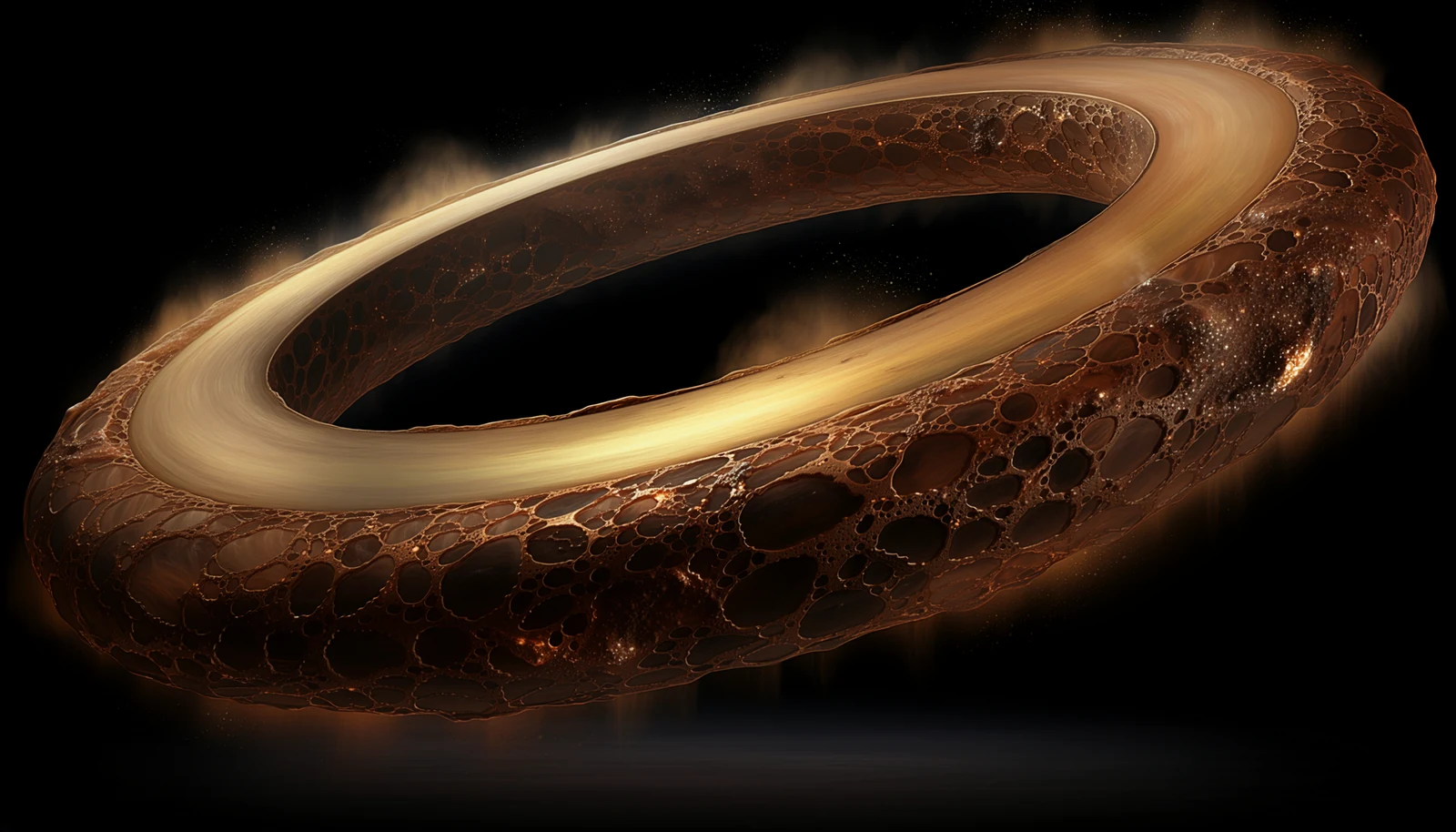
The Ring
After a set period the whole world returns, with all its records.
- Time
- Memory
- Identity
Text: Nebo D. Lukovich ·
Speculative model
Imagine a book whose last page leads to exactly the same first page. In the Ring the entire physical state closes in that way. The return includes the inhabitant’s body and the traces of its experience. That is what makes this world more demanding than the ordinary recurrence of the seasons.
In the developmental part of its history an Arcling can learn and experience novelty. The memories available to it refer to the events that shaped them. The imagined biology must then be part of a history that closes exactly. The rule of the cycle by itself leaves open how an inhabitant would experience its returning part.
The world’s rule
Speculative model
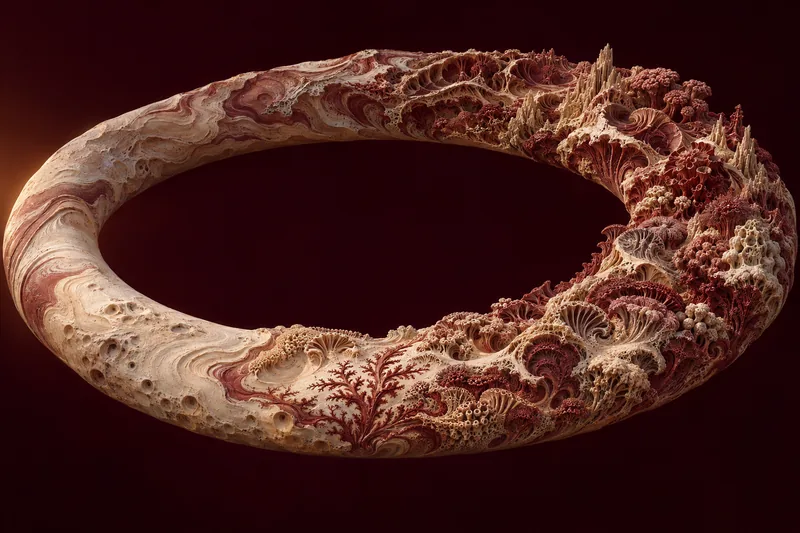
In the Ring the complete state of the world returns after a period T. To realize that requirement clearly in a small model, we choose a finite network of reversible operations. The first part of the cycle carries out a sequence G. The second part runs through its inverse sequence G-1. The final result is a return to the initial state.
We can picture the sequence G as several moves of a puzzle. The inverse sequence takes those moves back in reverse order, reversing each operation exactly. To truly obtain the same state at the end, we must also include every auxiliary trace of the procedure. In our world we apply the same requirement to the whole.
The requirement of return covers every record in the world. We include auxiliary traces too, together with the physical state that determines the next operation. Every memory acquired has to be part of the same cycle. In a small check we followed an eight-bit assembly. All 256 possible initial states returned to the start after twelve prescribed steps.
Reversible processing has real footing in research. Bennett’s paper shows how a computation can be organized through reversible steps with careful handling of intermediate results. Our exactly periodic cosmos introduces an additional global postulate. Its rich biology we have to imagine separately. Bennett
A cosmic home
Speculative model
The Great Rosette covers many regions with periodic histories. In their developmental part there are ordered assemblies from which inhabitants can obtain work. We call those sources unwinders. While they support the surrounding processes, they themselves change. Everything that happens to them must then take part in the later closing of the whole cycle.
Half-Arc is a region with long-lasting access to such configurations. In one part of its history inhabitants can build ever more complex relations. Their records hold correlations with earlier local events, so life appears to them as a series of changes with a familiar arrow of memory.
We imagine the origin of reproductive processes within that developmental part. The complete history must also include every trace of their emergence. What a subjective description of the inverse epoch would be remains open. The algebraic return by itself does not settle what it would mean, from within, to follow that half of the cycle.
The being and its life
Imagined beings
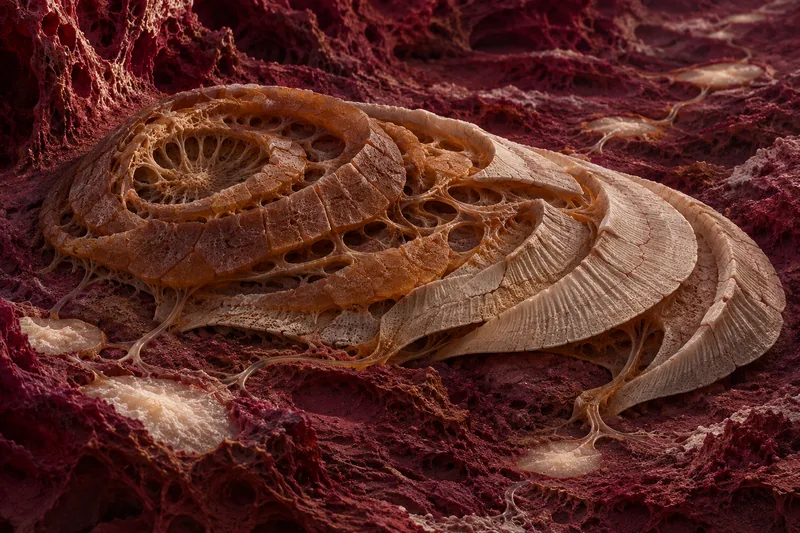
An Arcling’s body is maintained by parts that exchange excitations and together repair their arrangement. It comes to know its surroundings through the events available at the current stage of the cycle. A memory is a present record that carries the trace of an earlier encounter. So an Arcling can learn during its developmental epoch, and each new response becomes part of the same periodic history.
Imagine an Arcling’s experience of novelty while it is only just forming links between a present encounter and earlier memories. The description of the whole cycle belongs to our external model. For the Arcling, knowing about distant events would require suitable records and the means to read them. Its view of the world therefore depends on what is truly available to it at that stage.
An offspring receives assemblies of its own and prepared auxiliary states. In the developmental epoch their history can branch. Under the condition of full closure each of those processes must again reach the prescribed state. A memory of the previous full circle would introduce a difference with respect to that requirement. That is why our stories stay in the part where records can really be maintained.
Life under those laws
Imagined beings
Arclings could value the shape of the complete history in different ways. One culture could invest in the harmony of events across the whole period. Another would devote its attention to the local relations available in the developmental epoch. Their basic laws would be the same, while the meaning of life would be given different emphases.
A work of art might be an entire chosen sequence of changes. A complete view of it would belong to our description. An inhabitant would come to know its parts along its own path. The difference between available knowledge and a philosophical idea of the whole would leave room for different beliefs.
The completeness of the cycle leaves an interesting space for local uncertainty. An Arcling has certain records and tries to predict the next encounter from them. Knowing the law of return does not by itself reveal every detail of it. In our story it could weigh possibilities and change its behaviour according to the reasons available, while that procedure as a whole belongs to the same closed history. I think its debates about freedom would therefore also depend on whether it is speaking of its experience of deciding or of a description of the entire period.
A scene
Imagined beings
Rin was preparing an experiment on the return of a small assembly. His colleague suggested that they keep the result in a separate register. Rin went over the boundary of the experiment and included that register as well. Then they added a record of its being read. Every check left a new trace that had to enter the whole. For a small sub-assembly they could demonstrate closure while they themselves stayed outside its period. When they considered the return of the entire world, their own positions were part of the same account. Rin described that difference in an available note. He finished the experiment in the developmental epoch and shared the result with his colleague. Their conversation was at that very moment extending the local history.
Established science
Scientific footing
In 1973 Bennett showed that any computation can be carried out in reversible steps, with careful handling of intermediate results. That is a well-founded result of the theory of computation. A cosmos that returns exactly to its initial state is an additional global postulate, and we leave open how the returning half of the cycle would be experienced.
Sources for this world
- C. H. Bennett (1973). Logical Reversibility of Computation. IBM Journal of Research and Development 17, 525–532.
Added by the site’s editors. The sources below support the starting idea, while life in this world remains a thought experiment.
Gallery of this world
Illustrations are AI-assisted and serve as visual analogies. The rule diagrams are the author’s own. This chapter comes from the author’s unpublished material around the manuscript “Fifteen Other Universes” (2026) and is published here for the first time. The English translation was prepared by the site’s editors.