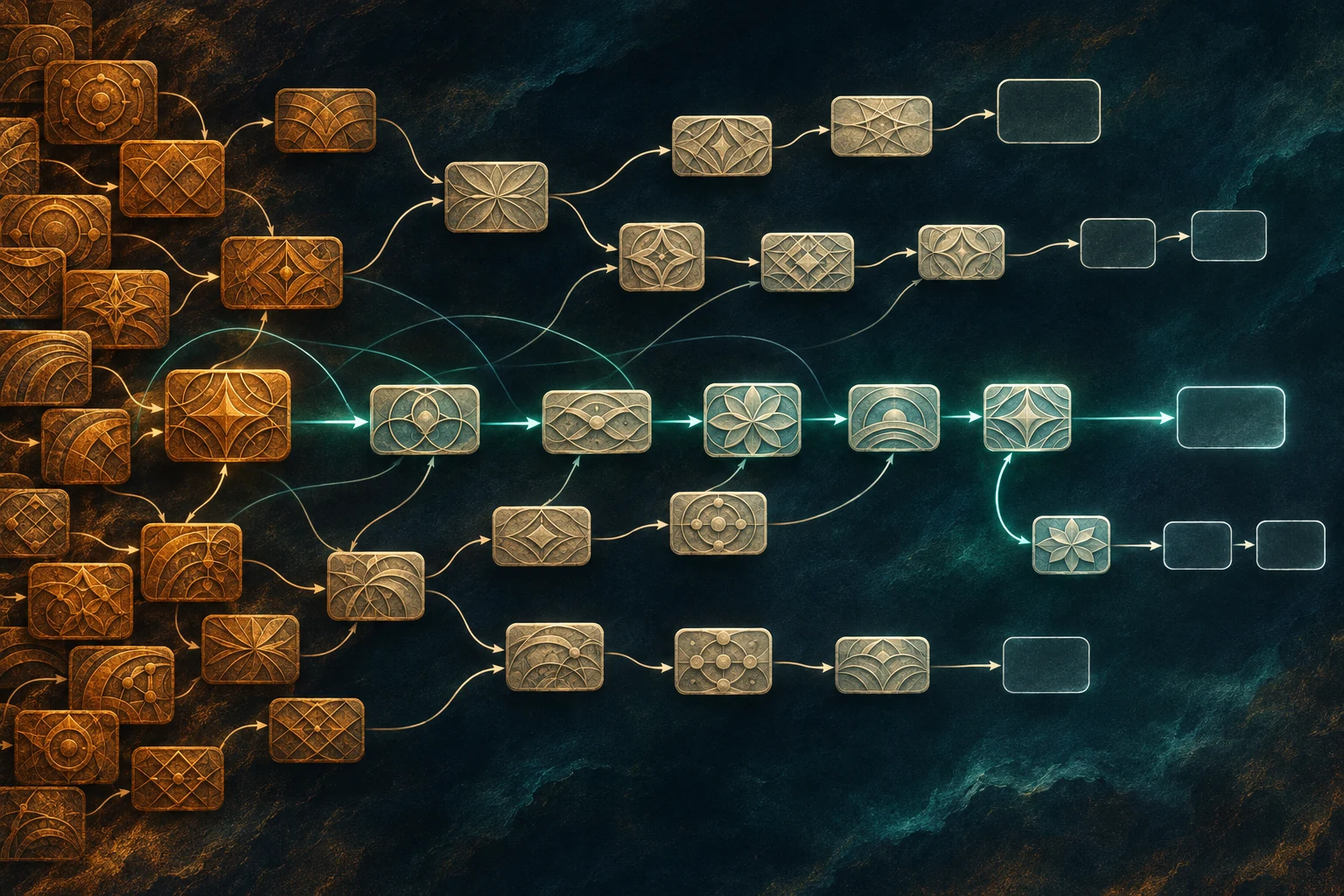
World 16 of 22 · Other universes
The Archive
Everything that happens stays on record, and every new event spends room for the future.
- Time
- Memory
- Scarcity
- Identity
Text: Nebo D. Lukovich ·
The world’s rule
Speculative model
In the Archive there are realized records and free places. A new event links to earlier records and spends a unique right to a particular continuation. Content already realized stays the same. A correction receives a new record of its own and a definite link to the earlier one.
Such events create a partial order. Two distant branches can advance with no common moment that would reconcile them at once. Their later encounter must have real references at its disposal, and resources for processing. The role of spatial availability is taken over by the possibility of reaching a given content through a permitted series of readings.
The sum of free and written places stays conserved. When a fund of sixty-four places spends eight, fifty-six remain. The name of a right can be written in several places. Its one-time capacity to be spent belongs to a particular, unique continuation. We thereby set in advance a condition that prevents the same fund from financing several independent futures.
A cosmic home
Speculative model
The Proto-Archive comprises a great common origin of events. Its active branches advance at different rhythms. The Open Fund distributes the finite free places with which existing processes can be extended.
Margin is an active edge with favourable access to records and to remaining rights. History there can be very rich, and future space limited. A change in the access path affects how many new events have to be spent to find something again.
We imagine the first reproductive processes as sequences whose events steer the emergence of a similar sequence. Every offspring must receive a separate part of the fund. The origin of such an ability remains a hypothesis. In working out the Archive we would have to check in particular how unique ownership of a continuation is realized by local rules.
The being and its life
Imagined beings
A Continuer is an active description able to steer the next write. Its memories lie in the references available to it. It comes to know the content of its own past through an actual process of searching, which also creates events and spends space for continuation.
Imagine a Continuer that has kept an entire conversation from long ago. To return to it, it may have to process many intermediate references. A useful summary requires additional places, but can later shorten access. Its value depends on how much future activity it makes possible with the fund available.
If we attribute experience to such a process, it would be determined by the available continuation of its history. This remains a constructional hypothesis. The mere persistence of a record tells us about a preserved past. Living activity requires a remaining possibility of a new step.
Reproduction divides the fund between separate continuations. A parent can give an offspring initial references and rights to new events. Activity ends when no permitted extension is left. Some other process could later access the preserved content. Whether it thereby continues the same person requires a separate assumption about continuity.
Life under those laws
Imagined beings
The Archive’s economy would manage the capacity for future experience. The skill of useful summarizing would be part of caring for another. A gift that shortens a necessary search can leave the recipient more room for new events.
Revoking a decision becomes a new event. Its effectiveness depends on whether subsequent readers will reach it. Privacy would be arranged through access paths and the distribution of rights. History would keep the trace of an earlier decision even when the community supports a different continuation.
From that arises the question of how much it is worth to preserve the way to a conclusion. A short reference saves future steps, while the traces of how it arose allow checking. One inhabitant might invest more of its fund in testimony about the origin of an important claim. Another would accept a summary resting on trust already built. A conserved account of resources permits both choices, so the fairness of their exchange would depend on agreement and on the availability of data. As literature, we can imagine a community in which the verifiable origin of a record is an especially valuable gift.
Art could use a carefully chosen path through the past. Each experience of it would spend part of the viewer’s future. I think that in such a culture the duration of attention would become a very definite expression of respect.
A scene
Imagined beings
Aven prepared a fund for his successor and checked that their rights to continuation were separate. Then he handed over references to important events. Among them the successor found a long path that Aven had often repeated. It spent part of its own fund to prepare a shorter useful reference and sent it to the parent. Aven checked its content through several new writes. The old records stayed available, and the next access will take fewer steps. He looked at the remaining fund and set aside room for one more shared conversation. The exchange they had just completed changed how many future encounters both can afford.
Established science
Scientific footing
The idea that the world is at root a partially ordered set of events exists in physics: in 1987 Bombelli, Lee, Meyer and Sorkin proposed space-time as a causal set. It is a research programme in quantum gravity without experimental confirmation. The finite fund of free places and the unique right to a continuation are our rules.
Sources for this world
- L. Bombelli, J. Lee, D. Meyer, R. D. Sorkin (1987). Space-time as a causal set. Physical Review Letters 59, 521–524.
Added by the site’s editors. The sources below support the starting idea, while life in this world remains a thought experiment.
Gallery of this world
Illustrations are AI-assisted and serve as visual analogies. The rule diagrams are the author’s own. This chapter comes from the author’s unpublished material around the manuscript “Fifteen Other Universes” (2026) and is published here for the first time. The English translation was prepared by the site’s editors.