World 18 of 22 · The same laws, different numbers
The Compact Cosmos
Gravity is ten times stronger, and every metre of height is expensive.
- Values of the constants
- Scarcity
- Boundary of body and home
Text: Nebo D. Lukovich ·
Imagined beings
Garun stood on the third deck of the scaffold and watched the stone beam climb. Six were hauling, two minding the counterweight. The rope hummed. Nothing on Pebble is lifted quickly, so he had time to run the numbers once more.
Lookout Tower stood twenty-seven metres tall. From its top the view reached nine kilometres, and from the ground barely two and a half. The neighbouring settlement lay seventeen kilometres away, with a twenty-metre tower of its own. Three more metres of height, and two flames would see each other over the curve of the world for the first time.
Then he felt a faint tremor under his feet. One leg of the scaffold was sinking into the embankment, a thumb’s width at a time. Garun knew what a fall means here. A body that falls from its own height hits the ground as if it had fallen from twice that.
He raised his hand. The beam stopped, swayed, and started back down, more slowly than it had climbed. The builders were silent. The Festival of Lighting was three days away, and a whole year on Pebble lasts barely nine.
“We widen the foundation,” he said. “The tower will wait.”
When the shift ended he climbed to the top alone and looked east for a long time. Ember stood behind his back, low over the west, in the same place as always. The horizon was near, sharp as the edge of a table. Beyond it, in the deepening dusk, someone else’s fire was burning. He knew it was.
Why everything stays close to the ground
Established science
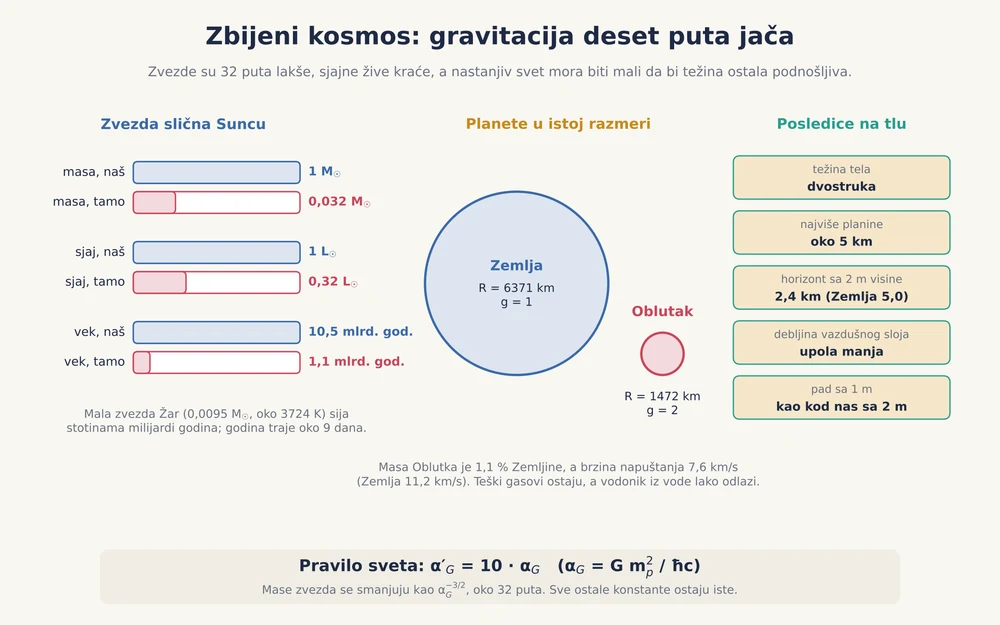
In our world gravity is unimaginably weak. Its strength between particles is measured by the dimensionless number αG = Gmp2/ħc, which is about 6 · 10−39. In the Compact Cosmos that number is ten times larger. Everything else stays the same: atoms, chemistry, light.
A star is a balance between gravity, which compresses the gas, and pressure, which resists it. When gravity grows stronger, the balance is reached with less matter. The natural measure of stellar mass changes as αG−3/2, so the stars of the Compact Cosmos are about thirty-two times lighter than ours. The same law holds for the Chandrasekhar mass, the limit above which a burnt-out star can no longer resist its own weight. Here it is 1.44 solar masses, and there 0.046. It should be stressed, though, that this law describes a characteristic scale. The brightness and lifetime of an individual star have to be calculated separately.
What our calculations show
Our calculation
We built a simplified model of a star along the lines of Adams’s 2008 paper. The star’s interior is described by the Lane–Emden equation, which we solve numerically. We tuned the model so that it gives the correct luminosity for our Sun, and then changed gravity alone.
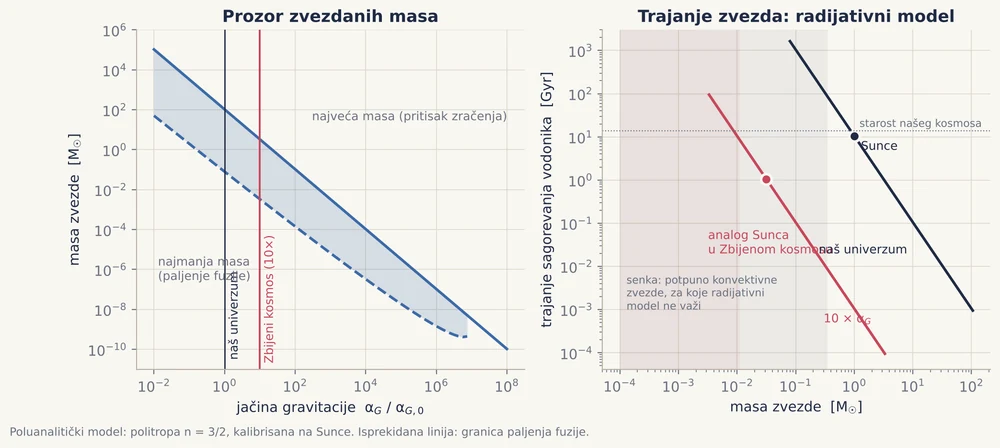
According to our model, stars in the Compact Cosmos exist in a range from roughly 0.0025 to a few solar masses. Both limits depend on how the model is tuned. The lower limit comes from exact scaling of the known limit in our cosmos. The upper limit depends on how heavy the largest star in our cosmos is. If that is 105 solar masses, we get 3.3, and if it is 150 to 300, we get 4.7 to 9.5. The twin of our Sun, a star in the same position within that range, has 3.2 per cent of the Sun’s mass and a third of its luminosity. It spends its fuel ten times faster relative to its store, so it shines for about one billion years instead of ten. On Earth, life had reached only as far as bacteria in that time.
Smaller stars are thriftier, however, so we calculate them in a different way. Stars lighter than a third of a solar mass are fully convective. The gas in them circulates constantly from the centre to the surface, so the star burns almost all of its hydrogen over its lifetime. We therefore computed such stars with a separate model, tuned to the red dwarfs of our cosmos. The star we named Ember has slightly less than one per cent of the Sun’s mass. According to that model, it shines with a little more than a thousandth of the Sun’s luminosity, its surface is at about 3,700 degrees, and the upper estimate of its lifetime is about 540 billion years. In 1997 Laughlin, Bodenheimer and Adams found that the smallest stars of our cosmos last about ten trillion years, so this outcome is to be expected.
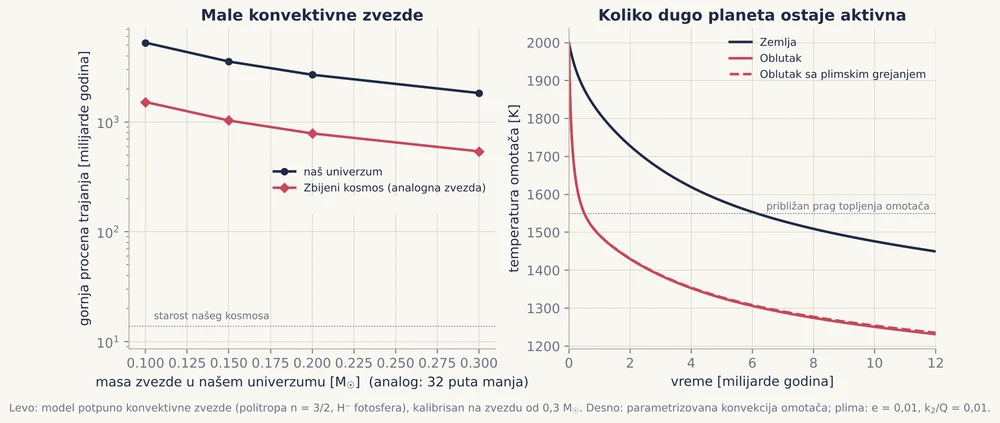
Long-lived sources of energy therefore exist. We also checked how much stronger gravity may become before stars disappear. Our model gives a limit of a few million times, and Adams’s analytic estimate for hydrogen burning about two hundred thousand times. The difference between the two models comes from simplifications, and a factor of ten lies deep in the safe region in both cases.
The second calculation concerns planets. Stronger gravity does not give every planet ten times the surface weight. Weight also depends on the size of the body, so we solved the equations of internal equilibrium numerically for rocky planets of various masses.
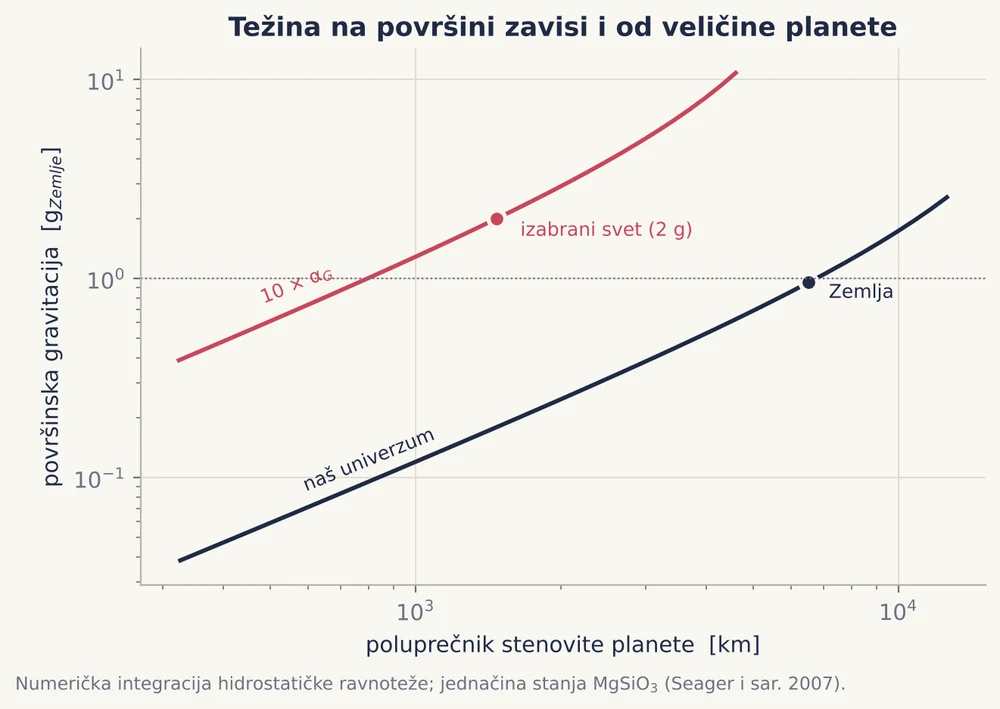
A planet the size of Earth would have a surface gravity more than ten times ours there. A world with Earth’s weight would be a ball about 800 kilometres in radius. Such a body holds an atmosphere poorly, worse than Mars. So we chose a middle course: Pebble has a radius of 1,472 kilometres, slightly smaller than the Moon’s, a mass similar to the Moon’s and a surface gravity twice Earth’s. Its escape velocity is 7.6 kilometres per second.
We checked what that means for the air. Nitrogen, oxygen and water vapour stay bound even if the upper atmosphere is heated to a thousand degrees. Hydrogen, however, leaves easily. When the star’s radiation breaks a water molecule high in the atmosphere, the freed hydrogen escapes the planet, so Pebble slowly loses its water. How quickly depends on Ember’s radiation and on the initial store of water, and that is something we cannot calculate reliably.
Life on Pebble
Imagined beings
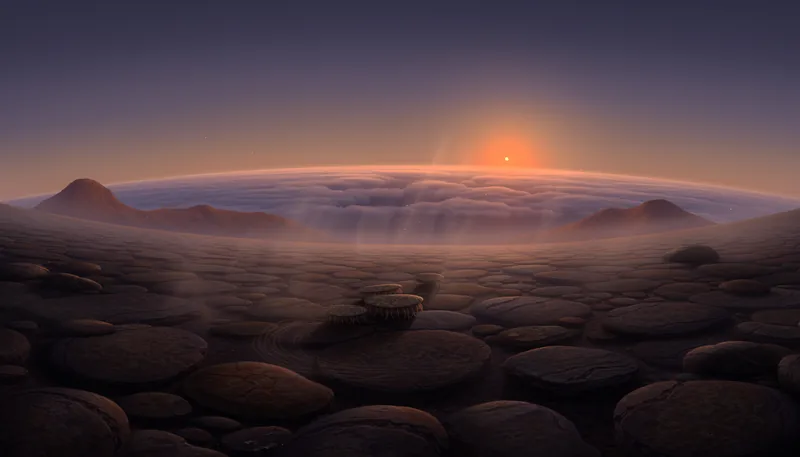
Pebble orbits very close to Ember, at less than a twentieth of Earth’s distance from the Sun, so its year lasts about nine of our days. At so small a distance the tide has probably long since stopped the planet’s rotation, so Pebble always turns the same face to Ember. Garun’s settlement lies near the boundary between day and night, where the star hangs motionless low over the horizon. Ember’s surface is at about 3,700 degrees, so its light looks orange, like candlelight.
On the ground everything is measured differently. The envelope of air is half as deep as Earth’s, so clouds drift low. Mountains hardly exceed five kilometres, because rock under double weight gives way sooner. The horizon is two and a half kilometres from the eyes. It seems to me that such a world would always feel small to its inhabitants, like an island whose shore is visible from every hill.
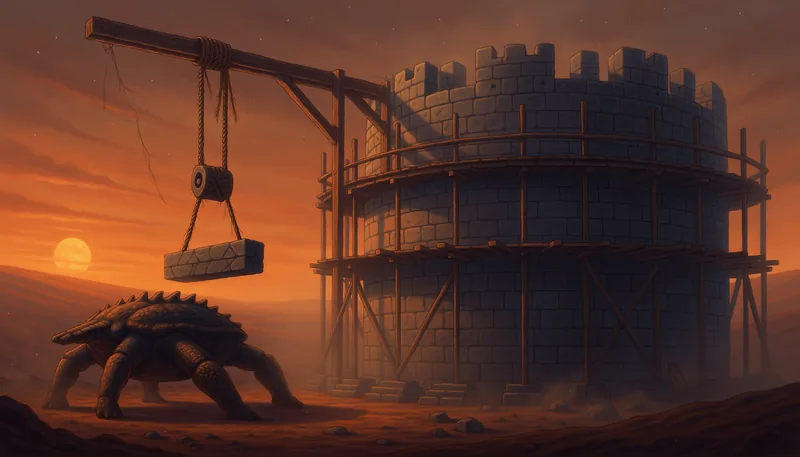
We named the inhabitants Groundlings. We picture them as low, broad beings with several points of support, because double weight punishes height and thin limbs. A fall is dangerous, so caution would be inborn. Building would be the most respected skill, and height the true measure of wealth. A thirty-metre tower there is what a skyscraper is here.
Here, of course, we leave calculation behind. The model tells us that a long-lived star exists, and a world that holds water for some time. On whether life would really appear, the model is silent. There is also a serious obstacle. A small planet loses its internal heat quickly. According to our cooling model, Pebble’s mantle falls below the melting temperature of rock after about half a billion years, even with radioactive heat. Tidal heating from Ember helps little, unless the orbit is noticeably elongated. With the volcanoes, the cycling of carbon between rock and air also dies out, the cycle that keeps Earth’s climate steady over billions of years. A nearby star can also shower the planet with flares. Garun’s world is therefore possible, but it sits at the very edge of habitability.
What height costs
Author’s reflection
For us the horizon is distant, and a fall from a chair harmless. We seldom think of that as the gift of one small number. Garun would probably say that our towers are light and our curiosity cheap. From any rise we see tens of kilometres.
I think the Compact Cosmos puts a simple question to us. How many of our aspirations are shaped by the fact that lifting costs us little? If every metre of height were expensive, perhaps we would build more slowly and choose more carefully what is worth seeing.
Established science
Scientific footing
In 2008 Adams showed that stable stars exist across a wide range of the strength of gravity and of the other constants. Laughlin, Bodenheimer and Adams calculated that the smallest stars of our cosmos last for trillions of years. The numbers for Ember and Pebble come from the author's models and depend on how they are tuned.
Sources for this world
- F. C. Adams (2008). Stars in other universes: stellar structure with different fundamental constants. Journal of Cosmology and Astroparticle Physics 08, 010.
- G. Laughlin, P. Bodenheimer, F. C. Adams (1997). The End of the Main Sequence. The Astrophysical Journal 482, 420–432.
Added by the site’s editors. The sources below support the starting idea, while life in this world remains a thought experiment.
Gallery of this world
Illustrations are AI-assisted and serve as visual analogies. The rule diagrams are the author’s own. This chapter is part of the essay “Five Universes That Could Have Existed” (2026). The charts and diagrams come from the author’s calculations. The English translation was prepared by the site’s editors.