
World 19 of 22 · The same laws, different numbers
The Grip
The electromagnetic force is a tenth stronger, and carbon becomes a treasure.
- Values of the constants
- Scarcity
Text: Nebo D. Lukovich ·
Imagined beings
The morning was cool. The water in the trough was just short of freezing, and Isel knew that meant dry air and calm clouds. A good day for drying darkbrick.
Darkbrick was all the community had. Dark, light bricks of pressed leaves, husks and everything that had once been alive. Each held what Flint lacks most. Isel counted them every morning, the way someone else counts a flock.
The lightning struck without rain. A moment later a thin, straight column of smoke rose from the drying shed. Isel ran. He knew what that smoke carried: what three generations had gathered gram by gram was now leaving for the sky.
At the door a decision was waiting for him. To the left, sacks of seed for the next sowing. To the right, the stacked darkbrick, with the flames between. People were already arriving with wet sand.
“On the darkbrick,” he said. “We will borrow seed.”
They fought the fire until noon. They lost a tenth of the store. In the evening Isel sat for a long time beside the extinguished heap. The air will give all of it back to the plants one day, he thought. But slowly, and to everyone alike.
The force that holds atoms together
Established science
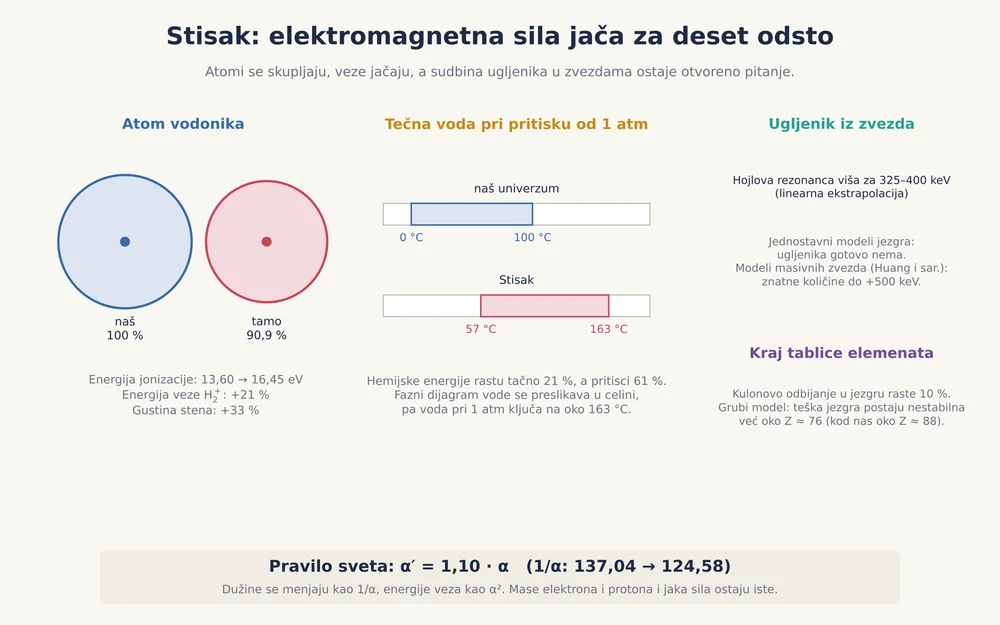
The electromagnetic force is measured by the fine-structure constant, α ≈ 1/137. It determines how tightly a nucleus holds its electrons, how large atoms are and how much energy a chemical bond carries. In the Grip, α is ten per cent larger, approximately 1/124.6. Particle masses and the strong nuclear force stay the same.
Two simple rules hold for the hydrogen atom. The size of the atom falls as 1/α, and the energy binding the electron rises as α2. A force ten per cent stronger therefore gives atoms nine per cent smaller and bonds twenty-one per cent stronger.
What our calculations show
Our calculation
We did not take these rules for granted. We solved the Schrödinger equation for the hydrogen atom numerically, with the stronger force entered into the equation itself. The ionization energy rose from 13.60 to 16.45 electronvolts. Then we examined the simplest molecule, the hydrogen ion with two nuclei and one electron. The bond shortened from 106 to 96 picometres and strengthened by exactly 21 per cent. The energy of the molecule’s vibrations rose in the same ratio.
What does that mean for complex chemistry? To a first approximation, very little. All atoms and all bonds change together, like a drawing enlarged on a photocopier. Carbon still forms four bonds, and water remains a bent molecule. Only the scales shift. Rocks are a third denser. The temperatures at which bonds break are a fifth higher. For light atoms this rule holds exactly: all energies rise as the square of α, all lengths fall as 1/α, and pressures rise as the fifth power of α. Using the international tables of the properties of water, we calculated that ice would melt at 57 and water boil at about 163 of our degrees Celsius, at a pressure of one of our atmospheres. That is why Isel’s cool morning is scorching for us. In heavy atoms, relativistic effects appear that break the rule. For oxygen that error is below half a per cent, and for gold and lead it becomes large.
The real surprise awaits us in the stars. Carbon forms by the fusion of three helium nuclei, and that process depends on one fortunately placed energy level in the carbon nucleus, the so-called Hoyle resonance. Stronger electric repulsion raises that level. According to the calculations of Oberhummer and colleagues and of Epelbaum’s group, the shift is 30 to 40 kiloelectronvolts for each per cent of change in α. For ten per cent we get 325 to 400 kiloelectronvolts. Here we must be precise. Those calculations cover changes in α of a few per cent, so the value for ten per cent is a straight-line extension beyond the tested range.
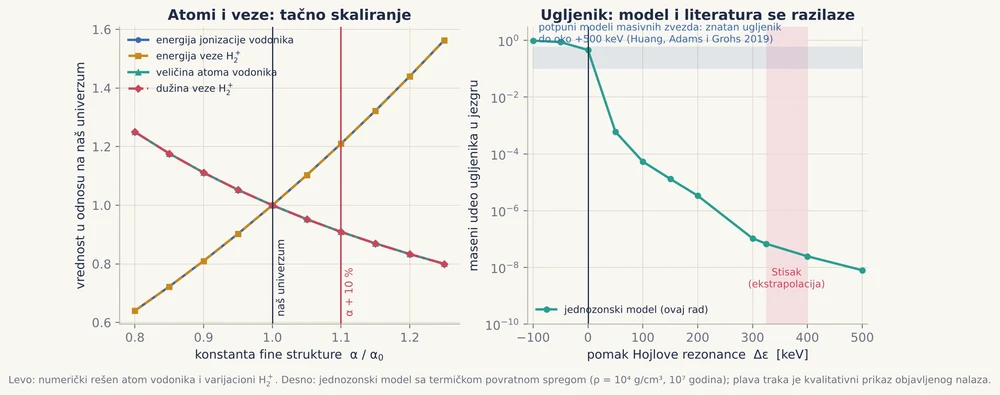
What then happens to carbon we calculated in a simple model of a stellar core. In it the core heats up as much as is needed for helium to burn within a given time. The model gives the right amount of carbon for our cosmos, but it proved oversensitive to the position of the resonance. For a shift of one hundred kiloelectronvolts it predicts a drop in carbon of several tens of thousands of times, whereas the full stellar simulations of Schlattl and colleagues give a drop of three to ten times. We therefore do not take its result for the Grip as an answer.
Published stellar simulations offer better footing, although they do not agree with one another completely. Schlattl and colleagues found that carbon in massive stars almost vanishes at a shift of about 250 kiloelectronvolts, while smaller stars respond more mildly. Huang, Adams and Grohs, with newer models of massive stars, obtained substantial amounts of carbon all the way up to about 500 kiloelectronvolts. The Grip, at 325 to 400, lies right between those estimates. The honest statement, then, is that we do not know how much carbon the Grip has. We know only the direction with confidence: relatively more oxygen, and less carbon than here.
We checked several further consequences. The mass difference between the neutron and the proton shrinks from 1.29 to 1.19 megaelectronvolts, so hydrogen stays stable. Stars of solar mass shine a little more faintly and live a fifth longer. Heavy nuclei decay more readily: a rough model says that stable elements end at around osmium, so gold and lead there would be radioactive.
Life on Flint
Imagined beings
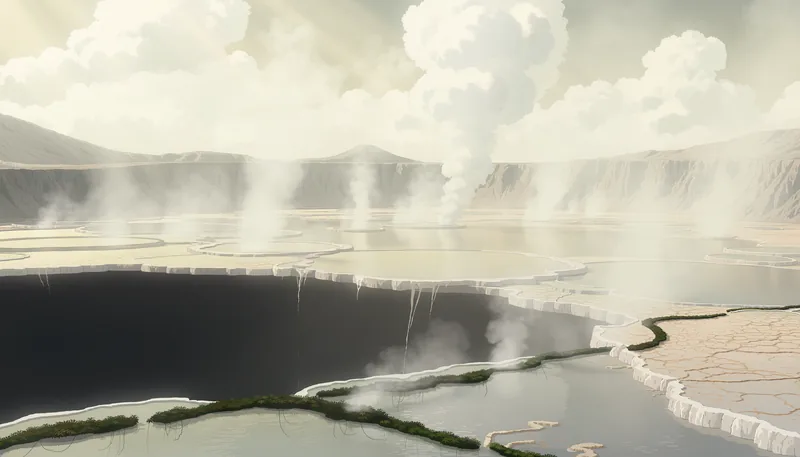
We named Isel’s world Flint. It is a planet of silicates and oxides, with plenty of water and very little carbon in its air and soil. We attribute the poverty of carbon above all to the way the planet formed. Earth too has unusually little carbon compared with the Sun. In 2021 Li and colleagues explained that this happens when a planet forms in the warm part of the dusty disc around a young star, inside the so-called soot line, where carbon dust breaks down and passes into gas. Flint is such a world, and it formed in a cosmos that may itself be somewhat poorer in carbon. If life exists there, carbon would be to it what phosphorus is to us: an essential ingredient that is never in sufficient supply. Plants would grow slowly. Every fallen leaf would have value.
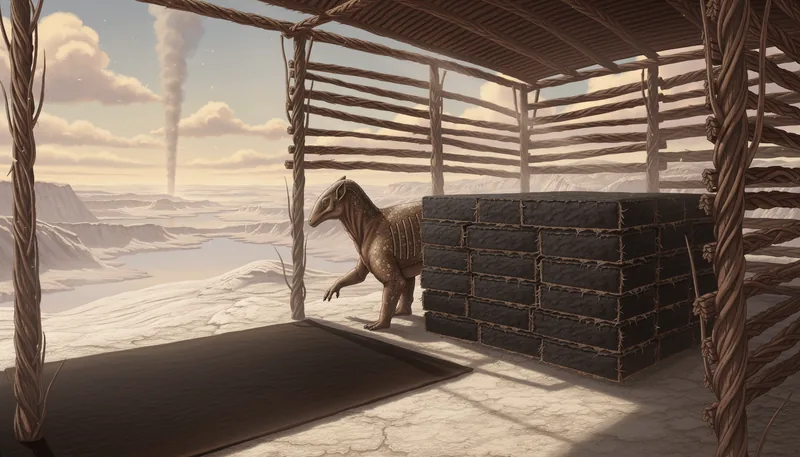
So we imagined a civilization of thrift. The Flintfolk do not light fires for warmth, because a flame sends carbon into the air, from which plants return it very slowly. They return their dead to the community. Wealth is measured in darkbrick. It seems to me that such a society would develop a strict, almost ceremonial ethic of circulation, because nothing living could be allowed to go to waste.
Let us be honest, though. Life with so little carbon might never have started at all. Our calculation speaks reliably about atoms, and about stars it gives only the direction of change. Everything after that is our imagination.
What is precious
Author’s reflection
We live in an abundance we do not notice. Carbon is the fourth most abundant element in our cosmos, so life squanders it in forests, bones and limestone. On Flint, poems would be written about it.
In my view, this world teaches us something important about value. What is precious is what life depends on and what is scarce. For us that may be attention, or time. It is worth asking what Isel, who counts his bricks of darkbrick, would say about the way we spend what we have least of.
Established science
Scientific footing
The position of the Hoyle resonance depends on the strength of the electromagnetic force, as Oberhummer and colleagues calculated. The stellar simulations of Schlattl and colleagues and of Huang, Adams and Grohs give different estimates of how much carbon then remains, so its amount in the Grip is uncertain. The scaling of atoms and bonds follows from quantum mechanics for light atoms.
Sources for this world
- H. Oberhummer, A. Csótó, H. Schlattl (2000). Stellar Production Rates of Carbon and Its Abundance in the Universe. Science 289, 88–90.
- H. Schlattl, A. Heger, H. Oberhummer, T. Rauscher et al. (2004). Sensitivity of the C and O production on the 3α rate. Astrophysics and Space Science 291, 27–56.
- L. Huang, F. C. Adams, E. Grohs (2019). Sensitivity of carbon and oxygen yields to the triple-alpha resonance in massive stars. Astroparticle Physics 105, 13–24.
- J. Li, E. A. Bergin, G. A. Blake, F. J. Ciesla, M. M. Hirschmann (2021). Earth’s carbon deficit caused by early loss through irreversible sublimation. Science Advances 7, eabd3632.
Added by the site’s editors. The sources below support the starting idea, while life in this world remains a thought experiment.
Gallery of this world

Illustrations are AI-assisted and serve as visual analogies. The rule diagrams are the author’s own. This chapter is part of the essay “Five Universes That Could Have Existed” (2026). The charts and diagrams come from the author’s calculations. The English translation was prepared by the site’s editors.