World 20 of 22 · The same laws, different numbers
The Beryllium Cosmos
One more nucleus is stable, so carbon is plentiful and water barely there.
- Values of the constants
- Scarcity
Text: Nebo D. Lukovich ·
Imagined beings
Tavi went down the cutting at first light. Shiny gravel crunched under her feet, the small clear crystals that children on Soot throw into the ditch. Black, greasy walls rose on either side.
At the bottom the vein was waiting. That was their name for the sealed cistern, the largest in the settlement. Tavi lowered the measuring rod through the opening and drew it out. The wet line stood two marks lower than ten days before.
She went round the wall with her palm, slowly. At the third joint she felt cold. A thin, almost invisible crack, and around it a breath of moisture leaving for the dry air. Water does not spill here. It simply vanishes.
She plugged the crack with resin and sat down to calculate. The dew season was still forty days off. With what was left, the settlement would last thirty.
There remained the old reserve, the one no living person had opened. It was kept for a year without dew. Tavi looked at the seal for a long time. Then she broke it, wrote her name in the book of the vein and set off back up the cutting. The others had to be told today that the cistern must be dug in deeper.
The step that is missing here
Established science
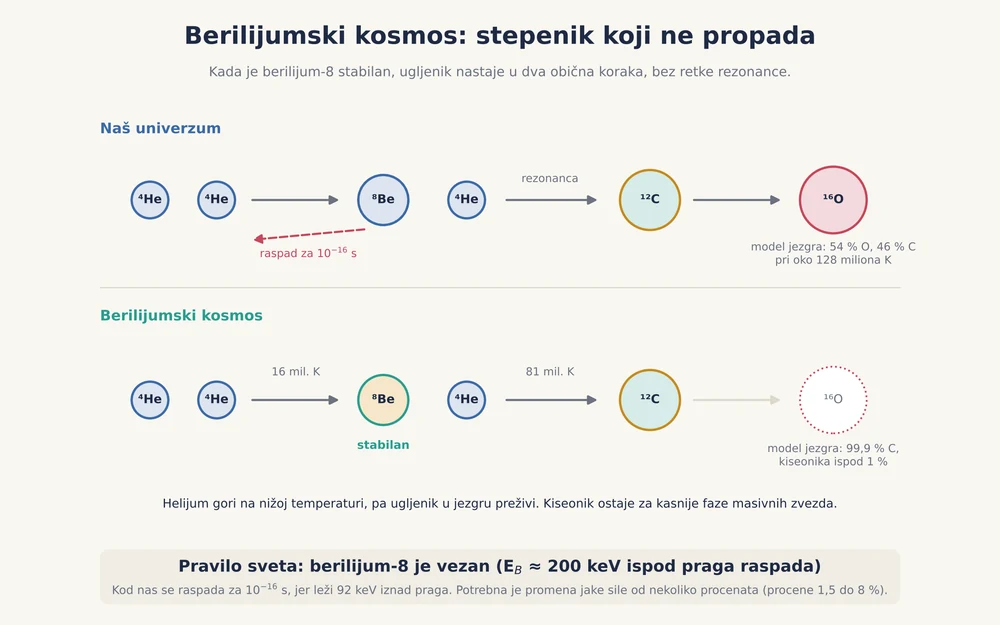
After hydrogen and helium, the path to heavier elements in our cosmos meets a gap. Two helium nuclei can fuse into beryllium-8, but that nucleus decays in 10−16 of a second. It lies just 92 kiloelectronvolts above the decay threshold. Carbon therefore forms through a rare triple collision, with the help of the Hoyle resonance we met in the Grip.
In the Beryllium Cosmos that step holds. Beryllium-8 is bound, say 200 kiloelectronvolts below the threshold. It is important to say that this is a derived quantity. The binding energy of a nucleus is a consequence of the strong force, the quark masses and electric repulsion. Adams and Grohs estimated that a change in the strength of the strong force of a few per cent would be enough for stable beryllium. Depending on the model of the nucleus, the estimates range from 1.5 to 8 per cent, and in some models more. Such a change would of course shift other nuclei as well. Here we follow only one of its consequences.
What our calculations show
Our calculation
We built a small reaction network with four nuclei: helium, beryllium, carbon and oxygen. We took the rate of the first step from the work of Adams and Grohs. Nobody knows the rates of the other steps in such a cosmos, so we varied them over a wide range. We also introduced a simple “thermostat”: the core heats or cools until energy production matches the star’s luminosity, so the fuel lasts some ten million years. The thermostat follows changes gradually, because helium and beryllium in such a star keep turning into one another, and abrupt adjustments would make the calculation unreliable.
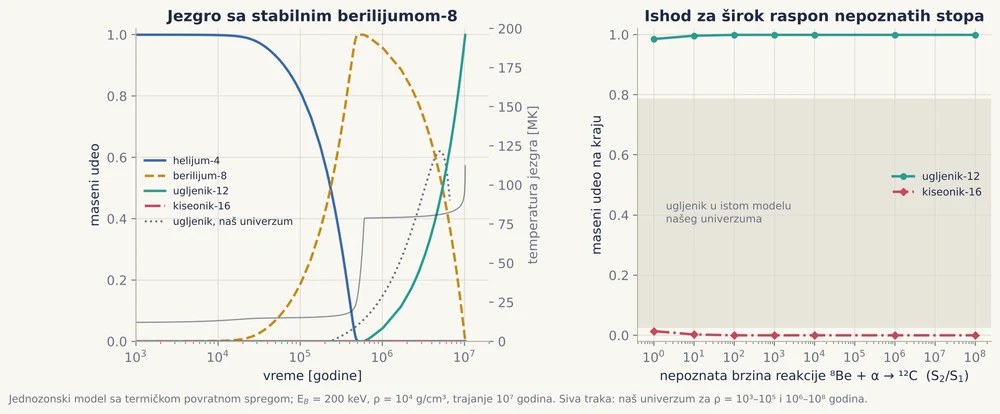
The outcome has two phases. First helium turns into beryllium, already at about 16 million degrees. That is roughly the temperature at the centre of our Sun. Then the core contracts and heats to about 81 million degrees, and beryllium captures helium and becomes carbon. When both helium and beryllium are used up, the core is 99.9 per cent carbon. There is almost no oxygen, because the temperature is too low for the next step.
For comparison, the same model in our cosmos gives a core with about 46 per cent carbon, and from 3 to 79 per cent depending on density and burning time. That matches what real stars give, so the model distinguishes the two universes well. The result for the Beryllium Cosmos is robust. We varied the unknown reaction rates by up to a hundred million times, the density a hundredfold, the burning time a hundredfold and the speed of the thermostat. Carbon stayed between 98.5 and 99.9 per cent every time, and oxygen below one and a half per cent.
The threshold is interesting too. If beryllium is bound by 50 kiloelectronvolts, the core holds about nine per cent oxygen. At 100 kiloelectronvolts carbon is 98 per cent, and from 150 upwards the core is practically pure carbon. For the weakest binding we examined, 30 kiloelectronvolts, the integration failed, and we record that failure in the appendix.
Our finding confirms the main conclusion of Adams and Grohs. Carbon can form without a triple collision and without any special resonance. Their full simulations also show that such stars shine stably. Oxygen in that cosmos would form only in the later, hotter phases of massive stars, which our model does not cover.
Here the composition of one star’s core has to be distinguished from the composition of the whole cosmos. Our calculation speaks about a core in which helium has burnt out. In massive stars, however, burning continues, temperatures rise to hundreds of millions of degrees, and oxygen also forms from the breakdown of neon. How much oxygen would finally reach the interstellar gas, nobody has yet calculated. Adams and Grohs openly leave that aside in their paper. The claim that oxygen and water are scarce in the Beryllium Cosmos is therefore a reasonable assumption, and nothing more than that.
Life on Soot
Imagined beings
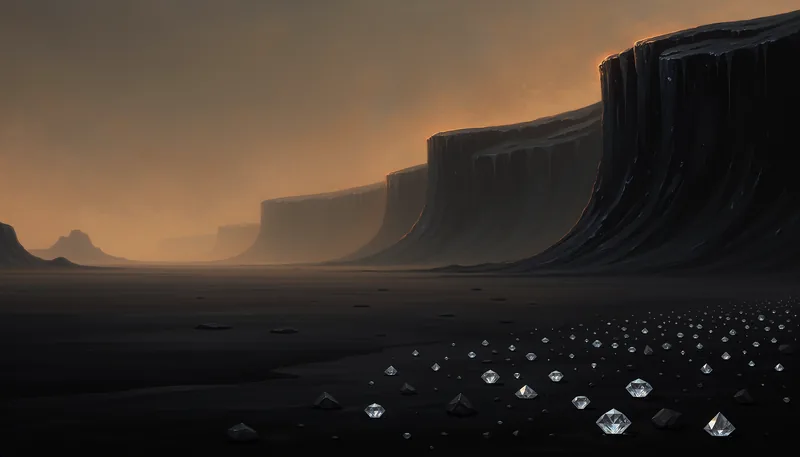
When there is more carbon than oxygen, which is what we assume for the Beryllium Cosmos, planets are built differently. Astronomers have already considered such worlds in our own cosmos, under the name carbon planets. In place of silicate rock we expect graphite, carbides and, at depth, diamond. All available oxygen binds with carbon, so very little is left for water.
We named Tavi’s world Soot. The ground is black, the air dry, and the diamond gravel worthless. Water is scarce and kept under seal. The chemistry of atoms is the same as ours, so carbon-based life would have building material in abundance. What it would lack is a solvent.
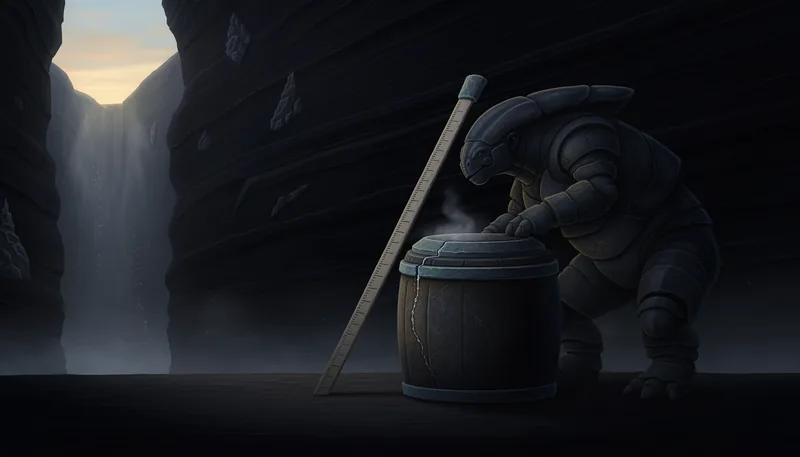
We named the inhabitants Waterkeepers. We imagine a culture in which everything turns on conserving moisture: thick skin, a nocturnal life, underground settlements. The highest duty is care of the vein. I think such beings would listen with disbelief to stories of a planet where water falls from the sky and runs off into the sea.
Here too the story has gone further than the calculation. Our model speaks about the cores of stars. The composition of planets, the amount of water and the possibility of life remain conjecture, resting on what we know about carbon worlds. Soot is, in that sense, one of the possible worlds of the Beryllium Cosmos.
The only door, or one of many
Author’s reflection
The Hoyle resonance was long regarded as the finest example of fine-tuning. In our cosmos carbon does indeed depend on it. The Beryllium Cosmos shows, however, that another path exists, an even simpler one. Nobody there would speak of a miraculous resonance. They would speak, perhaps, of the miracle that water exists at all.
That seems instructive to me. When we see something important hanging by a thin thread, we tend to conclude that there is no other way. Sometimes, though, it is only the path our world happened to take. How many more of our “only possible” solutions are in fact one of several?
Established science
Scientific footing
In 2017 Adams and Grohs showed that with stable beryllium-8 carbon would form without a triple collision and without the Hoyle resonance, and stars would shine stably. Carbon planets were considered by Kuchner and Seager. A scarcity of oxygen and water across such a cosmos is an assumption that nobody has yet calculated.
Sources for this world
- F. C. Adams, E. Grohs (2017). Stellar helium burning in other universes: A solution to the triple alpha fine-tuning problem. Astroparticle Physics 87, 40–54.
- M. J. Kuchner, S. Seager (2005). Extrasolar Carbon Planets. arXiv:astro-ph/0504214.
Added by the site’s editors. The sources below support the starting idea, while life in this world remains a thought experiment.
Gallery of this world
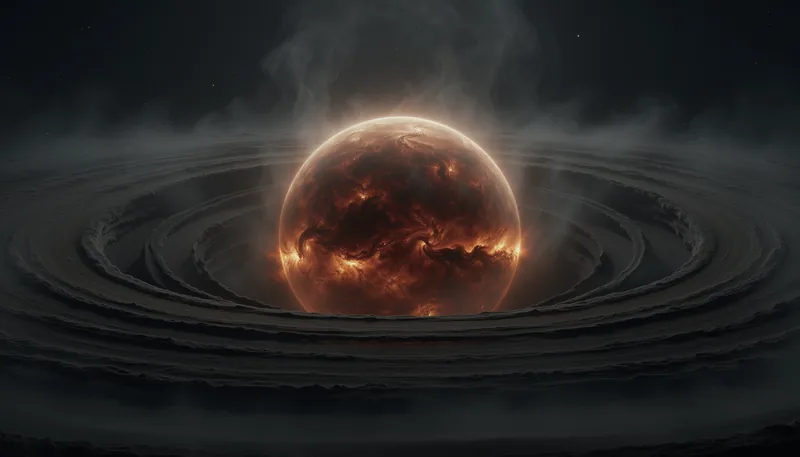
Illustrations are AI-assisted and serve as visual analogies. The rule diagrams are the author’s own. This chapter is part of the essay “Five Universes That Could Have Existed” (2026). The charts and diagrams come from the author’s calculations. The English translation was prepared by the site’s editors.