World 21 of 22 · The same laws, different numbers
Cosmic Islands
Empty space carries thirty times more energy, and every galaxy is left alone.
- Values of the constants
- Limits of knowledge
Text: Nebo D. Lukovich ·
Imagined beings
Meda had been looking at five smudges for thirty years.
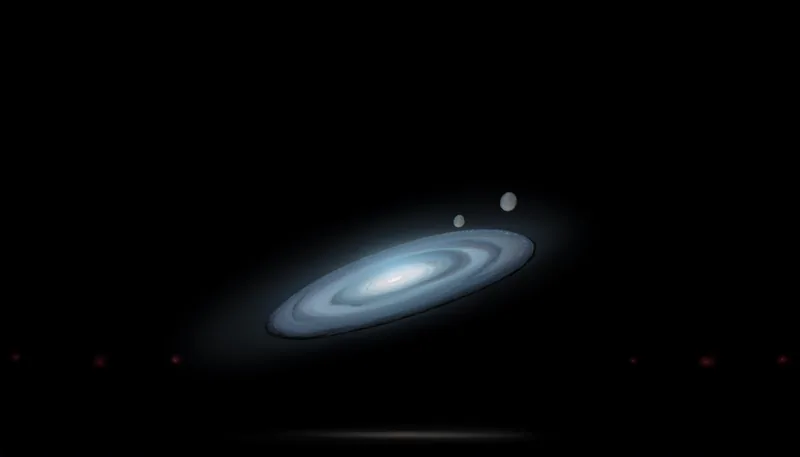
All the other observers on Luma studied the Vault, the great bright arc of stars that was the whole sky and the whole world. Beyond it lay darkness. In that darkness, at the very limit of the great mirror’s sensitivity, Meda had found five faint, dark-red points.
“Cold clouds of dust,” her old teacher used to say. “Somewhere at the edge of the Vault.”
She, however, split their light. After many nights she recognized a familiar pattern of lines, the same one the stars of the Vault give, only stretched seven times. Then a new star flared up in one of the smudges. Such stars in the Vault flash and fade within a hundred days or so. This one smouldered for two years.
Seven times longer. The same number.
That night she did not sleep. If both light and time stretch equally, the smudges are very far away and leaving very fast. And if they are leaving, they were once closer. Perhaps there were once more of them.
She wrote it in her journal, then stopped. She had nothing to prove it with. She could only leave accurate measurements to those who would look after her, at a sky with one smudge fewer.
The energy of empty space
Established science
Empty space in our cosmos carries a small amount of energy. It does not depend on expansion, so in time it overpowers everything else and pushes galaxies apart ever faster. For us that acceleration began about six billion years ago. In the Cosmic Islands the density of that energy is thirty times greater.
Here we must take care over what we hold fixed. We followed the set-up of Barnes and colleagues. The early cosmos is the same as ours: the same amount of ordinary and dark matter per photon, the same initial unevenness in density. Only the vacuum energy changes. From that, the Friedmann equation itself determines how that world expands. We do not choose its “present-day” Hubble constant; it follows from the calculation.
What our calculations show
Our calculation
We solved the Friedmann equation and the equation for the growth of small overdensities numerically. We first tested the model on our own cosmos. It gave an age of 13.8 billion years and the onset of accelerated expansion at 7.6 billion, just as measurements show. We then computed the same quantities with the independent astronomy library astropy, and the two calculations differ by about one part in a hundred thousand.
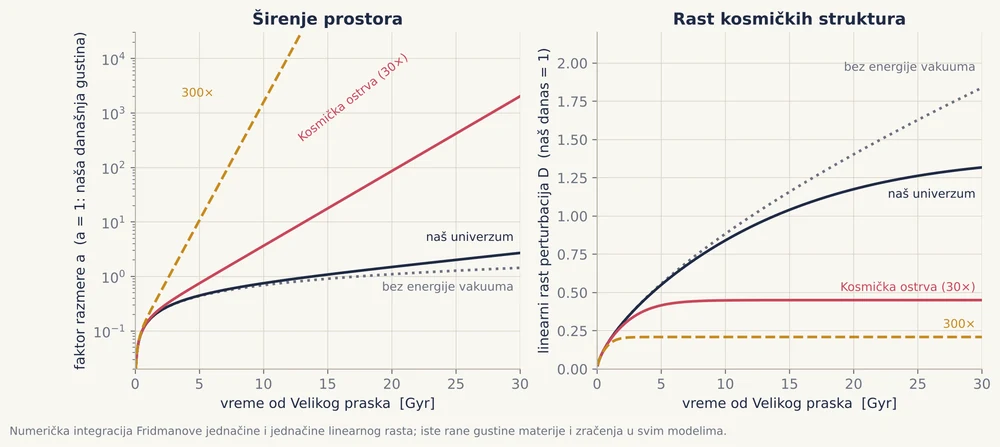
In the Cosmic Islands acceleration begins after only 1.4 billion years. From then on space doubles every 2.2 billion. The growth of structure stops at 45 per cent of the value we have today. We compared our numbers with the large EAGLE simulations by the same group. For the two moments they quote, the agreement is within four per cent.
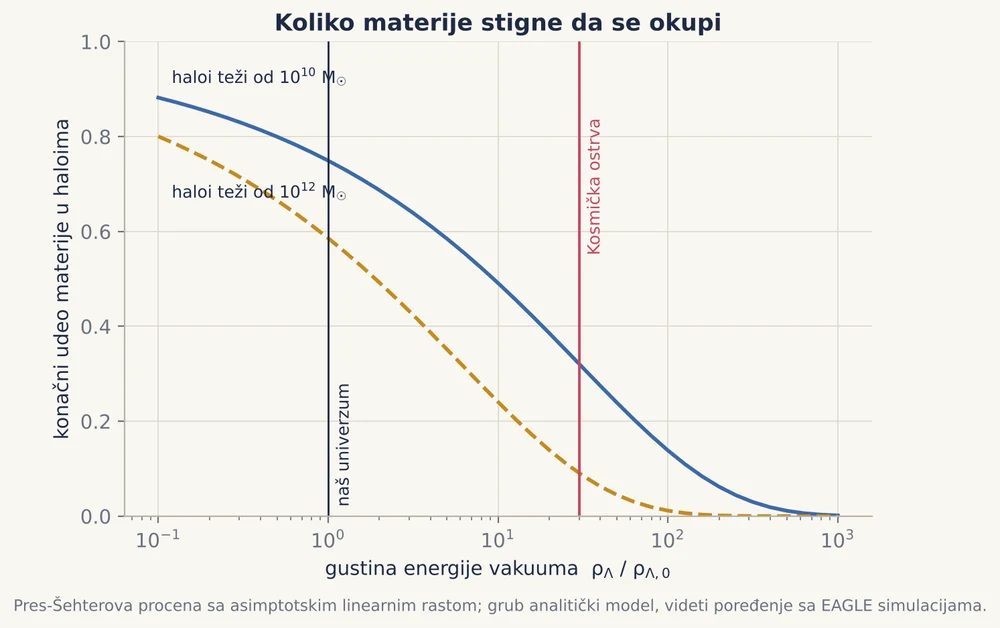
Do galaxies form at all? They do. That is indeed the most important finding of Barnes and colleagues: stars in the cosmos are mostly born early, before acceleration takes over. Only a vacuum energy a hundred times greater seriously reduces the number of stars. Our rough estimate says that in the Cosmic Islands about a third of matter ends up in haloes the size of small galaxies, against three quarters here. There are almost no large clusters.
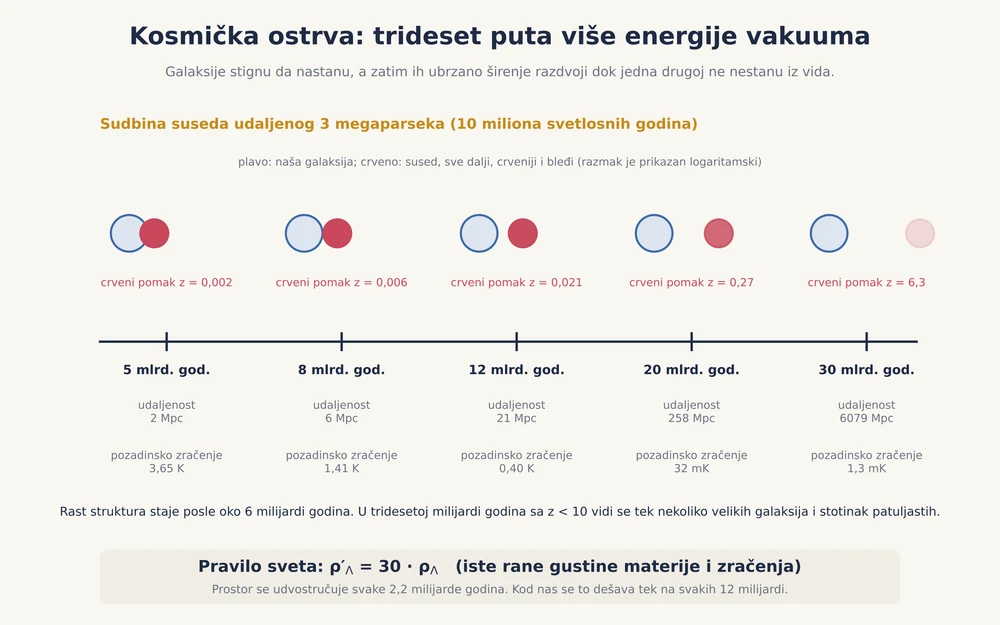
So galaxies exist, but they stay alone. We followed the fate of a neighbour that was three megaparsecs away in the early epoch, like the nearby galaxy groups are from us today. After twelve billion years its redshift is still negligible. After twenty billion it is 0.27. In the thirtieth billion it reaches 6.3: all light is stretched seven times and shifted deep into the infrared. How many galaxies then still have a redshift below ten? All of them must be closer than about five megaparsecs, so the answer depends on how many galaxies that space holds. If we count only galaxies the size of our Milky Way, one or none remains. With somewhat smaller galaxies we get about ten, and with dwarfs about a hundred. Ten billion years later, almost none remains.
Life on Luma
Imagined beings
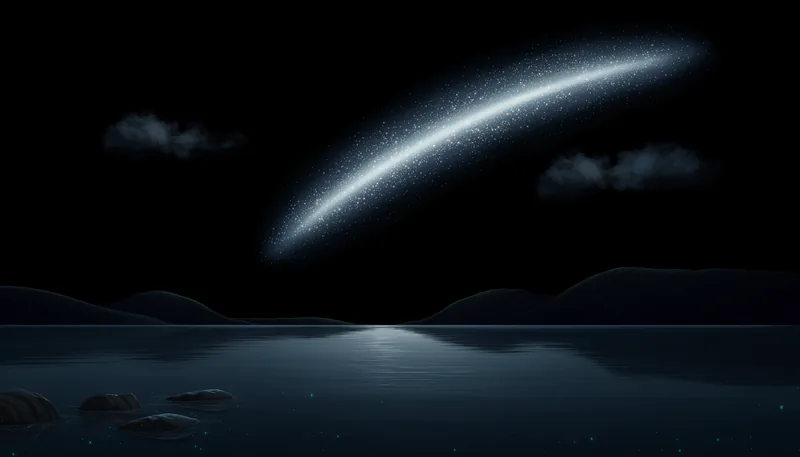
We placed Meda’s world in the thirtieth billion years. That is possible, because stars slightly lighter than the Sun last that long and longer. Chemistry, planets and stars are the same as ours. Only the sky is different.
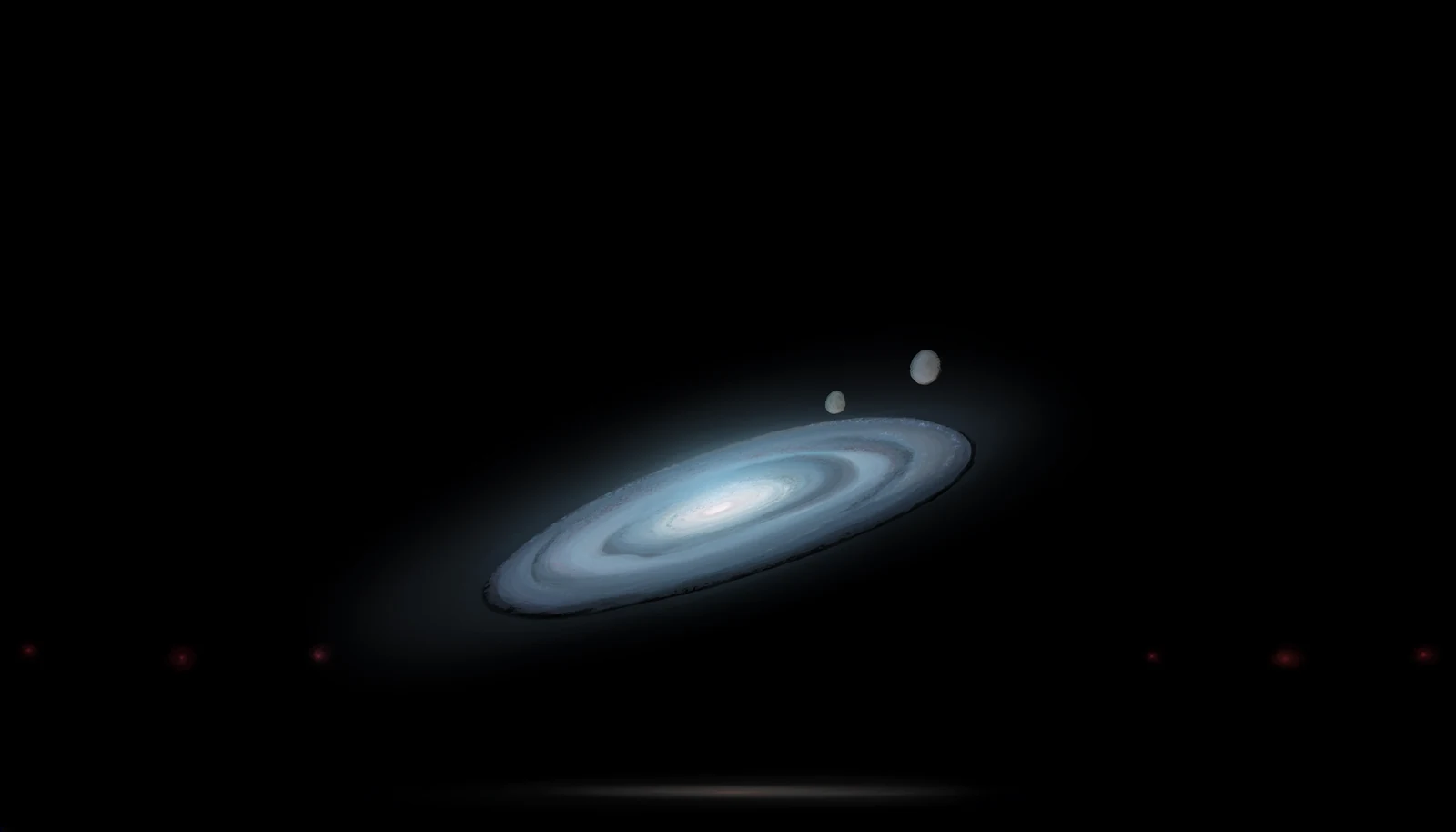
For the inhabitants of Luma, their galaxy is everything that exists. They call it the Vault. Its satellite dwarf galaxies stay gravitationally bound to it, because they lie within about a third of a megaparsec. The Lumans see them as pale clouds and easily take them for part of the Vault itself. The background radiation, the echo of the hot beginning by which we recognized the Big Bang, has cooled to a thousandth of a degree above absolute zero. Its waves are about two metres long and completely drowned in the galaxy’s own radio noise. The expansion of space cannot be seen, because there are not enough distant beacons.
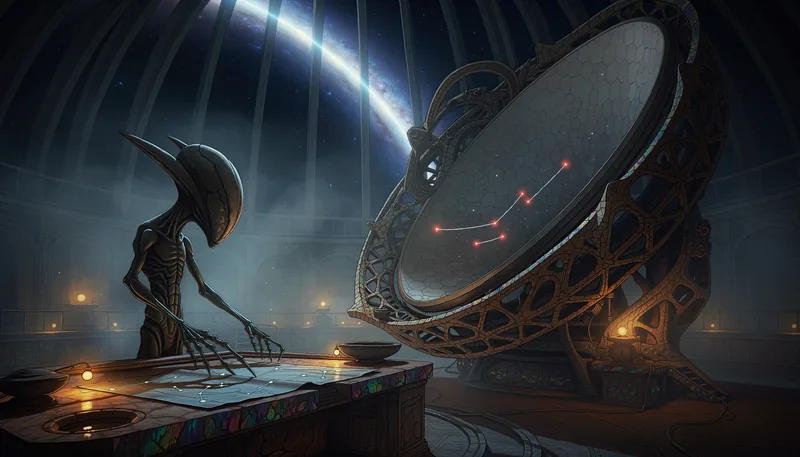
Such a civilization could have excellent physics and astronomy and still believe in an eternal, unchanging cosmos of a single island. In 2007 Krauss and Scherrer described exactly such a future for our own world, only much further off. In our story Meda is one of the few who sensed the truth. Her measurements are accurate. All she lacks is a sky against which to test them.
What has already gone beyond the horizon
Author’s reflection
The Cosmic Islands raise an uncomfortable question. We are proud of our picture of the cosmos, and it rests on a fortunate circumstance. We live early enough to still see other galaxies and the echo of the beginning. Had we appeared much later, the very same physics would have given us a poorer sky and a wrong conclusion.
I think a certain modesty follows from that. If the Lumans are denied the evidence we have, it is worth asking what evidence we are denied. Perhaps something has already left our sky too, something without which we cannot put the whole story together. The answer is out of our reach for now. We can, like Meda, measure carefully and leave accurate records.
Established science
Scientific footing
Barnes and colleagues showed with the EAGLE simulations that galaxies and stars form even with a considerably greater vacuum energy, because stars are born early. In 2007 Krauss and Scherrer described how observers in the far future of our own cosmos lose the evidence of expansion. The number of galaxies still visible in the story depends on the assumed density of galaxies.
Sources for this world
- L. A. Barnes, P. J. Elahi, J. Salcido, R. G. Bower et al. (2018). Galaxy formation efficiency and the multiverse explanation of the cosmological constant with EAGLE simulations. Monthly Notices of the Royal Astronomical Society 477, 3727–3743.
- L. M. Krauss, R. J. Scherrer (2007). The return of a static universe and the end of cosmology. General Relativity and Gravitation 39, 1545–1550.
Added by the site’s editors. The sources below support the starting idea, while life in this world remains a thought experiment.
Gallery of this world
Illustrations are AI-assisted and serve as visual analogies. The rule diagrams are the author’s own. This chapter is part of the essay “Five Universes That Could Have Existed” (2026). The charts and diagrams come from the author’s calculations. The English translation was prepared by the site’s editors.