
World 22 of 22 · The same laws, different numbers
The Quiet Cosmos
A world without the weak force: stone hardly ages, and the past has no dates.
- Values of the constants
- Limits of knowledge
- Memory
Text: Nebo D. Lukovich ·
Imagined beings
Nohu had been counting layers since spring.
The cliff above the lake was a book. Each year, one pale band of summer silt and one dark band of winter silt. Nohu worked from the bottom up, with a needle and a cord, and drove in a peg at every hundred years. So far there were four hundred and ten of them.
This morning the rain had brought down part of the slope. Beneath the last peg new rock had appeared, and the layers in it stood aslant, cut off as if with a knife. Above the cut his orderly sequence began. Below lay something older, tilted and worn.
How much time had that cut swallowed? A thousand years? A thousand thousand?
Nohu sat before the cliff for a long time. There was nothing in the stone that could answer him. Stone on Steadfast hardly ages. A grain of sand ten years old and a grain as old as the world differ only in a few stray atoms, which no instrument of the Quietfolk can count.
In the evening he opened the chronicle. Beneath the number forty-one thousand he drew a thick line and wrote: here is a break of unknown duration. Then he added a sentence his predecessors had never had to write. The world is older than our counting, and we do not know by how much.
The force we seldom mention
Established science
The weak nuclear force has an unusual job. It transforms: it turns a neutron into a proton and back. Thanks to it a free neutron decays in about fifteen minutes, the Sun burns hydrogen, and some atoms are radioactive. What would happen if we switched it off?
In 2006 Harnik, Kribs and Perez showed that such a world can be surprisingly similar to ours, but on one important condition. The weak force cannot be removed on its own. Without it, almost all matter turns into helium in the first minutes, and stars are left without fuel. Two more things are therefore changed at the same time. The initial ratio of neutrons to protons is set by hand. The number of matter particles per photon is reduced about sixtyfold. The Quiet Cosmos is thus a coordinated change of several parameters, and that should be said openly. Our calculation includes both accompanying changes, as well as the absence of neutrinos in the early plasma. Harnik and colleagues also adjust the size of the initial density variations, and we take that from their paper without a calculation of our own.
Before settling on this world we considered another possibility: a cosmos in which the electron is 20 per cent heavier. That scenario is simpler, but its consequences resemble the Grip, with smaller and tighter atoms. The Quiet Cosmos brings something truly new, and it also offers the chance of a strict check on the calculation.
What our calculations show
Our calculation
We simulated the first minutes after the Big Bang. Our program follows six kinds of light nuclei in an expanding and cooling plasma, through twelve nuclear reactions and their reverse processes. The reaction rates are taken directly from the public REACLIB database, which gives the source of measurement for each reaction. We first tested the program on our own cosmos. It gave 24.3 per cent helium and 2.50 atoms of deuterium per hundred thousand atoms of hydrogen. The most precise published program of this kind, PRIMAT, gives 24.7 per cent and 2.46. The small difference in helium comes from a simplified treatment of neutron decay, which does not exist in the Quiet Cosmos anyway.
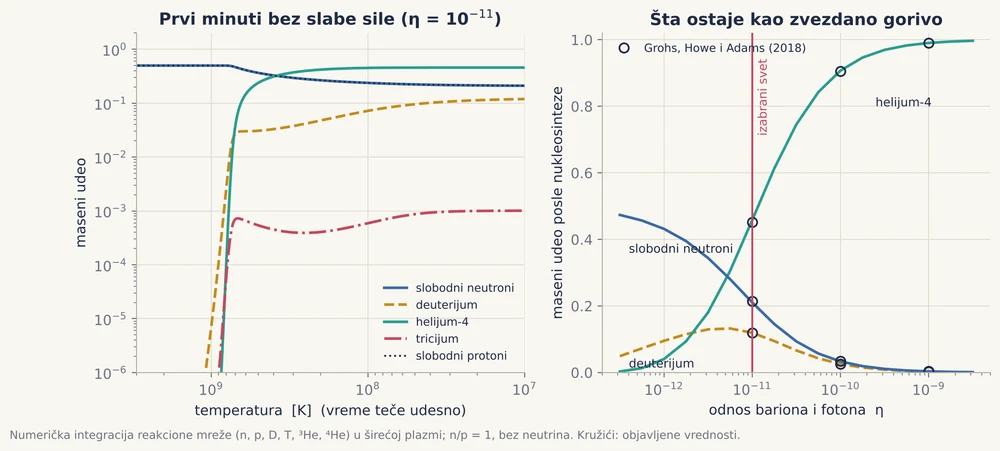
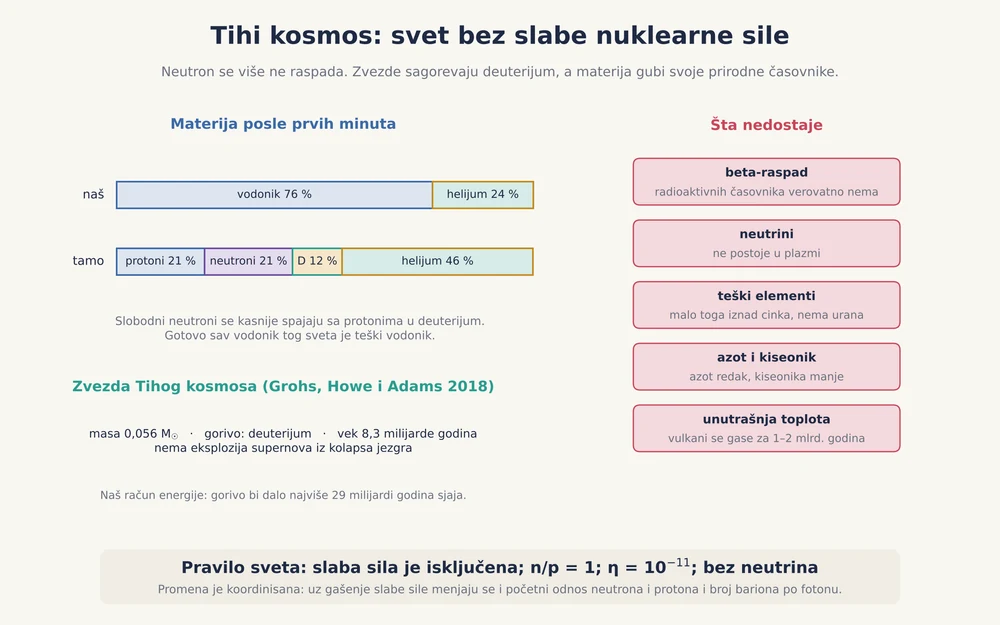
Then we switched off the weak force. An unusual mixture emerges from the first minutes of the Quiet Cosmos: 21 per cent free protons, 21 per cent free neutrons, 12 per cent deuterium and 46 per cent helium. In 2018 Grohs, Howe and Adams published a table of the same quantities, computed with an independent program. We compared it with our calculation in two ways. With the reaction rates from the older program on which their calculation rests, our numbers agree with the table to better than one part in a thousand, for all six nuclei and three values of the number of particles per photon. With modern rates from the REACLIB database the differences are one to two per cent, and up to nine per cent for the rare helium-3. Those differences reflect progress in measuring reactions and do not change the picture. We also tested the numerics themselves: changing the accuracy of the integration and the starting temperature alters the result by less than one part in a million.
We also tried switching the weak force off gradually, with no other changes. With a force ten times weaker, helium is 61 per cent. With one a hundred times weaker, it is 82 per cent. Less and less hydrogen remains, which makes clear why the change in the number of particles per photon is needed as well.
The neutrons that remain in that world no longer decay. As soon as the gas thickens, they join with protons into deuterium, heavy hydrogen. It is the main stellar fuel. Here we rely on the full simulations of Grohs and colleagues, because our simple stellar model does not describe such objects well. A typical star of the Quiet Cosmos has about six per cent of the Sun’s mass and shines for 8.3 billion years. Our rough energy calculation gives an upper limit of some thirty billion years, so the estimates agree in order of magnitude. According to the same authors, stars of one to ten per cent of a solar mass last from three to thirty billion years. The zone in which a planet can have liquid water shifts as the star ages, so a planet stays in it for roughly a third of the star’s lifetime.
Life on Steadfast
Imagined beings
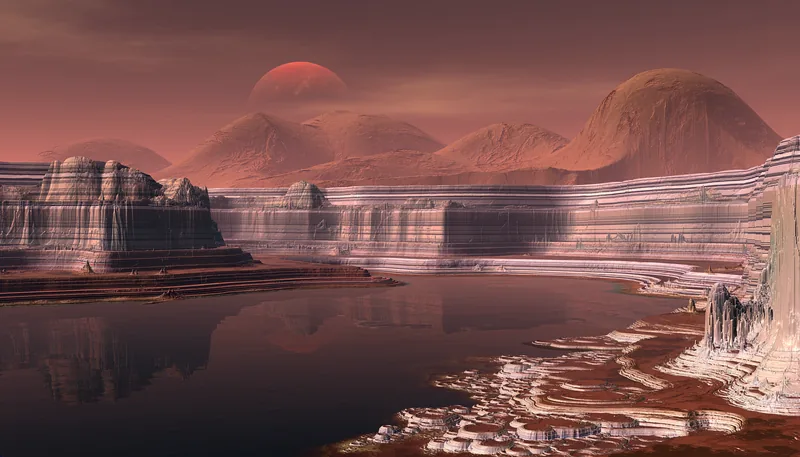
We named Nohu’s world Steadfast, and its star Smoulder. Only light nuclei emerge from the first minutes, and heavier elements form later, in stars. Free neutrons do not decay, so they join with protons as the gas thickens. That is why, according to Grohs and colleagues, almost all the remaining hydrogen is heavy hydrogen, and the lakes are mostly heavy water. For comparison, if half the water in the body were heavy, earthly life would not survive. Life on Steadfast would therefore have to arise in heavy water from the very start. There is less oxygen than here, because the explosions of massive stars that scatter it in our cosmos are absent. There is enough carbon, so the ratio of carbon to oxygen is higher than ours. Nitrogen is scarce, because the stars of the Quiet Cosmos do not produce it as an end product. According to the authors, such a world is still chemically suitable, with the caveat that heavy water slows many of life’s reactions.
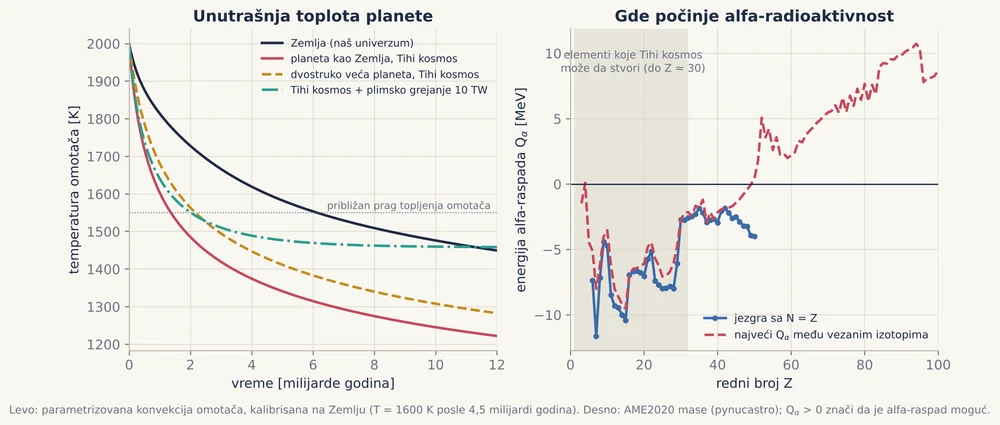
The deepest difference is quieter. Without the weak force there is no beta decay. What remains, in principle, are alpha decay and fission, driven by the strong and electromagnetic forces. So we checked, in the tables of measured nuclear masses, which nuclei could be alpha-radioactive. Among all light nuclei up to zinc, only beryllium-8 is unstable to alpha decay. The next such nuclei appear only at tin, and with very small decay energy. Uranium and thorium form in our cosmos through the rapid capture of neutrons in cosmic explosions, and Grohs and colleagues showed that this process is absent in the Quiet Cosmos. Slow neutron capture exists, but how many heavy nuclei it creates nobody has calculated. I therefore think it justified to say that radioactivity there is probably very weak, without claiming that it is entirely absent.
What does that mean for a planet? We built a simple cooling model of a rocky planet, tuned to give the present temperature of Earth’s mantle correctly. Earth, with its radioactive heat, keeps its volcanic activity for about six billion years. Without that heat the mantle falls below the limit in one to one and a half billion years. A planet of twice the diameter lasts about two billion. A strong tide from a close moon or star could prolong the activity. Steadfast is thus a world with a short geological youth and a long silence after it.

So the Quietfolk probably lack what we call radiometric dating. The age of Earth, the age of rocks and fossils, even the age of charcoal from a prehistoric hearth, we read from the slow decay of unstable atoms. Nohu has only layers of silt and tree rings. Where the sequence breaks, knowledge stops. It seems to me that such a civilization would have a long memory and a short history, with many lines like the one in Nohu’s chronicle.
Other clocks do exist, though. Cosmic rays, if there are any there, slowly create rare stable atoms in surface rock, such as helium-3 and neon-21. Their amount tells how long the rock has been exposed to the sky. We use that method alongside radioactive isotopes. For the Quietfolk it would be the only one, and it would demand very sensitive instruments. The third clock is Smoulder. According to the simulations, their star changes slowly in brightness over its life. Anyone who understood the burning of deuterium could estimate the age of the world from Smoulder. The road to that knowledge, however, is a long one.
How old something is
Author’s reflection
We are used to the past having dates. We know that Earth is four and a half billion years old, and we say that sentence as if it were self-evident. The Quiet Cosmos reminds us that it is the gift of one inconspicuous force. Atoms that decay at a regular pace are clocks we did not make.
In my view, Nohu’s line in the chronicle is an honest gesture. He knows how far his counting reaches and is able to write that down. It is worth asking where such lines ought to be drawn in our own stories of origin, and whether we draw them often enough.
Established science
Scientific footing
In 2006 Harnik, Kribs and Perez described a cosmos without the weak force that stays similar to ours, given coordinated changes to two more parameters. In 2018 Grohs, Howe and Adams calculated its nucleosynthesis and its stars with stable neutrons. Weak radioactivity and short geological activity are the author's estimates, with no claim that radioactivity is entirely absent.
Sources for this world
- R. Harnik, G. D. Kribs, G. Perez (2006). A universe without weak interactions. Physical Review D 74, 035006.
- E. Grohs, A. R. Howe, F. C. Adams (2018). Universes without the weak force: Astrophysical processes with stable neutrons. Physical Review D 97, 043003.
Added by the site’s editors. The sources below support the starting idea, while life in this world remains a thought experiment.
Gallery of this world

Illustrations are AI-assisted and serve as visual analogies. The rule diagrams are the author’s own. This chapter is part of the essay “Five Universes That Could Have Existed” (2026). The charts and diagrams come from the author’s calculations. The English translation was prepared by the site’s editors.